Institute of Neuropathology, University Medical Center, Robert-Koch-Straße 40, 37099 Göttingen, Germany.
Department of Neurology, University Medical Center, Robert-Koch-Straße 40, 37099 Göttingen, Germany.
J Neuroinflammation. 2019 Nov 16;16(1):228. doi: 10.1186/s12974-019-1593-2.
In the past, multiple sclerosis (MS) medications have been primarily designed to modulate T cell properties. Based on the emerging concept that B cells are equally important for the propagation of MS, we compared the effect of four commonly used, primarily T cell-targeting MS medications on B cells.
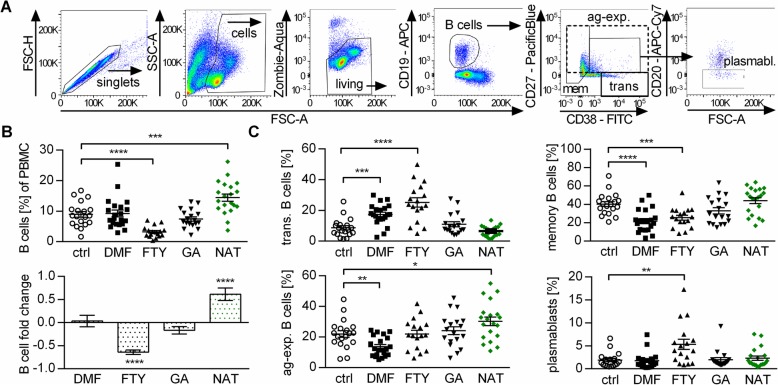
Using flow cytometry, we analyzed peripheral blood mononuclear cells (PBMC) of untreated (n = 19) and dimethyl fumarate (DMF; n = 21)-, fingolimod (FTY; n = 17)-, glatiramer acetate (GA; n = 18)-, and natalizumab (NAT; n = 20)-treated MS patients, focusing on B cell maturation, differentiation, and cytokine production.
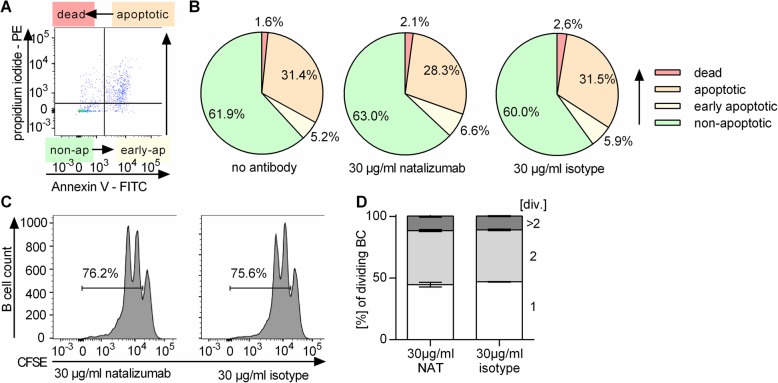
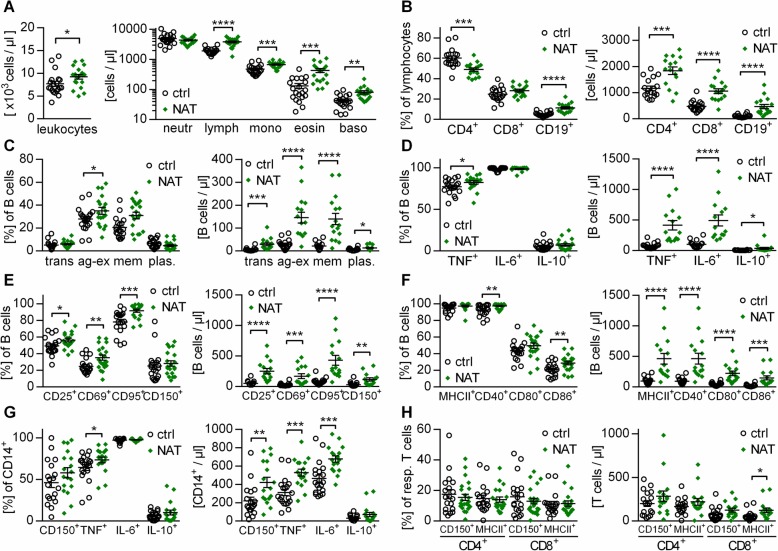
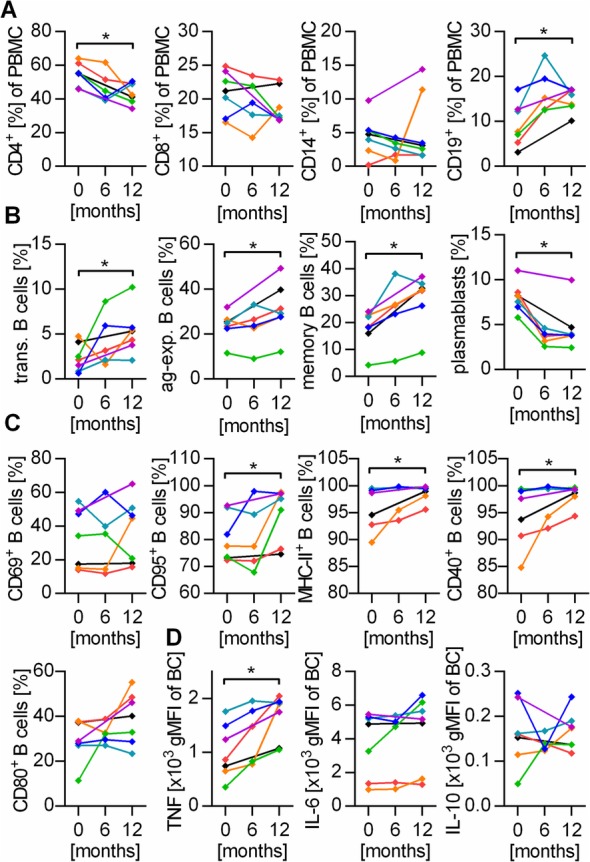
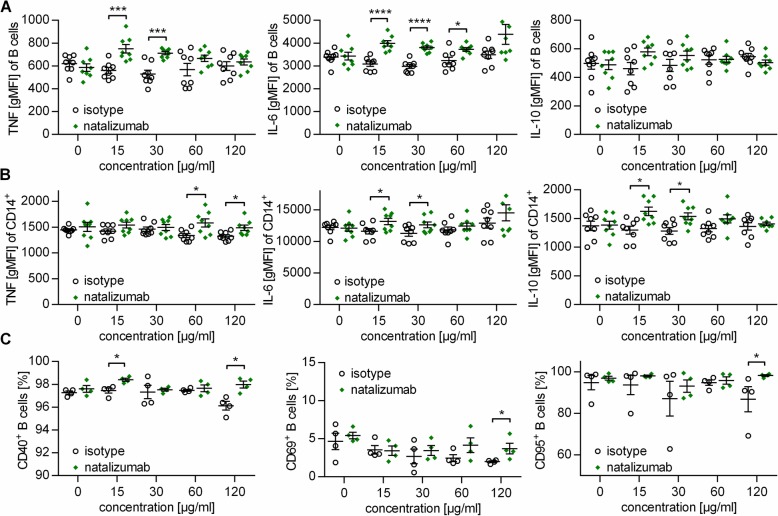
While GA exerted minor effects on the investigated B cell properties, DMF and FTY robustly inhibited pro-inflammatory B cell function. In contrast, NAT treatment enhanced B cell differentiation, activation, and pro-inflammatory cytokine production when compared to both intraindividual samples collected before NAT treatment initiation as well as untreated MS controls. Our mechanistic in vitro studies confirm this observation.
Our data indicate that common MS medications have differential, in part opposing effects on B cells. The observed activation of peripheral B cells upon NAT treatment may be instructive to interpret its unfavorable effect in certain B cell-mediated inflammatory conditions and to elucidate the immunological basis of MS relapses after NAT withdrawal.
Protocols were approved by the ethical review committee of the University Medical Center Göttingen (#3/4/14).
过去,多发性硬化症(MS)药物主要设计用于调节 T 细胞特性。基于 B 细胞对 MS 传播同样重要的新观点,我们比较了四种常用的主要靶向 T 细胞的 MS 药物对 B 细胞的影响。
使用流式细胞术,我们分析了未经治疗(n=19)和二甲基富马酸(DMF;n=21)、芬戈莫德(FTY;n=17)、那他珠单抗(NAT;n=20)治疗的 MS 患者的外周血单核细胞(PBMC),重点研究 B 细胞成熟、分化和细胞因子产生。
虽然 GA 对研究的 B 细胞特性影响较小,但 DMF 和 FTY 可显著抑制促炎 B 细胞功能。相比之下,与 NAT 治疗前的个体样本和未经治疗的 MS 对照组相比,NAT 治疗增强了 B 细胞分化、激活和促炎细胞因子的产生。我们的体外机制研究证实了这一观察结果。
我们的数据表明,常见的 MS 药物对 B 细胞具有不同的、部分相反的影响。在 NAT 治疗时观察到外周 B 细胞的激活可能有助于解释其在某些 B 细胞介导的炎症情况下的不利影响,并阐明 NAT 停药后 MS 复发的免疫学基础。
方案得到了哥廷根大学医学中心伦理审查委员会的批准(#3/4/14)。