Developmental Exposure Alcohol Research Center, Behavioral Neuroscience Program, Department of Psychology, Binghamton University-SUNY, Binghamton, NY, United States.
Developmental Exposure Alcohol Research Center, Behavioral Neuroscience Program, Department of Psychology, Binghamton University-SUNY, Binghamton, NY, United States.
Int Rev Neurobiol. 2019;148:231-303. doi: 10.1016/bs.irn.2019.08.001. Epub 2019 Aug 24.
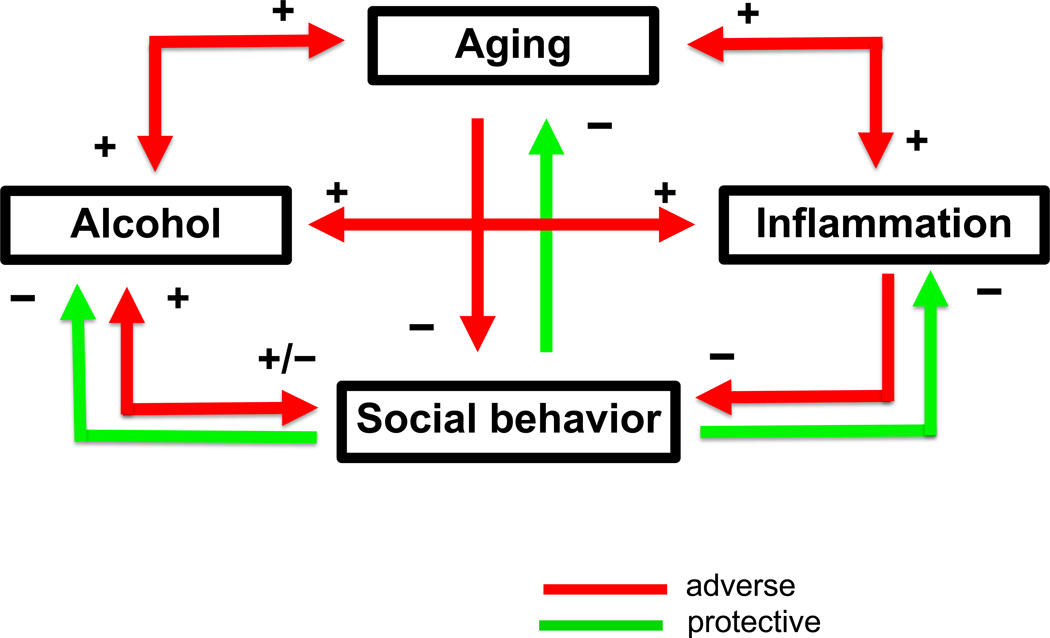
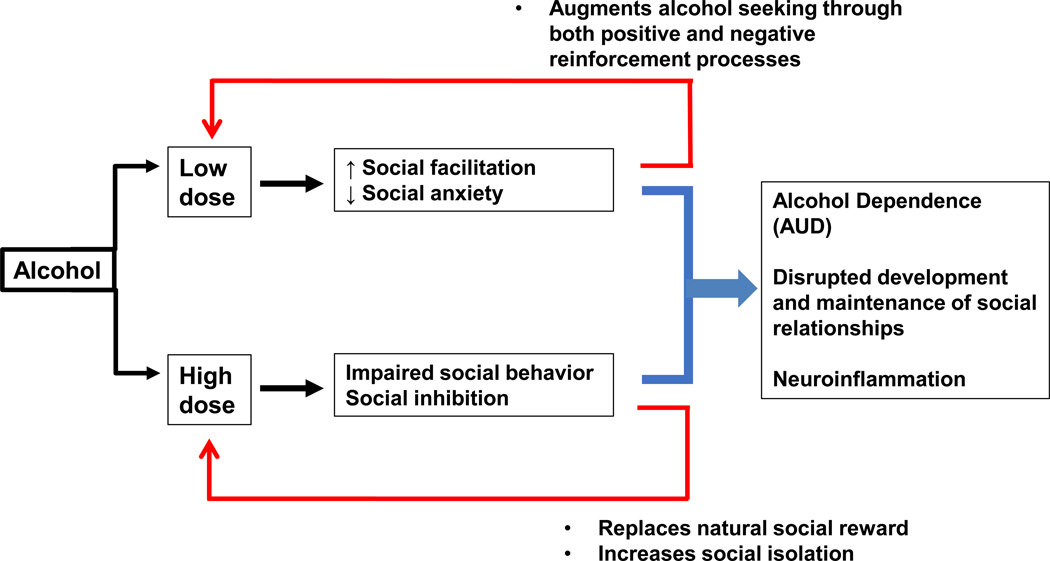
The passage of time dictates the pace at which humans and other organisms age but falls short of providing a complete portrait of how environmental, lifestyle and underlying biological processes contribute to senescence. Two fundamental features of the human experience that change dramatically across the lifespan include social interactions and, for many, patterns of alcohol consumption. Rodent models show great utility for understanding complex interactions among aging, social behavior and alcohol use and abuse, yet little is known about the neural changes in late aging that contribute to the natural decline in social behavior. Here, we posit that aging-related neuroinflammation contributes to the insipid loss of social motivation across the lifespan, an effect that is exacerbated by patterns of repeated alcohol consumption observed in many individuals. We provide a comprehensive review of (i) neural substrates crucial for the expression of social behavior under non-pathological conditions; (ii) unique developmental/lifespan vulnerabilities that may contribute to the divergent effects of low-and high-dose alcohol exposure; and (iii) aging-associated changes in neuroinflammation that may sit at the intersection between social processes and alcohol exposure. In doing so, we provide an overview of correspondence between lifespan/developmental periods between common rodent models and humans, give careful consideration to model systems used to aptly probe social behavior, identify points of coherence between human and animal models, and point toward a multitude of unresolved issues that should be addressed in future studies. Together, the combination of low-dose and high-dose alcohol effects serve to disrupt the normal development and maintenance of social relationships, which are critical for both healthy aging and quality of life across the lifespan. Thus, a more complete understanding of neural systems-including neuroinflammatory processes-which contribute to alcohol-induced changes in social behavior will provide novel opportunities and targets for promoting healthy aging.
时间的流逝决定了人类和其他生物衰老的速度,但它不能完全描绘环境、生活方式和潜在的生物过程如何导致衰老。人类一生中经历的两个基本特征在整个生命周期中都会发生巨大变化,包括社交互动和许多人饮酒模式。啮齿动物模型对于理解衰老、社交行为和饮酒之间的复杂相互作用非常有用,但对于导致社交行为自然下降的老年期神经变化知之甚少。在这里,我们假设与衰老相关的神经炎症导致社交动机在整个生命周期中逐渐丧失,而许多人观察到的反复饮酒模式加剧了这种效应。我们全面回顾了 (i) 在非病理条件下表达社交行为的关键神经基质;(ii) 可能导致低剂量和高剂量酒精暴露产生不同影响的独特发育/寿命脆弱性;和 (iii) 与衰老相关的神经炎症变化,这些变化可能处于社交过程和酒精暴露的交叉点。这样做的同时,我们概述了常见啮齿动物模型和人类之间的寿命/发育时期的对应关系,仔细考虑了用于适当探测社交行为的模型系统,确定了人类和动物模型之间的一致性,并指出了未来研究中应解决的许多未解决问题。总之,低剂量和高剂量酒精效应的结合会破坏社交关系的正常发展和维持,而社交关系对于整个生命周期的健康衰老和生活质量都是至关重要的。因此,更全面地了解导致酒精引起的社交行为变化的神经系统,包括神经炎症过程,将为促进健康衰老提供新的机会和目标。