Erythropoulou-Kaltsidou Anastasia, Polychronopoulos Georgios, Tziomalos Konstantinos
First Propedeutic Department of Internal Medicine, Medical School, Aristotle University of Thessaloniki, AHEPA Hospital, Thessaloniki, Greece.
Diabetes Ther. 2020 Jan;11(1):7-14. doi: 10.1007/s13300-019-00724-w. Epub 2019 Nov 16.
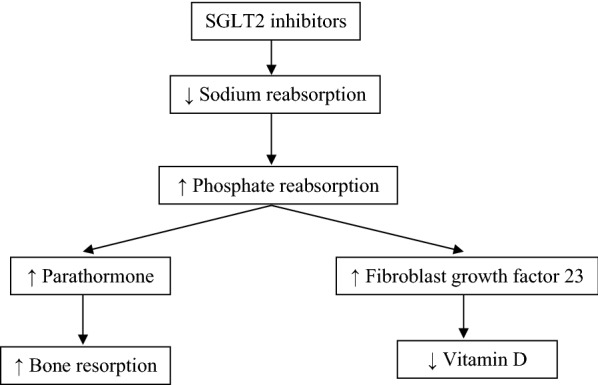
Patients with type 2 diabetes mellitus (T2DM) appear to have increased risk for fractures. In this context, the finding that canagliflozin, a sodium-glucose co-transporter-2 (SGLT) inhibitor, increased the risk for fracture compared with placebo in the Canagliflozin Cardiovascular Assessment Study (CANVAS), a large randomized controlled trial (RCT) in patients with established cardiovascular disease or multiple cardiovascular risk factors, created concern. In the present review, we summarize the data regarding the association between SGLT2 inhibitors and fracture risk in patients with T2DM. In contrast to the findings reported in CANVAS, canagliflozin did not affect the risk of fracture in a more recent, large RCT in patients with diabetic nephropathy. In addition, empagliflozin and dapagliflozin, other members of this class, also do not appear to affect the incidence of fracture. Moreover, there is no clear pathogenetic mechanism through which SGLT2 inhibitors increase the risk for fractures. Therefore, available data are inconclusive to attribute to these drugs a direct responsibility for bone fractures.
2型糖尿病(T2DM)患者似乎骨折风险增加。在此背景下,在一项针对已患心血管疾病或有多种心血管危险因素患者的大型随机对照试验(RCT)——卡格列净心血管评估研究(CANVAS)中,发现钠-葡萄糖协同转运蛋白2(SGLT)抑制剂卡格列净与安慰剂相比增加了骨折风险,这引发了关注。在本综述中,我们总结了有关SGLT2抑制剂与T2DM患者骨折风险之间关联的数据。与CANVAS中报告的结果相反,在一项针对糖尿病肾病患者的最新大型RCT中,卡格列净并未影响骨折风险。此外,该类别的其他药物恩格列净和达格列净似乎也不影响骨折发生率。而且,尚无明确的致病机制表明SGLT2抑制剂会增加骨折风险。因此,现有数据尚无定论,无法认定这些药物对骨折直接负有责任。