Cantó Laura Navarro, Boscá Sara Carratalá, Vicente Carmen Alcalá, Gil-Perontín Sara, Pérez-Miralles Francisco, Villalba Jessica Castillo, Nuñez Laura Cubas, Casanova Estruch Bonaventura
Departament of Neurology, Hospital General Universitario de Elche, Alicante, Spain.
Neuroimunology and Multiple Sclerosis Research Group, Hospital Universitari i Politècnic La Fe de València, Valencia, Spain.
Front Neurol. 2019 Nov 1;10:1157. doi: 10.3389/fneur.2019.01157. eCollection 2019.
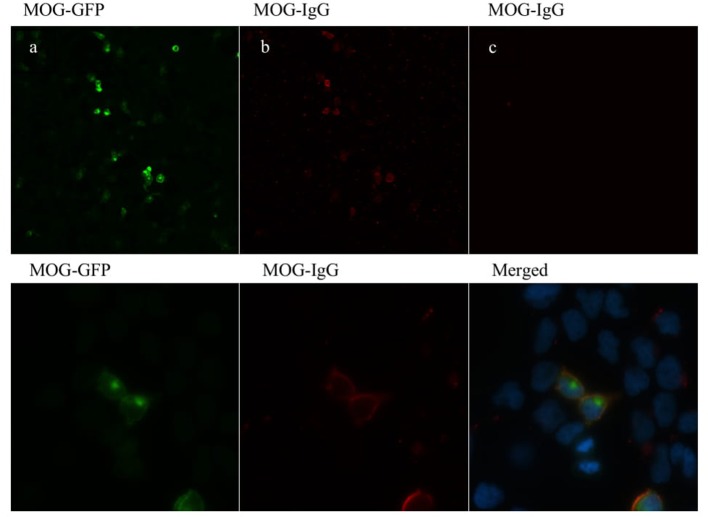
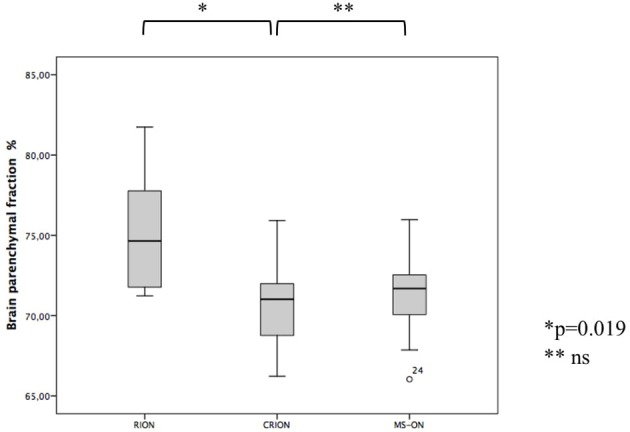
Chronic relapsing inflammatory optic neuritis (CRION) is one of the more common phenotypes related to myelin oligodendrocyte glycoprotein antibodies (MOG-Abs). The absence of specific biomarkers makes distinguishing between CRION and relapsing inflammatory ON (RION) difficult. A recent work has suggested a widespread affectation of the central nervous system in CRION patients. In order to search for a potential CRION marker we have measured brain atrophy in a cohort of patients, stratified by phenotypes: CRION, RION, multiple sclerosis with a history of optic neuritis (MS-ON), and MOG-Abs status. A cross-sectional study was conducted in 31 patients (seven CRION, 11 RION, and 13 MS-ON). All patients were tested for MOG and aquaporin-4 antibodies (AQ4-Abs). Clinical data were collected. Brain atrophy was calculated by measuring the brain parenchyma fraction (BPF) with Neuroquant® software. Four of seven CRION patients and one of 11 RION patients were positive for MOG-Abs ( = 0.046) and no MS-ON patients tested positive to MOG-Abs. All patients were negative to AQ4-Abs. The BPF was lower in patients with CRION than patients with RION (70.6 vs. 75.3%, = 0.019) and similar to that in MS-ON patients. Brain atrophy in idiopathic inflammatory relapsing ON is present in patients with the CRION phenotype. Data from this study reflect that the optic nerve is a main target involved in these patients but not the only one. Our results should be further investigated in comprehensive and prospective studies.
慢性复发性炎性视神经炎(CRION)是与髓鞘少突胶质细胞糖蛋白抗体(MOG-Abs)相关的较常见表型之一。由于缺乏特异性生物标志物,区分CRION和复发性炎性视神经炎(RION)很困难。最近的一项研究表明,CRION患者的中枢神经系统受到广泛影响。为了寻找潜在的CRION标志物,我们对一组患者进行了脑萎缩测量,这些患者按表型分层:CRION、RION、有视神经炎病史的多发性硬化症(MS-ON)以及MOG-Abs状态。对31例患者(7例CRION、11例RION和13例MS-ON)进行了横断面研究。所有患者均检测了MOG和水通道蛋白4抗体(AQ4-Abs)。收集了临床数据。使用Neuroquant®软件通过测量脑实质分数(BPF)来计算脑萎缩。7例CRION患者中有4例、11例RION患者中有1例MOG-Abs呈阳性(P = 0.046),没有MS-ON患者MOG-Abs检测呈阳性。所有患者AQ4-Abs均为阴性。CRION患者的BPF低于RION患者(70.6%对75.3%,P = 0.019),与MS-ON患者相似。CRION表型的特发性炎性复发性视神经炎患者存在脑萎缩。本研究数据表明,视神经是这些患者的主要受累靶点,但不是唯一靶点。我们的结果应在全面和前瞻性研究中进一步探讨。