The Key Laboratory of Biomedical Information Engineering of Ministry of Education, Institute of Health and Rehabilitation Science, School of Life Science and Technology, Xi'an Jiaotong University, The Key Laboratory of Neuro-informatics & Rehabilitation Engineering of Ministry of Civil Affairs, Xi'an, Shaanxi 710049, China.
Department of Equipment, Xi'an People's Hospital (Xi'an Fourth Hospital), China.
Dis Markers. 2021 Jun 14;2021:9948751. doi: 10.1155/2021/9948751. eCollection 2021.
This study investigated changes in small-world topology and brain functional connectivity in patients with optic neuritis (ON) by resting-state functional magnetic resonance imaging (rs-fMRI) and based on graph theory.
A total of 21 patients with ON (8 males and 13 females) and 21 matched healthy control subjects (8 males and 13 females) were enrolled and underwent rs-fMRI. Data were preprocessed and the brain was divided into 116 regions of interest. Small-world network parameters and area under the integral curve (AUC) were calculated from pairwise brain interval correlation coefficients. Differences in brain network parameter AUCs between the 2 groups were evaluated with the independent sample -test, and changes in brain connection strength between ON patients and control subjects were assessed by network-based statistical analysis.
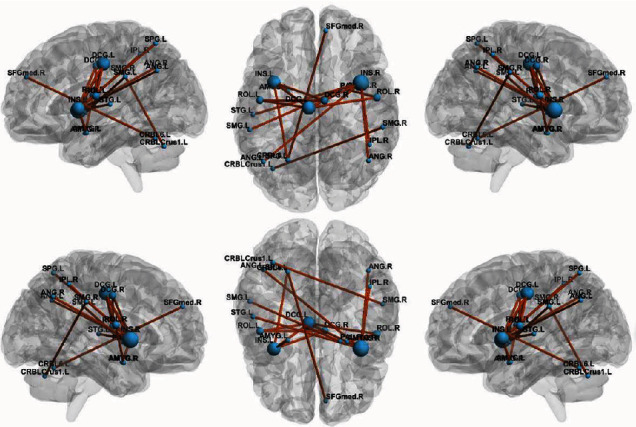
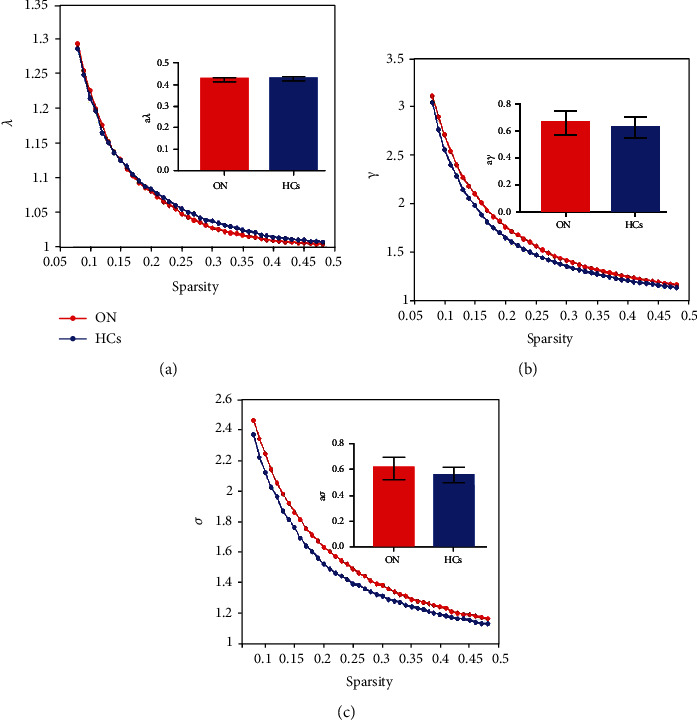
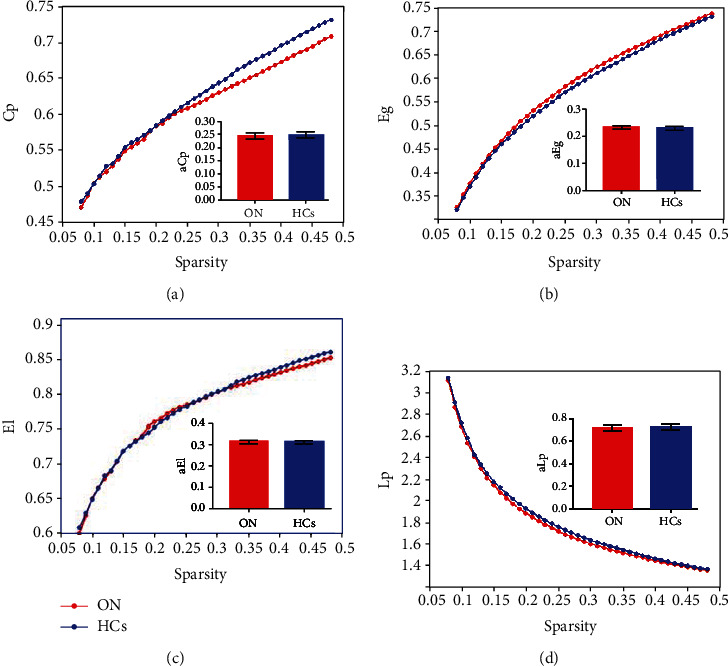
In the sparsity range from 0.08 to 0.48, both groups exhibited small-world attributes. Compared to the control group, global network efficiency, normalized clustering coefficient, and small-world value were higher whereas the clustering coefficient value was lower in ON patients. There were no differences in characteristic path length, local network efficiency, and normalized characteristic path length between groups. In addition, ON patients had lower brain functional connectivity strength among the rolandic operculum, medial superior frontal gyrus, insula, median cingulate and paracingulate gyri, amygdala, superior parietal gyrus, inferior parietal gyrus, supramarginal gyrus, angular gyrus, lenticular nucleus, pallidum, superior temporal gyrus, and cerebellum compared to the control group ( < 0.05).
Patients with ON show typical "small world" topology that differed from that detected in HC brain networks. The brain network in ON has a small-world attribute but shows reduced and abnormal connectivity compared to normal subjects and likely causes symptoms of cognitive impairment.
本研究通过静息态功能磁共振成像(rs-fMRI)和基于图论的方法,研究视神经炎(ON)患者小世界拓扑结构和脑功能连接的变化。
共纳入 21 例 ON 患者(8 名男性,13 名女性)和 21 名匹配的健康对照者(8 名男性,13 名女性),并进行 rs-fMRI 检查。对数据进行预处理,将大脑分为 116 个感兴趣区。从成对脑区间相关系数计算小世界网络参数和曲线下面积(AUC)。采用独立样本 t 检验比较两组脑网络参数 AUC 的差异,采用基于网络的统计分析评估 ON 患者与对照组之间脑连接强度的变化。
在稀疏度范围为 0.08 至 0.48 时,两组均表现出小世界属性。与对照组相比,ON 患者的全局网络效率、标准化聚类系数和小世界值较高,而聚类系数值较低。组间特征路径长度、局部网络效率和标准化特征路径长度无差异。此外,与对照组相比,ON 患者大脑中 Rolandic 盖、内侧额上回、岛叶、中央扣带回和旁扣带回、杏仁核、顶上小叶、顶下小叶、缘上回、角回、豆状核、苍白球、颞上回和小脑的脑功能连接强度较低(<0.05)。
ON 患者表现出典型的“小世界”拓扑结构,与 HC 脑网络中检测到的不同。ON 患者的脑网络具有小世界属性,但与正常受试者相比,连接减少且异常,可能导致认知障碍症状。