Szasz Attila M, Minnaar Carrie Anne, Szentmártoni Gyongyver, Szigeti Gyula P, Dank Magdolna
Cancer Center, Semmelweis University, Budapest, Hungary.
Radiobiology, University of the Witwatersrand, Johannesburg, South Africa.
Front Oncol. 2019 Nov 1;9:1012. doi: 10.3389/fonc.2019.01012. eCollection 2019.
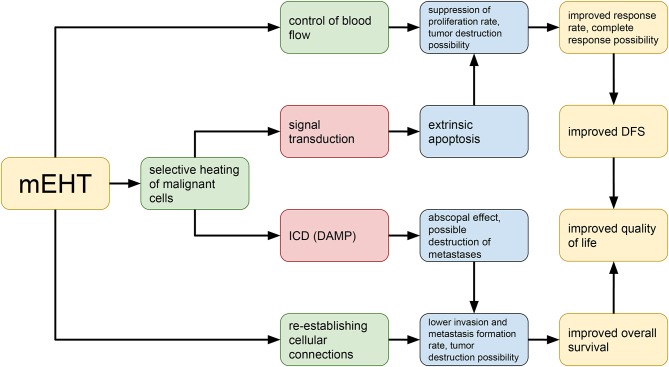
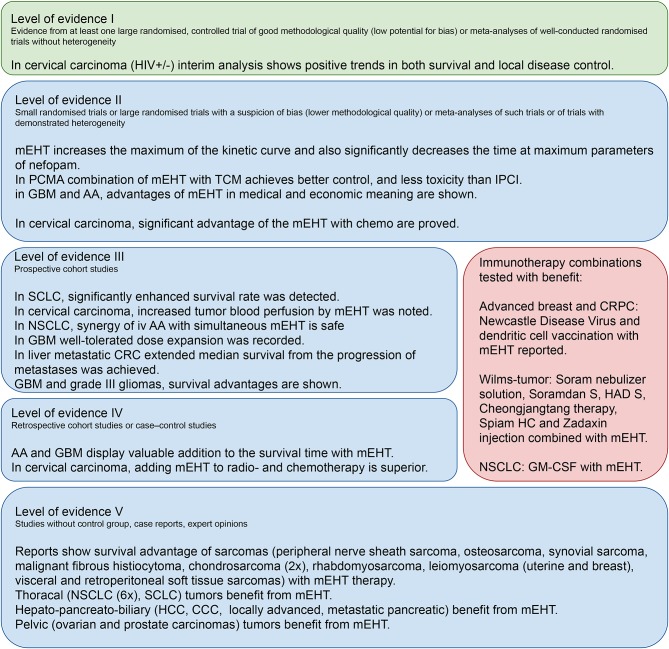
Modulated electro-hyperthermia (mEHT) is a variation of the conventional hyperthermia which selectively targets the malignant cell membranes in order to heat the malignant tissue and sensitize the tissue to oncology treatments. Although widely applied, the formulation of guidelines for the use thereof is still in progress for many tumors. In this paper we review the literature on the effects of mEHT in cancer patients on local disease control and survival. Our review on data presents the collected experience with capacitive hyperthermia treatments with the EHY-2000+ device (OncoTherm Ltd., Germany). A literature search was conducted in Pubmed and articles were grouped and discussed according to: trial type, animal studies, studies, and reviews. Search results from Conference Abstracts; Trial Registries; Thesis and Dissertations and the Oncothermia Journal were included in the discussions. Modulated electro-hyperthermia is a safe form of hyperthermia which has shown to effectively sensitizes deep tumors, regardless of the thickness of the adipose layers. The technology has demonstrated equal benefits compared to other forms of hyperthermia for a variety of tumors. Given the effective heating ability to moderate temperatures, the improved tumor perfusion, and ability to increase drug absorption, mEHT is a safe and effective heating technology which can be easily applied to sensitize tumors which have demonstrated benefits with the addition of hyperthermia. Modulated electro-hyperthermia also appears to improve local control and survival rates and appears to induce an abscopal (systemic) response to ionizing radiation. Based on clinical studies, the method mEHT is a feasible hyperthermia technology for oncological applications. Concomitant utilization of mEHT is supported by the preclinical and clinical data.
调制式电高热疗法(mEHT)是传统高热疗法的一种变体,它选择性地靶向恶性细胞膜,以加热恶性组织并使该组织对肿瘤治疗敏感。尽管已被广泛应用,但针对许多肿瘤的使用指南仍在制定中。在本文中,我们回顾了关于mEHT对癌症患者局部疾病控制和生存影响的文献。我们对数据的回顾展示了使用EHY - 2000 +设备(德国OncoTherm有限公司)进行电容性高热治疗的经验。在PubMed上进行了文献检索,并根据试验类型、动物研究、研究和综述对文章进行了分类和讨论。会议摘要、试验注册库、论文及学位论文以及《肿瘤热疗学杂志》的检索结果也纳入了讨论。调制式电高热疗法是一种安全的高热疗法形式,已证明能有效使深部肿瘤敏感,无论脂肪层厚度如何。与其他形式的高热疗法相比,该技术对多种肿瘤都显示出同等的益处。鉴于其有效加热至适度温度的能力、改善的肿瘤灌注以及增加药物吸收的能力,mEHT是一种安全有效的加热技术,可轻松应用于使添加高热疗法已显示出益处的肿瘤敏感。调制式电高热疗法似乎还能提高局部控制率和生存率,并且似乎能诱导对电离辐射的远隔(全身)反应。基于临床研究,mEHT方法是一种可行的肿瘤学应用高热疗法技术。临床前和临床数据支持mEHT的联合使用。