• 文献检索
  • 文档翻译
  • 深度研究
  • 学术资讯
  • Suppr Zotero 插件Zotero 插件
  • 邀请有礼
  • 套餐&价格
  • 历史记录
应用&插件
Suppr Zotero 插件Zotero 插件浏览器插件Mac 客户端Windows 客户端微信小程序
定价
高级版会员购买积分包购买API积分包
服务
文献检索文档翻译深度研究API 文档MCP 服务
关于我们
关于 Suppr公司介绍联系我们用户协议隐私条款
关注我们

Suppr 超能文献

核心技术专利:CN118964589B侵权必究
粤ICP备2023148730 号-1Suppr @ 2026

文献检索

告别复杂PubMed语法,用中文像聊天一样搜索,搜遍4000万医学文献。AI智能推荐,让科研检索更轻松。

立即免费搜索

文件翻译

保留排版,准确专业,支持PDF/Word/PPT等文件格式,支持 12+语言互译。

免费翻译文档

深度研究

AI帮你快速写综述,25分钟生成高质量综述,智能提取关键信息,辅助科研写作。

立即免费体验

小头畸形、畸形和癫痫在检测智力障碍和自闭症谱系障碍患者致病性拷贝数变异中的重要性差异。

Differences in the importance of microcephaly, dysmorphism, and epilepsy in the detection of pathogenic CNVs in ID and ASD patients.

作者信息

Capkova Zuzana, Capkova Pavlina, Srovnal Josef, Staffova Katerina, Becvarova Vera, Trkova Marie, Adamova Katerina, Santava Alena, Curtisova Vaclava, Hajduch Marian, Prochazka Martin

机构信息

Department of Medical Genetics, University Hospital Olomouc, Olomouc, Czech Republic.

Department of Medical Genetics/Faculty of Medicine and Dentistry, Palacky University Olomouc, Olomouc, Czech Republic.

出版信息

PeerJ. 2019 Nov 15;7:e7979. doi: 10.7717/peerj.7979. eCollection 2019.

DOI:10.7717/peerj.7979
PMID:31741789
原文链接:https://pmc.ncbi.nlm.nih.gov/articles/PMC6859875/
Abstract

BACKGROUND

Autism spectrum disorders (ASD) and intellectual disabilities (ID) are heterogeneous and complex developmental diseases with significant genetic backgrounds and overlaps of genetic susceptibility loci. Copy number variants (CNVs) are known to be frequent causes of these impairments. However, the clinical heterogeneity of both disorders causes the diagnostic efficacy of CNV analysis to be modest. This could be resolved by stratifying patients according to their clinical features.

AIM

First, we sought to assess the significance of particular clinical features for the detection of pathogenic CNVs in separate groups of ID and ASD patients and determine whether and how these groups differ from each other in the significance of these variables. Second, we aimed to create a statistical model showing how particular clinical features affect the probability of pathogenic CNV findings.

METHOD

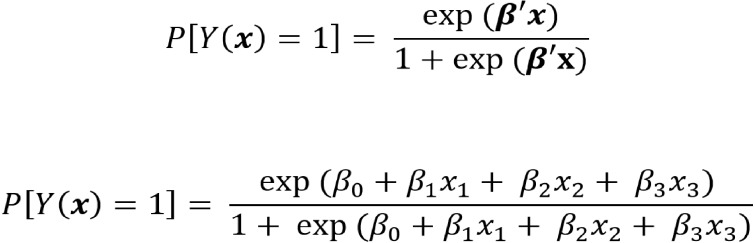
We tested a cohort of 204 patients with ID ( = 90) and ASD ( = 114) for the presence of pathogenic CNVs. We stratified both groups according to their clinical features. Fisher's exact test was used to determine the significance of these variables for pathogenic CNV findings. Logistic regression was used to create a statistical model of pathogenic CNV findings.

RESULTS

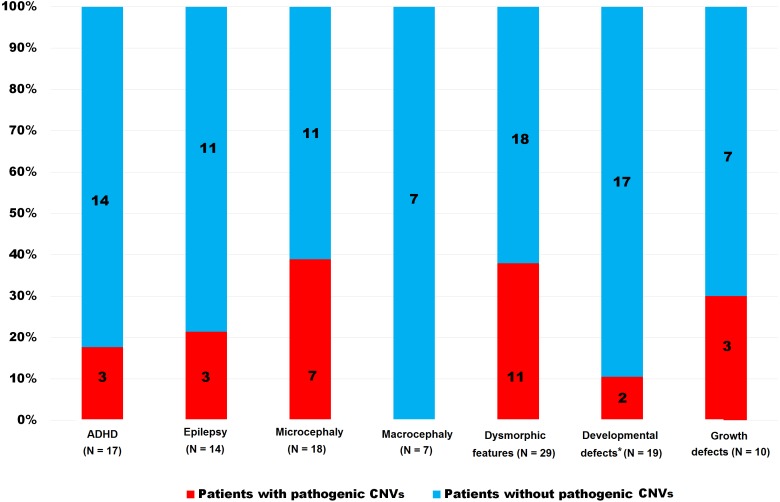
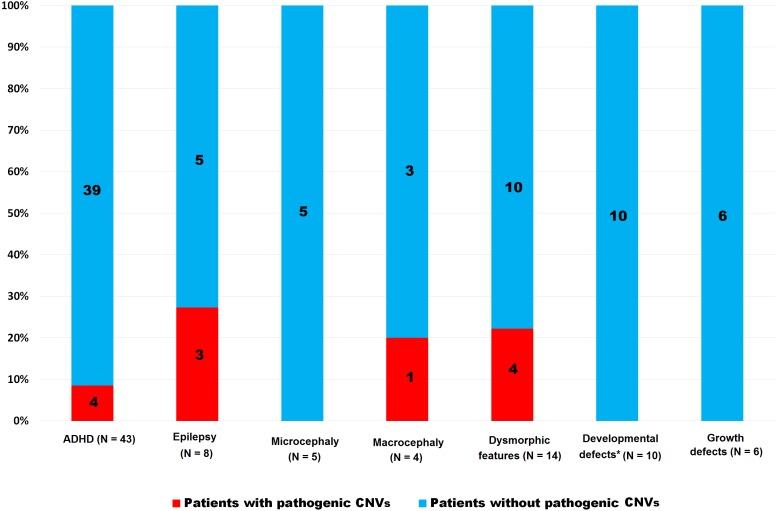
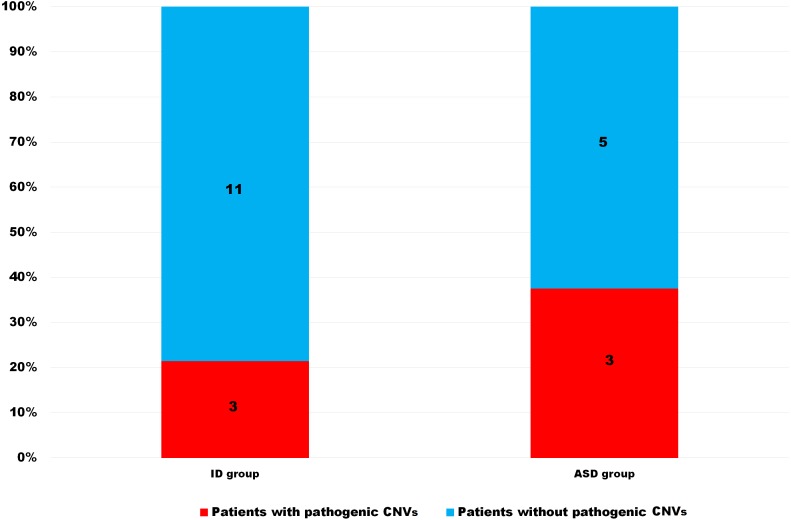
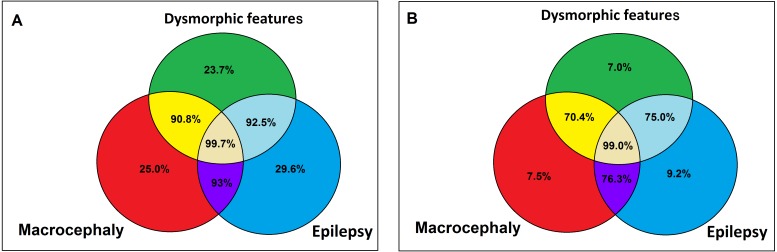
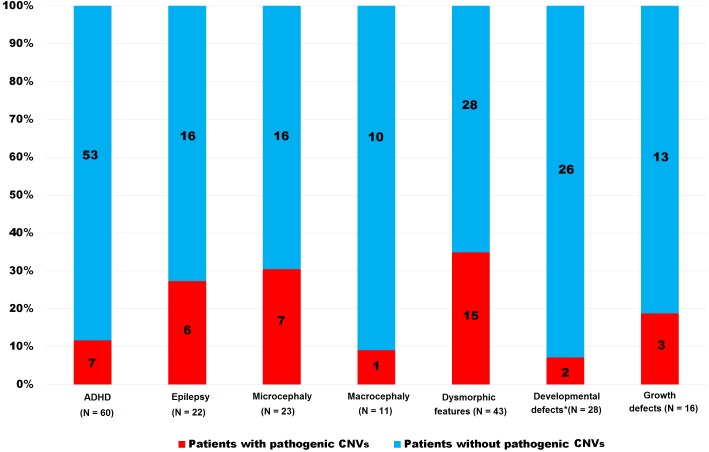
The frequency of pathogenic CNV was significantly higher in the ID group than in the ASD group: 18 (19.78%) versus 8 (7%) ( < 0.004). Microcephaly showed a significant association with pathogenic findings in ID patients ( < 0.01) according to Fisher's exact test, whereas epilepsy showed a significant association with pathogenic findings in ASD patients ( < 0.01). The probability of pathogenic CNV findings when epilepsy occurred in ASD patients was more than two times higher than if epilepsy co-occurred with ID (29.6%/14.0%). Facial dysmorphism was a significant variable for detecting pathogenic CNVs in both groups (ID = 0.05, ASD = 0.01). However, dysmorphism increased the probability of pathogenic CNV detection in the ID group nearly twofold compared to the ASD group (44.4%/23.7%). The presence of macrocephaly in the ASD group showed a 25% probability of pathogenic CNV findings by logistic regression, but this was insignificant according to Fisher's exact test. The probability of detecting pathogenic CNVs decreases up to 1% in the absence of dysmorphism, macrocephaly, and epilepsy in the ASD group.

CONCLUSION

Dysmorphism, microcephaly, and epilepsy increase the probability of pathogenic CNV findings in ID and ASD patients. The significance of each feature as a predictor for pathogenic CNV detection differs depending on whether the patient has only ASD or ID. The probability of pathogenic CNV findings without dysmorphism, macrocephaly, or epilepsy in ASD patients is low. Therefore the efficacy of CNV analysis is limited in these patients.

摘要

背景

自闭症谱系障碍(ASD)和智力障碍(ID)是具有显著遗传背景且遗传易感性位点存在重叠的异质性复杂发育疾病。已知拷贝数变异(CNV)是这些障碍的常见病因。然而,这两种疾病的临床异质性导致CNV分析的诊断效能一般。可通过根据患者临床特征进行分层来解决这一问题。

目的

首先,我们试图评估特定临床特征在检测ID和ASD患者不同组中致病性CNV方面的意义,并确定这些组在这些变量的意义上是否以及如何彼此不同。其次,我们旨在创建一个统计模型,展示特定临床特征如何影响致病性CNV发现的概率。

方法

我们对204例ID患者(n = 90)和ASD患者(n = 114)组成的队列进行检测,以确定是否存在致病性CNV。我们根据他们的临床特征对两组进行分层。采用Fisher精确检验来确定这些变量对致病性CNV发现的意义。使用逻辑回归创建致病性CNV发现的统计模型。

结果

ID组中致病性CNV的频率显著高于ASD组:18例(19.78%)对8例(7%)(P < 0.004)。根据Fisher精确检验,小头畸形在ID患者中与致病性发现显著相关(P < 0.01),而癫痫在ASD患者中与致病性发现显著相关(P < 0.01)。当癫痫发生在ASD患者中时,致病性CNV发现的概率比癫痫与ID共发时高出两倍多(29.6%/14.0%)。面部畸形是两组中检测致病性CNV的显著变量(ID组P = 0.05,ASD组P = 0.01)。然而,与ASD组相比,畸形使ID组中致病性CNV检测的概率增加了近两倍(44.4%/23.7%)。ASD组中巨头畸形的存在通过逻辑回归显示致病性CNV发现的概率为25%,但根据Fisher精确检验这并不显著。在ASD组中,若不存在畸形、巨头畸形和癫痫,检测致病性CNV的概率降低至1%。

结论

畸形、小头畸形和癫痫增加了ID和ASD患者中致病性CNV发现的概率。每个特征作为致病性CNV检测预测指标的意义因患者仅患有ASD还是ID而有所不同。在ASD患者中,不存在畸形、巨头畸形或癫痫时致病性CNV发现的概率较低。因此,CNV分析在这些患者中的效能有限。
https://cdn.ncbi.nlm.nih.gov/pmc/blobs/1fb3/6859875/00bbe3b63a30/peerj-07-7979-g006.jpg
https://cdn.ncbi.nlm.nih.gov/pmc/blobs/1fb3/6859875/37b4a7f7e276/peerj-07-7979-g001.jpg
https://cdn.ncbi.nlm.nih.gov/pmc/blobs/1fb3/6859875/73f0763540d6/peerj-07-7979-g002.jpg
https://cdn.ncbi.nlm.nih.gov/pmc/blobs/1fb3/6859875/d4fa7554f082/peerj-07-7979-g003.jpg
https://cdn.ncbi.nlm.nih.gov/pmc/blobs/1fb3/6859875/013913126e9d/peerj-07-7979-g004.jpg
https://cdn.ncbi.nlm.nih.gov/pmc/blobs/1fb3/6859875/b252cb377711/peerj-07-7979-g005.jpg
https://cdn.ncbi.nlm.nih.gov/pmc/blobs/1fb3/6859875/00bbe3b63a30/peerj-07-7979-g006.jpg
https://cdn.ncbi.nlm.nih.gov/pmc/blobs/1fb3/6859875/37b4a7f7e276/peerj-07-7979-g001.jpg
https://cdn.ncbi.nlm.nih.gov/pmc/blobs/1fb3/6859875/73f0763540d6/peerj-07-7979-g002.jpg
https://cdn.ncbi.nlm.nih.gov/pmc/blobs/1fb3/6859875/d4fa7554f082/peerj-07-7979-g003.jpg
https://cdn.ncbi.nlm.nih.gov/pmc/blobs/1fb3/6859875/013913126e9d/peerj-07-7979-g004.jpg
https://cdn.ncbi.nlm.nih.gov/pmc/blobs/1fb3/6859875/b252cb377711/peerj-07-7979-g005.jpg
https://cdn.ncbi.nlm.nih.gov/pmc/blobs/1fb3/6859875/00bbe3b63a30/peerj-07-7979-g006.jpg

相似文献

1
Differences in the importance of microcephaly, dysmorphism, and epilepsy in the detection of pathogenic CNVs in ID and ASD patients.小头畸形、畸形和癫痫在检测智力障碍和自闭症谱系障碍患者致病性拷贝数变异中的重要性差异。
PeerJ. 2019 Nov 15;7:e7979. doi: 10.7717/peerj.7979. eCollection 2019.
2
Rare Copy Number Variations and Predictors in Children With Intellectual Disability and Epilepsy.智力残疾和癫痫儿童中的罕见拷贝数变异及预测因素
Front Neurol. 2018 Nov 19;9:947. doi: 10.3389/fneur.2018.00947. eCollection 2018.
3
New insights in the interpretation of array-CGH: autism spectrum disorder and positive family history for intellectual disability predict the detection of pathogenic variants.阵列比较基因组杂交解读的新见解:自闭症谱系障碍和智力残疾的阳性家族史可预测致病变异的检测。
Ital J Pediatr. 2016 Apr 12;42:39. doi: 10.1186/s13052-016-0246-7.
4
A cohort study of neurodevelopmental disorders and/or congenital anomalies using high resolution chromosomal microarrays in southern Brazil highlighting the significance of ASD.一项使用高分辨率染色体微阵列对南里奥格兰德州神经发育障碍和/或先天性异常的队列研究,强调了 ASD 的重要性。
Sci Rep. 2024 Feb 14;14(1):3762. doi: 10.1038/s41598-024-54385-2.
5
Diagnostic implications of genetic copy number variation in epilepsy plus.癫痫伴发症中基因拷贝数变异的诊断意义。
Epilepsia. 2019 Apr;60(4):689-706. doi: 10.1111/epi.14683. Epub 2019 Mar 13.
6
Clinical correlates in children with autism spectrum disorder and CNVs: Systematic investigation in a clinical setting.自闭症谱系障碍患儿的临床相关性与 CNVs:临床环境中的系统研究。
Int J Dev Neurosci. 2020 Jun;80(4):276-286. doi: 10.1002/jdn.10024. Epub 2020 Mar 25.
7
Chromosomal microarray analysis of consecutive individuals with autism spectrum disorders or learning disability presenting for genetic services.对连续就诊的自闭症谱系障碍或学习障碍患者进行染色体微阵列分析,以提供遗传服务。
Gene. 2014 Feb 1;535(1):70-8. doi: 10.1016/j.gene.2013.10.020. Epub 2013 Nov 2.
8
MLPA is a practical and complementary alternative to CMA for diagnostic testing in patients with autism spectrum disorders and identifying new candidate CNVs associated with autism.对于自闭症谱系障碍患者的诊断测试以及识别与自闭症相关的新候选拷贝数变异(CNV),多重连接探针扩增技术(MLPA)是一种实用且互补的替代方法,可用于替代染色体微阵列分析(CMA)。
PeerJ. 2019 Jan 9;6:e6183. doi: 10.7717/peerj.6183. eCollection 2019.
9
[Application of copy number variation sequencing in patients with intellectual disability/developmental delay and autistic spectrum disorder].拷贝数变异测序在智力残疾/发育迟缓及自闭症谱系障碍患者中的应用
Zhonghua Yi Xue Yi Chuan Xue Za Zhi. 2023 Mar 10;40(3):308-316. doi: 10.3760/cma.j.cn511374-20220816-00551.
10
A genomic copy number variant analysis implicates the MBD5 and HNRNPU genes in Chinese children with infantile spasms and expands the clinical spectrum of 2q23.1 deletion.一项基因组拷贝数变异分析提示 MBD5 和 HNRNPU 基因与中国婴儿痉挛患儿相关,并扩展了 2q23.1 缺失的临床表型谱。
BMC Med Genet. 2014 May 29;15:62. doi: 10.1186/1471-2350-15-62.

引用本文的文献

1
Analysis of clinical and psychological characteristics of 225 children with autism spectrum disorder based on the C-PEP-3 scale.基于C-PEP-3量表对225例自闭症谱系障碍儿童的临床及心理特征分析
World J Psychiatry. 2025 Mar 19;15(3):101101. doi: 10.5498/wjp.v15.i3.101101.
2
Burden of Rare Copy Number Variants in Microcephaly: A Brazilian Cohort of 185 Microcephalic Patients and Review of the Literature.小头畸形中罕见拷贝数变异的负担:巴西185例小头畸形患者队列及文献综述
J Autism Dev Disord. 2024 Mar;54(3):1181-1212. doi: 10.1007/s10803-022-05853-z. Epub 2022 Dec 11.
3
Chromosomal microarray in postnatal diagnosis of congenital anomalies and neurodevelopmental disorders in Serbian patients.

本文引用的文献

1
A review of psychiatric conceptions of mental and behavioural disorders in Prader-Willi syndrome.《普拉德-威利综合征精神和行为障碍的精神科概念述评》。
Neurosci Biobehav Rev. 2018 Dec;95:396-405. doi: 10.1016/j.neubiorev.2018.10.006. Epub 2018 Oct 28.
2
Genetic profile and clinical application of chromosomal microarray in children with intellectual disability in Hong Kong.香港智障儿童染色体微阵列分析的基因图谱及临床应用
Hong Kong Med J. 2018 Oct;24(5):451-459. doi: 10.12809/hkmj187260.
3
Clinical Application of Chromosome Microarray Analysis in Han Chinese Children with Neurodevelopmental Disorders.
对塞尔维亚患者先天性畸形和神经发育障碍的产后诊断中的染色体微阵列分析。
J Clin Lab Anal. 2022 Jun;36(6):e24441. doi: 10.1002/jcla.24441. Epub 2022 Apr 20.
4
Genomics, convergent neuroscience and progress in understanding autism spectrum disorder.基因组学、趋同神经科学与自闭症谱系障碍研究进展。
Nat Rev Neurosci. 2022 Jun;23(6):323-341. doi: 10.1038/s41583-022-00576-7. Epub 2022 Apr 19.
5
Identification of copy number variants in children and adolescents with autism spectrum disorder: a study from Turkey.自闭症谱系障碍儿童和青少年中拷贝数变异的鉴定:一项来自土耳其的研究。
Mol Biol Rep. 2021 Nov;48(11):7371-7378. doi: 10.1007/s11033-021-06745-8. Epub 2021 Oct 12.
6
Clinical evaluation of patients with a neuropsychiatric risk copy number variant.对具有神经精神风险拷贝数变异的患者的临床评估。
Curr Opin Genet Dev. 2021 Jun;68:26-34. doi: 10.1016/j.gde.2020.12.012. Epub 2021 Jan 15.
染色体微阵列分析在汉族神经发育障碍儿童中的临床应用。
Neurosci Bull. 2018 Dec;34(6):981-991. doi: 10.1007/s12264-018-0238-2. Epub 2018 Jun 9.
4
High Incidence of Copy Number Variants in Adults with Intellectual Disability and Co-morbid Psychiatric Disorders.智力残疾合并共患精神障碍成人的拷贝数变异发生率较高。
Behav Genet. 2018 Jul;48(4):323-336. doi: 10.1007/s10519-018-9902-6. Epub 2018 Jun 7.
5
Chromosomal microarray analysis of Bulgarian patients with epilepsy and intellectual disability.对患有癫痫和智力障碍的保加利亚患者进行染色体微阵列分析。
Gene. 2018 Aug 15;667:45-55. doi: 10.1016/j.gene.2018.05.015. Epub 2018 May 9.
6
Rare partial octosomy and hexasomy of 15q11-q13 associated with intellectual impairment and development delay: report of two cases and review of literature.与智力障碍和发育迟缓相关的罕见的15q11 - q13部分八体性和六体性:两例报告及文献复习
Mol Cytogenet. 2018 Feb 5;11:15. doi: 10.1186/s13039-018-0365-5. eCollection 2018.
7
A prospective study of fetal head growth, autistic traits and autism spectrum disorder.前瞻性研究胎儿头围生长、自闭症特征与自闭症谱系障碍。
Autism Res. 2018 Apr;11(4):602-612. doi: 10.1002/aur.1921. Epub 2018 Jan 22.
8
Genomic Disorders in Psychiatry-What Does the Clinician Need to Know?精神医学中的基因组紊乱——临床医生需要了解什么?
Curr Psychiatry Rep. 2017 Sep 20;19(11):82. doi: 10.1007/s11920-017-0831-5.
9
Copy number variation analysis of patients with intellectual disability from North-West Spain.西班牙西北部智障患者的拷贝数变异分析。
Gene. 2017 Aug 30;626:189-199. doi: 10.1016/j.gene.2017.05.032. Epub 2017 May 12.
10
Cross-disorder comparative analysis of comorbid conditions reveals novel autism candidate genes.共病状况的跨疾病比较分析揭示了新的自闭症候选基因。
BMC Genomics. 2017 Apr 20;18(1):315. doi: 10.1186/s12864-017-3667-9.