Beversdorf David Q, Stevens Hanna E, Margolis Kara Gross, Van de Water Judy
Departments of Radiology, Neurology, and Psychological Sciences, and The Thompson Center for Neurodevelopmental Disorders, William and Nancy Thompson Endowed Chair in Radiology, University of Missouri, Columbia, MO, United States.
Departments of Psychiatry and Pediatrics, Iowa Neuroscience Institute, University of Iowa, Iowa City, United States.
Curr Pharm Des. 2019;25(41):4331-4343. doi: 10.2174/1381612825666191119093335.
Genetics is a major etiological contributor to autism spectrum disorder (ASD). Environmental factors, however, also appear to contribute. ASD pathophysiology due to gene x environment is also beginning to be explored. One reason to focus on environmental factors is that they may allow opportunities for intervention or prevention.
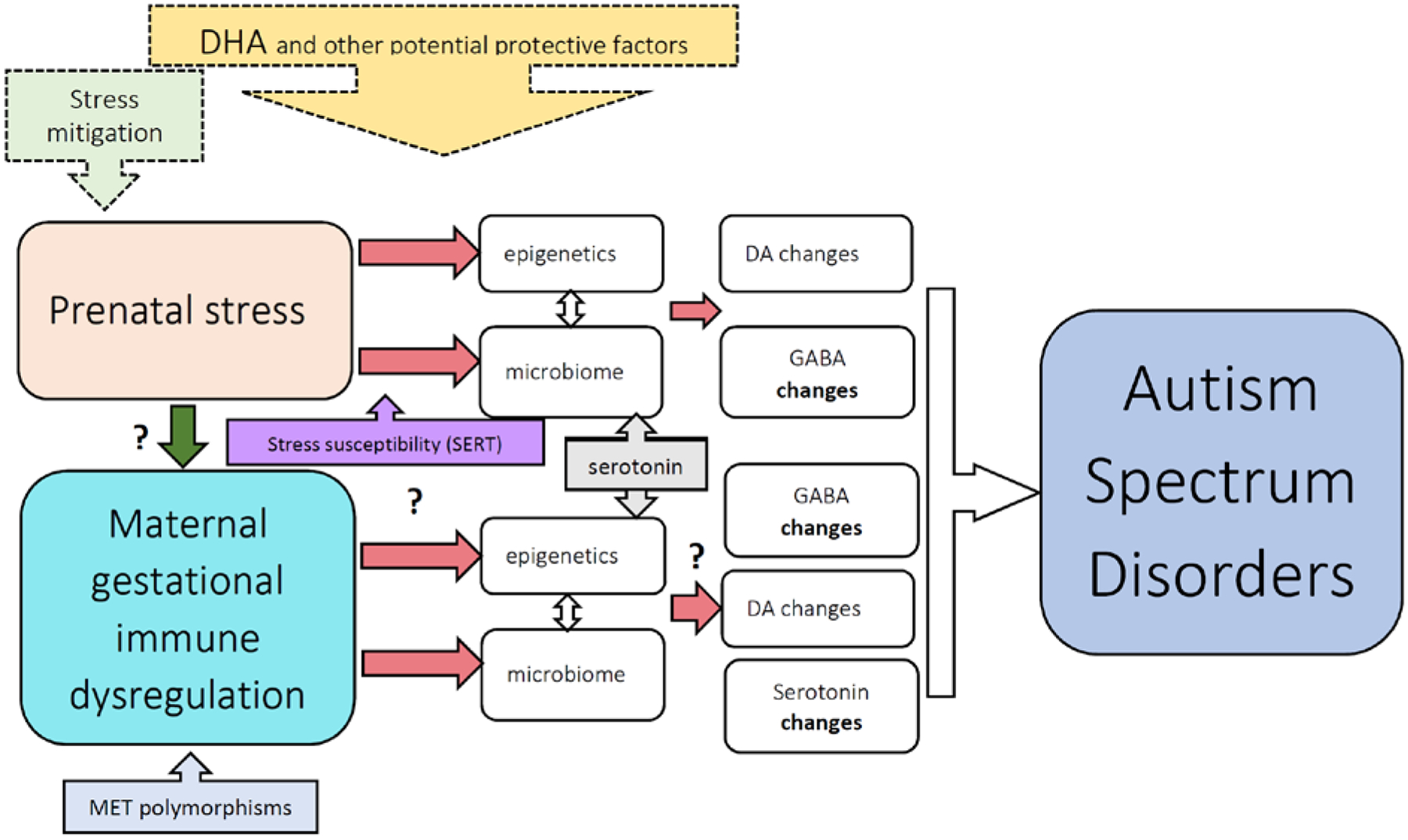
Herein, we review two such factors that have been associated with a significant proportion of ASD risk, prenatal stress exposure and maternal immune dysregulation. Maternal stress susceptibility appears to interact with prenatal stress exposure to affect offspring neurodevelopment. We also explore how maternal stress may interact with the microbiome in the neurodevelopmental setting. Additionally, understanding of the impact of maternal immune dysfunction on ASD has recently been advanced by recognition of specific fetal brain proteins targeted by maternal autoantibodies, and identification of unique mid-gestational maternal immune profiles. This might also be interrelated with maternal stress exposure. Animal models have been developed to explore pathophysiology targeting each of these factors.
We are beginning to understand the behavioral, pharmacopathological, and epigenetic effects related to these interactions, and we are beginning to explore potential mitigating factors. Continued growth in understanding of these mechanisms may ultimately allow for the identification of multiple potential targets for prevention or intervention for this subset of environmental-associated ASD cases.
遗传学是自闭症谱系障碍(ASD)的主要病因。然而,环境因素似乎也有影响。基因与环境相互作用导致的ASD病理生理学也开始得到探索。关注环境因素的一个原因是它们可能提供干预或预防的机会。
在此,我们综述了两个与相当比例的ASD风险相关的因素,即产前应激暴露和母体免疫失调。母体应激易感性似乎与产前应激暴露相互作用,影响后代神经发育。我们还探讨了母体应激在神经发育环境中可能如何与微生物群相互作用。此外,通过识别母体自身抗体靶向的特定胎儿脑蛋白,以及确定独特的孕中期母体免疫特征,最近对母体免疫功能障碍对ASD的影响的认识有了进展。这也可能与母体应激暴露相关。已经开发了动物模型来探索针对这些因素中每一个的病理生理学。
我们开始了解与这些相互作用相关的行为、药物病理学和表观遗传学效应,并且我们开始探索潜在的缓解因素。对这些机制的理解不断深入,最终可能有助于识别这一与环境相关的ASD病例子集的多个潜在预防或干预靶点。