Department of Microbiology-Immunology, Northwestern University Feinberg School of Medicine, Chicago, Illinois, USA.
Center for Structural Genomics of Infectious Diseases, Feinberg School of Medicine, Northwestern University, Chicago, Illinois, USA.
mBio. 2019 Nov 19;10(6):e02613-19. doi: 10.1128/mBio.02613-19.
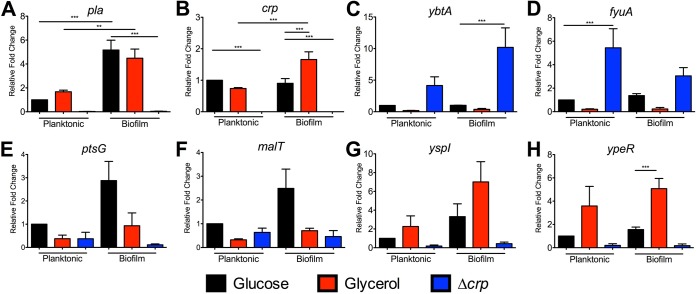
Cyclic AMP (cAMP) receptor protein (Crp) is an important transcriptional regulator of Expression of increases during pneumonic plague as the pathogen depletes glucose and forms large biofilms within lungs. To better understand control of Crp, we determined a 1.8-Å crystal structure of the protein-cAMP complex. We found that compared to Crp, C helix amino acid substitutions in Crp did not impact the cAMP dependency of Crp to bind DNA promoters. To investigate Crp-regulated genes during plague pneumonia, we performed RNA sequencing on both wild-type and Δ mutant bacteria growing in planktonic and biofilm states in minimal media with glucose or glycerol. Crp was found to dramatically alter expression of hundreds of genes in a manner dependent upon carbon source and growth state. Gel shift assays confirmed direct regulation of the and promoters, and Crp was then linked to growth on maltose as a sole carbon source. Iron regulation genes and were found to be indirectly regulated by Crp. A new connection between carbon source and quorum sensing was revealed as Crp was found to regulate production of acyl-homoserine lactones (AHLs) through direct and indirect regulation of genes for AHL synthetases and receptors. AHLs were subsequently identified in the lungs of -infected mice when expression was highest in biofilms. Thus, in addition to the well-studied gene, other Crp-regulated genes likely have important functions during plague infection. Bacterial pathogens have evolved extensive signaling pathways to translate environmental signals into changes in gene expression. While Crp has long been appreciated for its role in regulating metabolism of carbon sources in many bacterial species, transcriptional profiling has revealed that this protein regulates many other aspects of bacterial physiology. The plague pathogen requires this global regulator to survive in blood, skin, and lungs. During disease progression, this organism adapts to changes within these niches. In addition to regulating genes for metabolism of nonglucose sugars, we found that Crp regulates genes for virulence, metal acquisition, and quorum sensing by direct or indirect mechanisms. Thus, this single transcriptional regulator, which responds to changes in available carbon sources, can regulate multiple critical behaviors for causing disease.
环磷酸腺苷(cAMP)受体蛋白(Crp)是表达的重要转录调节剂,当病原体耗尽葡萄糖并在肺部形成大生物膜时,表达会增加。为了更好地理解对的控制,我们确定了该蛋白-cAMP 复合物的 1.8Å 晶体结构。我们发现,与 Crp 相比,Crp 中的 C 螺旋氨基酸取代不会影响 Crp 结合 DNA 启动子的 cAMP 依赖性。为了研究 plague 肺炎期间的 Crp 调节基因,我们对在含有葡萄糖或甘油的最小培养基中以浮游和生物膜状态生长的野生型和Δ突变细菌进行了 RNA 测序。发现 Crp 以依赖于碳源和生长状态的方式显著改变数百个基因的表达。凝胶移位分析证实了对和的直接调节,然后发现 Crp 与作为唯一碳源的麦芽糖上的生长有关。铁调节基因和被发现通过 Crp 间接调节。碳源和群体感应之间的新联系被揭示出来,因为发现 Crp 通过直接和间接调节酰基高丝氨酸内酯(AHL)合成酶和受体的基因来调节 AHL 的产生。当在生物膜中表达最高时,在感染的小鼠肺部中随后鉴定出 AHLs。因此,除了研究得很好的基因外,其他 Crp 调节的基因在 plague 感染期间可能具有重要功能。细菌病原体已经进化出广泛的信号通路,将环境信号转化为基因表达的变化。虽然 Crp 长期以来一直因其在许多细菌物种中调节碳源代谢的作用而受到重视,但转录谱分析表明,该蛋白调节细菌生理学的许多其他方面。鼠疫病原体需要这种全局调节剂才能在血液、皮肤和肺部中存活。在疾病进展过程中,该生物体适应这些小生境中的变化。除了调节非葡萄糖糖代谢的基因外,我们还发现 Crp 通过直接或间接机制调节毒力、金属获取和群体感应的基因。因此,这种单一的转录调节剂,它响应可用碳源的变化,可以调节导致疾病的多个关键行为。