Department of Environmental Health Sciences, University of Michigan School of Public Health, Ann Arbor, MI, USA.
Department of Biostatistics, University of Michigan School of Public Health, Ann Arbor, MI, USA.
Sci Rep. 2019 Nov 19;9(1):17049. doi: 10.1038/s41598-019-53448-z.
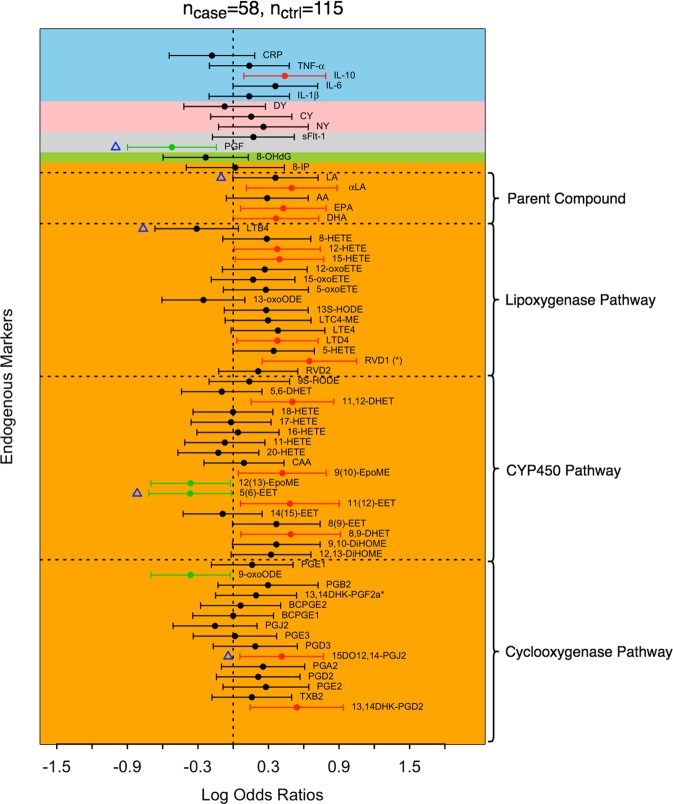
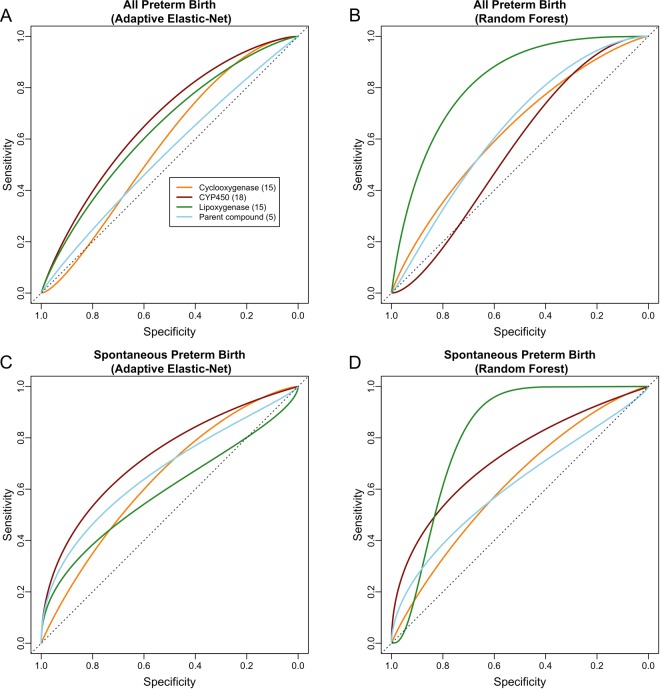
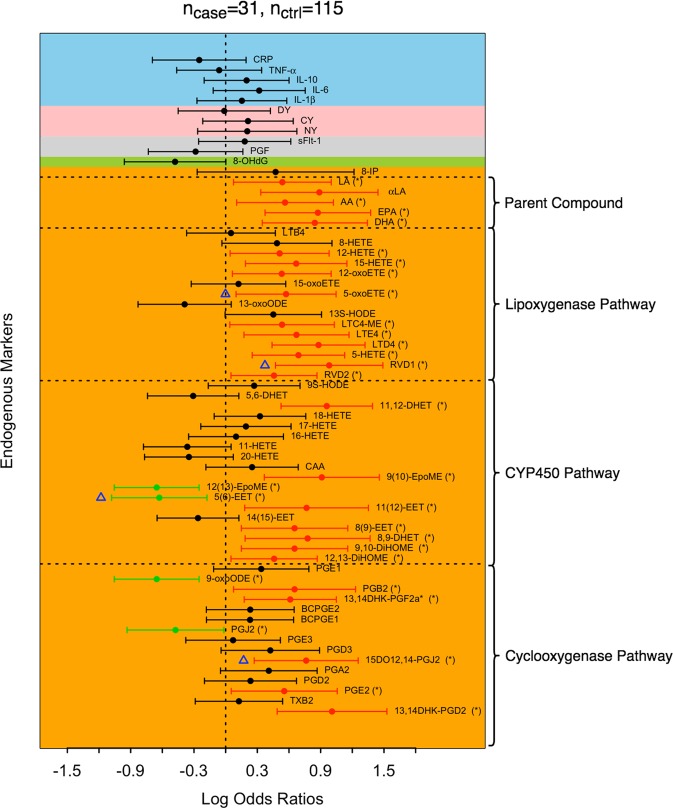
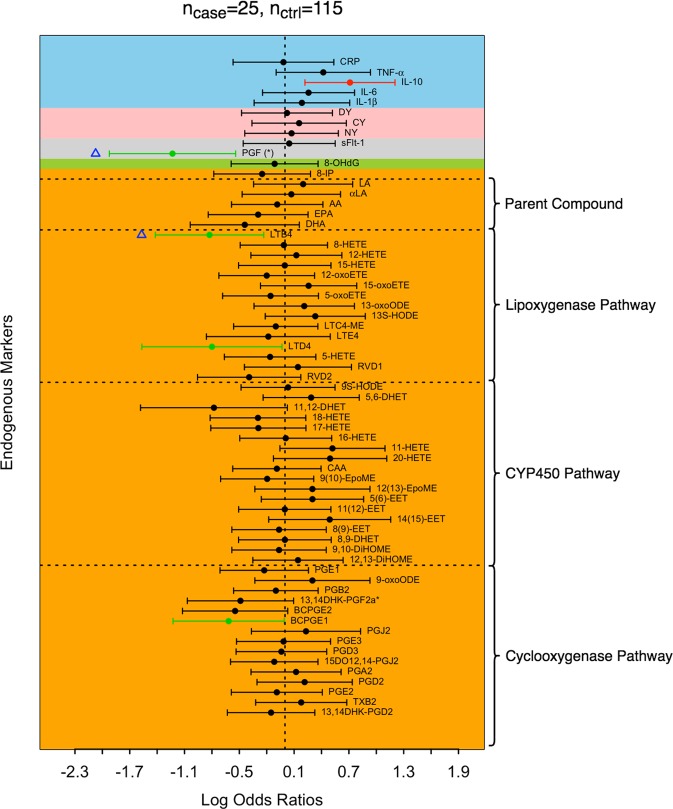
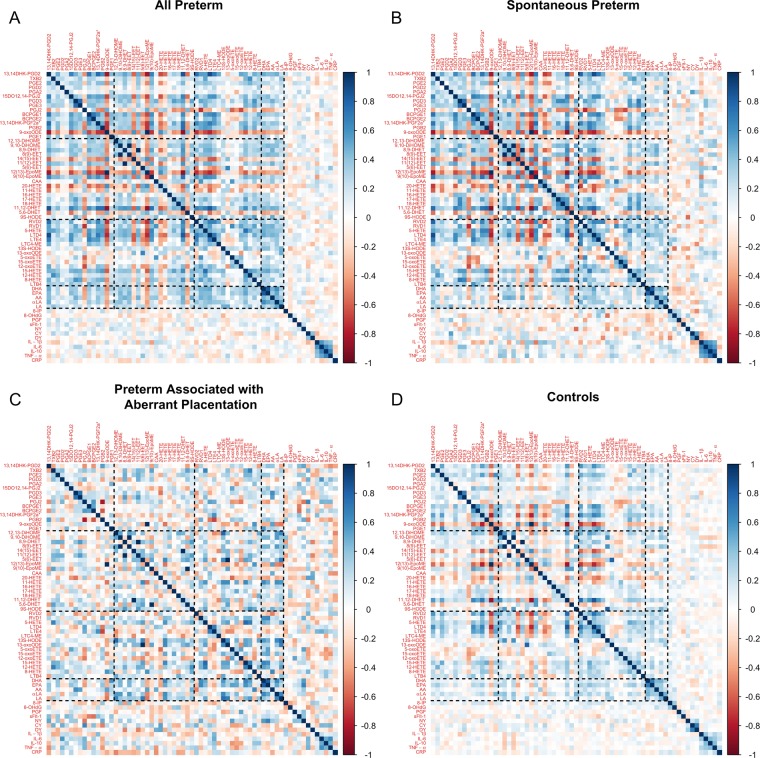
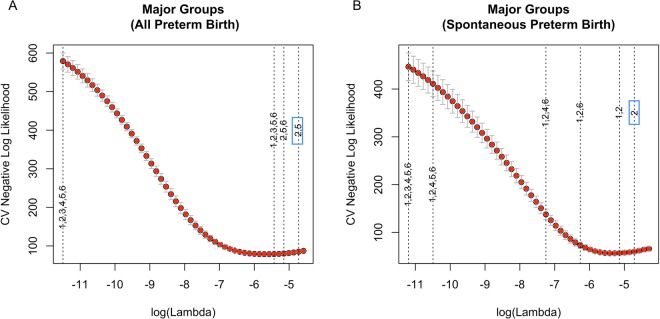
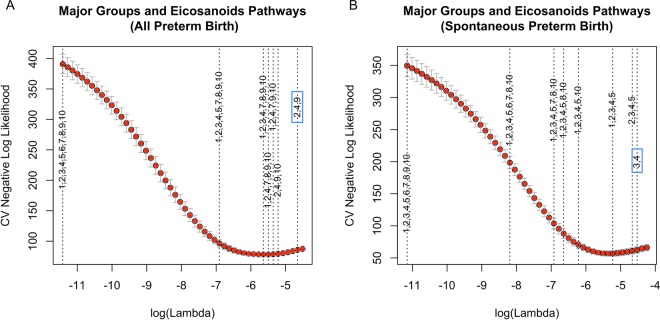
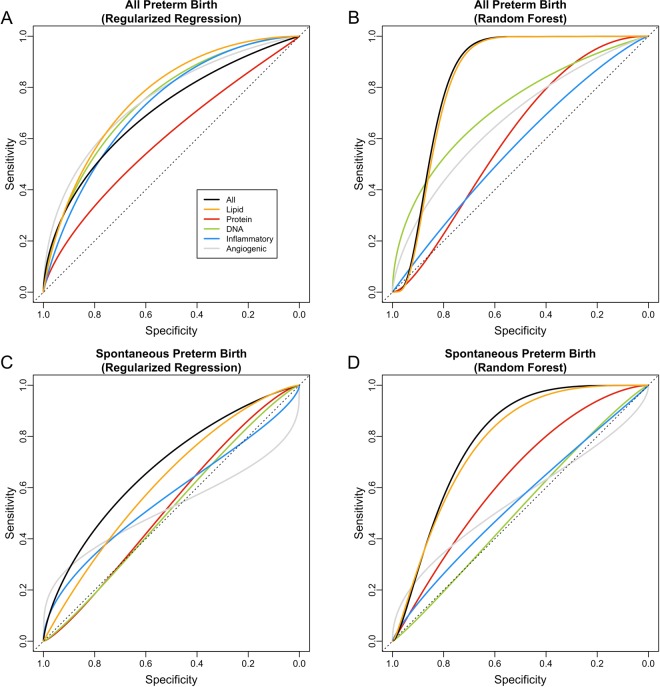
Endogenous signaling molecules derived from lipids, peptides, and DNA, are important regulators of physiological processes during pregnancy. The effect of their collective impact on preterm birth (delivery < 37 weeks gestation) is understudied. We aimed to characterize the associations and predictive capacity of an extensive panel of eicosanoids, immune biomarkers, oxidative stress markers, and growth factors towards preterm birth and its subtypes. We conducted a cross-sectional study of pregnant women (recruited < 15 weeks gestation) in the LIFECODES birth cohort, which included 58 cases of preterm birth and 115 controls that delivered term. Among the cases there were 31 cases who had a spontaneous preterm birth (cases who had spontaneous preterm labor and/or preterm premature rupture of membranes) and 25 that had preterm birth associated with aberrant placentation (cases who had preeclampsia and/or intrauterine growth restriction) and 2 cases that could not be sufficiently categorized as either. We analyzed single biomarker associations with each preterm birth outcome using multiple logistic regression. Adaptive elastic-net was implemented to perform a penalized multiple logistic regression on all biomarkers simultaneously to identify the most predictive biomarkers. We then organized biomarkers into biological groups and by enzymatic pathways and applied adaptive elastic-net and random forest to evaluate the accuracy of each group for predicting preterm birth cases. The majority of associations we observed were for spontaneous preterm birth, and adaptive elastic-net identified 5-oxoeicosatetraenoic acid, resolvin D1, 5,6-epoxy-eicsatrienoic acid, and 15-deoxy-12,14-prostaglandin J2 as most predictive. Overall, lipid biomarkers performed the best at separating cases from controls compared to other biomarker categories (adaptive elastic-net AUC = 0.78 [0.62, 0.94], random forest AUC = 0.84 [0.72, 0.96]). Among the enzymatic pathways that differentiate eicosanoid metabolites, we observed the highest prediction of overall preterm birth by lipoxygenase metabolites using random forest (AUC = 0.83 [0.69, 0.96]), followed by cytochrome p450 metabolites using adaptive elastic-net (AUC = 0.74 [0.52, 0.96]). In this study we translate biological hypothesis into the language of modern machine learning. Many lipid biomarkers were highly associated with overall and spontaneous preterm birth. Among eicosanoids, lipoxygenase and cytochrome p450 products performed best in identifying overall and spontaneous preterm birth. The combination of lipid biomarkers may have good utility in clinical settings to predict preterm birth.
内源性信号分子来源于脂质、肽和 DNA,是妊娠期间生理过程的重要调节剂。它们的集体影响对早产(<37 周分娩)的影响还在研究中。我们旨在描述广泛的花生四烯酸、免疫生物标志物、氧化应激标志物和生长因子对早产及其亚型的关联和预测能力。我们对 LIFECODES 出生队列中的孕妇(招募时<15 周妊娠)进行了横断面研究,其中包括 58 例早产病例和 115 例足月分娩对照病例。在病例中,有 31 例为自发性早产(病例为自发性早产临产和/或早产胎膜早破),25 例为与异常胎盘有关的早产(病例为子痫前期和/或宫内生长受限),还有 2 例无法充分归类为上述两种情况。我们使用多元逻辑回归分析了每个早产结局与单一生物标志物的关联。适应性弹性网络用于对所有生物标志物同时进行惩罚性多元逻辑回归,以识别最具预测性的生物标志物。然后,我们将生物标志物按生物学组和酶途径进行分类,并应用自适应弹性网络和随机森林评估每个组预测早产病例的准确性。我们观察到的大多数关联都是自发性早产,适应性弹性网络确定 5-氧代二十碳四烯酸、分辨率 D1、5,6-环氧-eicostrienoic 酸和 15-脱氧-12,14-前列腺素 J2 为最具预测性的生物标志物。总的来说,与其他生物标志物类别相比,脂质生物标志物在将病例与对照区分开方面表现最佳(自适应弹性网络 AUC=0.78[0.62,0.94],随机森林 AUC=0.84[0.72,0.96])。在区分花生四烯酸代谢物的酶途径中,我们观察到使用随机森林对整体早产的预测最高(AUC=0.83[0.69,0.96]),其次是使用适应性弹性网络的细胞色素 P450 代谢物(AUC=0.74[0.52,0.96])。在这项研究中,我们将生物学假设转化为现代机器学习的语言。许多脂质生物标志物与整体和自发性早产高度相关。在花生四烯酸中,脂氧合酶和细胞色素 P450 产物在识别整体和自发性早产方面表现最好。脂质生物标志物的组合可能在临床环境中有很好的预测早产的效用。