Paul Yvonne, Ellapen Terry J, Barnard Marco, Hammill Henriëtte V, Swanepoel Mariëtte
Department of Sport and Dental Therapy, Faculty of Health Science, Tshwane University of Technology, Cape Town, South Africa.
School of Biokinetics, Recreation and Sport, Physical Activity Sport and Recreation (PhASRec), North-West University, Potchefstroom, South Africa.
Afr J Disabil. 2019 Oct 23;8:576. doi: 10.4102/ajod.v8i0.576. eCollection 2019.
Many patients with Down syndrome (PWDS) have poor cardiometabolic risk profiles, aerobic capacities and weak hypotonic muscles, primarily because of physical inactivity and poor diet.
This study discusses the benefits of exercise therapy on body composition, aerobic capacity, muscle strength, proprioception and cardiometabolic profiles of PWDS.
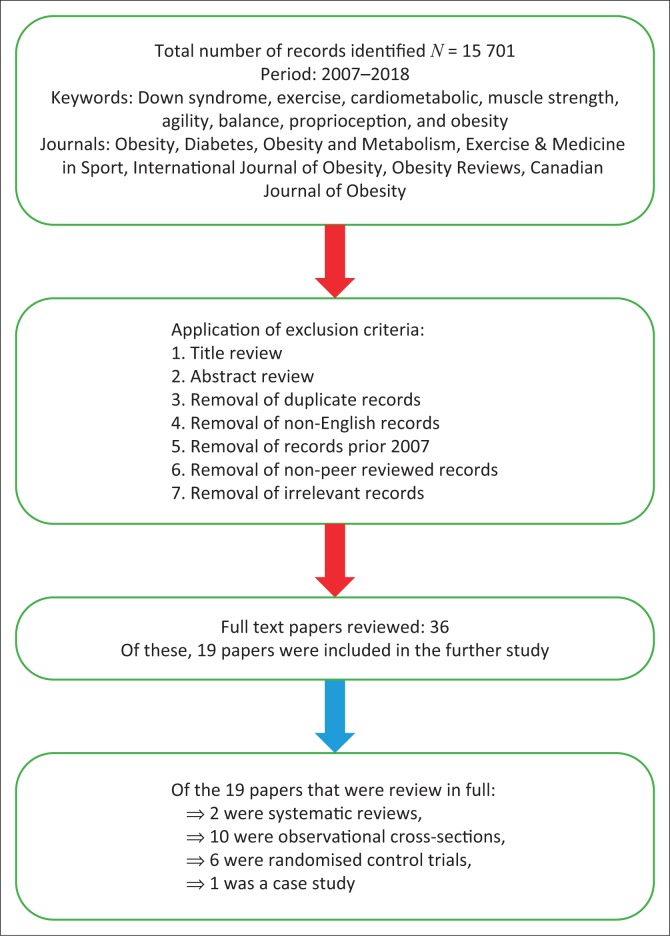
A literature review using the Crossref metadatabase, following Preferred Reporting Items for Systematic Reviews and Meta-Analyses (PRISMA), focusing on the period 2007-2018, was undertaken. Each record was judged adopting the modified Downs and Black Appraisal Scale. The literature investigation identified 15 701 records. Records were excluded if they were published before 2007, pertained to the impact of exercise on intellectual disabilities beyond Down syndrome or the impact of medical, pharmaceutical, nutrition and psychological interventions among PWDS and were published in languages besides English. Nineteen articles were synthesised into this commentary.
PWDS have a heightened cardiometabolic risk profile and high oxidative stress associated with elevated insulin resistance, poor insulin sensitivity, atherosclerosis and hypertension. PWDS have low aerobic capacity (VO), peak heart rates, muscle strength, agility and balance. Regular physical activity is beneficial to improve their VO and muscle strength. Moreover, regular physical activity reduces lipid peroxidation and arterial cell wall damage, the pathogenesis of atheroma is limited.
Exercise therapy compliance seems to have a positive impact on the cardiometabolic risk profile, muscle strength and aerobic work capacity of PWDS. Nonetheless, additional vigorous experimental investigations are necessary to better understand the effect of exercise therapy on the aerobic, strength, proprioception and cardiometabolic risk profile of PWDS.
许多唐氏综合征患者(PWDS)存在不良的心脏代谢风险状况、有氧能力以及虚弱的低张性肌肉,主要原因是缺乏身体活动和饮食不佳。
本研究探讨运动疗法对PWDS的身体成分、有氧能力、肌肉力量、本体感觉和心脏代谢状况的益处。
采用Crossref元数据库进行文献综述,遵循系统评价和Meta分析的首选报告项目(PRISMA),重点关注2007年至2018年期间。每条记录采用改良的唐斯和布莱克评估量表进行评判。文献调查共识别出15701条记录。如果记录发表于2007年之前、涉及运动对唐氏综合征以外的智力残疾的影响、或涉及PWDS中医疗、药物、营养和心理干预的影响,以及以英语以外的语言发表,则将其排除。19篇文章被综合纳入本评论。
PWDS具有更高的心脏代谢风险状况和与胰岛素抵抗升高、胰岛素敏感性差、动脉粥样硬化和高血压相关的高氧化应激。PWDS的有氧能力(VO)、峰值心率、肌肉力量、敏捷性和平衡能力较低。规律的体育活动有利于改善他们的VO和肌肉力量。此外,规律的体育活动可减少脂质过氧化和动脉细胞壁损伤,限制动脉粥样硬化的发病机制。
运动疗法依从性似乎对PWDS的心脏代谢风险状况、肌肉力量和有氧工作能力有积极影响。尽管如此,仍需要更多有力的实验研究,以更好地了解运动疗法对PWDS的有氧、力量、本体感觉和心脏代谢风险状况的影响。