Nagayoshi Sho, Oshima Yoshitake, Ando Takafumi, Aoyama Tomoko, Nakae Satoshi, Usui Chiyoko, Kumagai Shuzo, Tanaka Shigeho
Omron Healthcare Co Ltd, Muko, Japan.
Graduate School of Human-Environment Studies, Kyushu University, Fukuoka, Japan.
BMJ Open Sport Exerc Med. 2019 Oct 28;5(1):e000592. doi: 10.1136/bmjsem-2019-000592. eCollection 2019.
A triaxial accelerometer with an algorithm that could discriminate locomotive and non-locomotive activities in adults has been developed. However, in the elderly, this accelerometer has not yet been validated. The aim were to examine the validity of this accelerometer in the healthy elderly, and to compare the results with those derived in a healthy younger sample.
Twenty-nine healthy elderly subjects aged 60-80 years (Elderly), and 42 adults aged 20-59 years (Younger) participated. All subjects performed 11 activities, including locomotive and non-locomotive activities with a Douglas bag while wearing the accelerometer (Active style Pro HJA-750C). Physical activity intensities were expressed as metabolic equivalents (METs). The relationship between the METs measured using the Douglas bag and METs predicted using the accelerometer was evaluated.
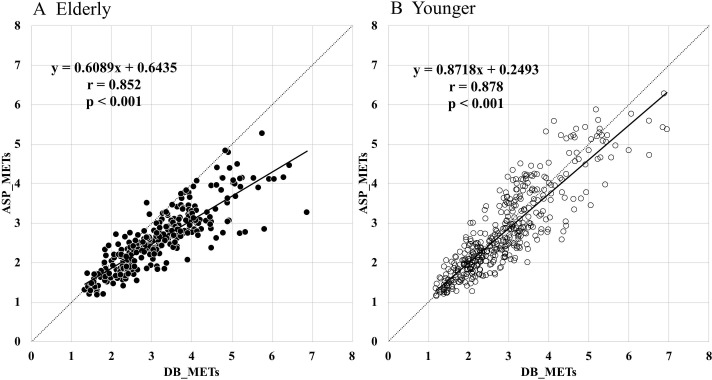
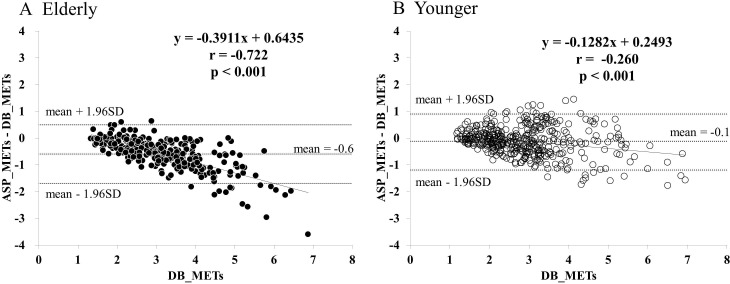
A significant correlation between actual and predicted METs was observed in both Elderly (r=0.85, p<0.001) and Younger (r=0.88, p<0.001). Predicted METs significantly underestimated compared with actual METs in both groups (p<0.001). The mean of the errors was -0.6±0.6 METs in Elderly and -0.1±0.5 METs in Younger. The degree of underestimation increased with increasing METs in Elderly (p<0.001). A stepwise multiple regression analysis revealed that predicted METs, age, and weight were related to actual METs in both groups.
The degree of correlation between predicted and actual METs was comparable in elderly and younger participants, but the prediction errors were greater in elderly participants, particular at higher-intensity activities, which suggests that different predicting equations may be needed for the elderly.
已开发出一种带有算法的三轴加速度计,该算法可区分成年人的 locomotive 和 non-locomotive 活动。然而,在老年人中,这种加速度计尚未得到验证。目的是检验这种加速度计在健康老年人中的有效性,并将结果与健康年轻样本中的结果进行比较。
29 名年龄在 60 - 80 岁的健康老年人(老年组)和 42 名年龄在 20 - 59 岁的成年人(年轻组)参与了研究。所有受试者在佩戴加速度计(Active style Pro HJA - 750C)的情况下,使用道格拉斯袋进行了 11 项活动,包括 locomotive 和 non-locomotive 活动。身体活动强度以代谢当量(METs)表示。评估了使用道格拉斯袋测量的 METs 与使用加速度计预测的 METs 之间的关系。
在老年组(r = 0.85,p < 0.001)和年轻组(r = 0.88,p < 0.001)中,实际 METs 和预测 METs 之间均观察到显著相关性。两组中预测的 METs 均显著低于实际 METs(p < 0.001)。老年组误差均值为 -0.6±0.6 METs,年轻组为 -0.1±0.5 METs。老年组中,低估程度随 METs 增加而增加(p < 0.001)。逐步多元回归分析显示,两组中预测的 METs、年龄和体重均与实际 METs 相关。
老年和年轻参与者中预测 METs 与实际 METs 的相关程度相当,但老年参与者的预测误差更大,尤其是在高强度活动时,这表明老年人可能需要不同的预测方程。