Hedt-Gauthier Bethany L, Jeufack Herve Momo, Neufeld Nicholas H, Alem Atalay, Sauer Sara, Odhiambo Jackline, Boum Yap, Shuchman Miriam, Volmink Jimmy
Department of Global Health and Social Medicine, Harvard Medical School, Boston, Massachusetts, USA.
Accenture Toronto, Toronto, Ontario, Canada.
BMJ Glob Health. 2019 Oct 18;4(5):e001853. doi: 10.1136/bmjgh-2019-001853. eCollection 2019.
Collaborations are often a cornerstone of global health research. Power dynamics can shape if and how local researchers are included in manuscripts. This article investigates how international collaborations affect the representation of local authors, overall and in first and last author positions, in African health research.
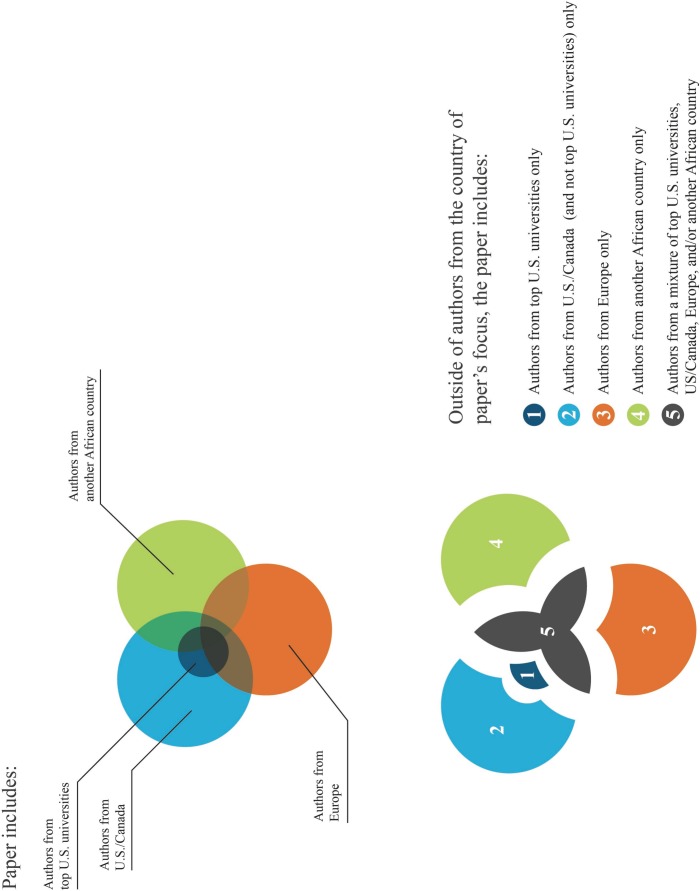
We extracted papers on 'health' in sub-Saharan Africa indexed in PubMed and published between 2014 and 2016. The author's affiliation was used to classify the individual as from the country of the paper's focus, from another African country, from Europe, from the USA/Canada or from another locale. Authors classified as from the USA/Canada were further subclassified if the author was from a top US university. In primary analyses, individuals with multiple affiliations were presumed to be from a high-income country if they contained any affiliation from a high-income country. In sensitivity analyses, these individuals were presumed to be from an African country if they contained any affiliation an African country. Differences in paper characteristics and representation of local coauthors are compared by collaborative type using χ² tests.
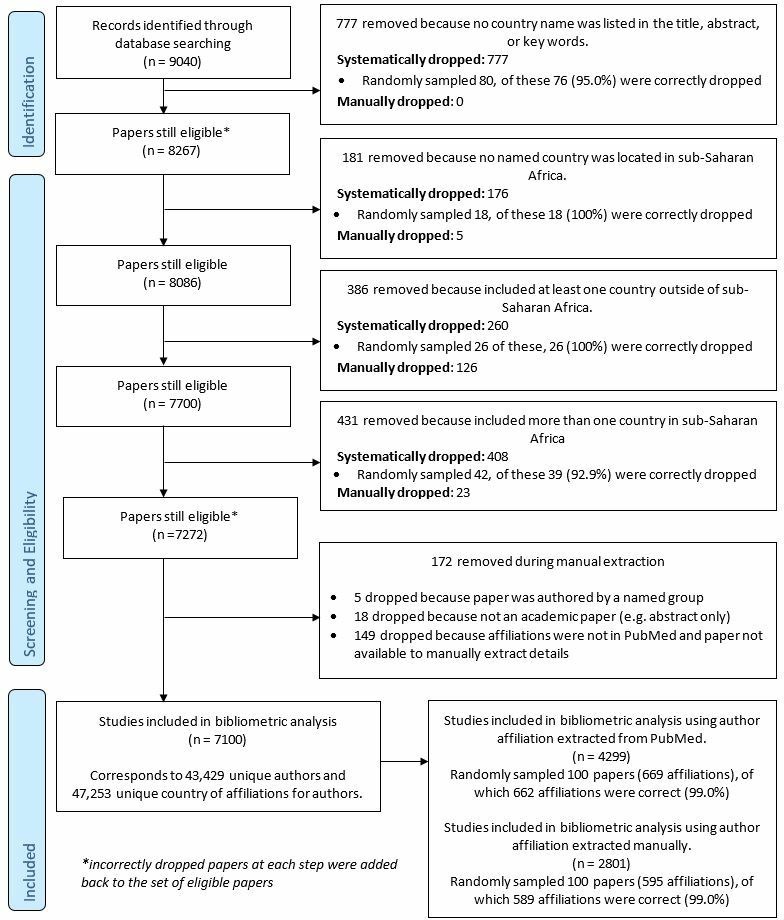
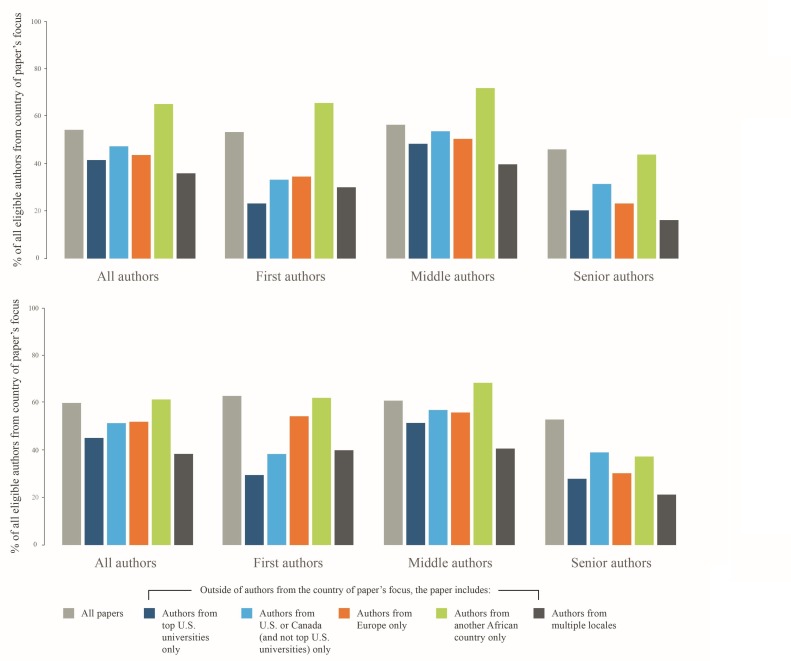
Of the 7100 articles identified, 68.3% included collaborators from the USA, Canada, Europe and/or another African country. 54.0% of all 43 429 authors and 52.9% of 7100 first authors were from the country of the paper's focus. Representation dropped if any collaborators were from USA, Canada or Europe with the lowest representation for collaborators from top US universities-for these papers, 41.3% of all authors and 23.0% of first authors were from country of paper's focus. Local representation was highest with collaborators from another African country. 13.5% of all papers had no local coauthors.
Individuals, institutions and funders from high-income countries should challenge persistent power differentials in global health research. South-South collaborations can help African researchers expand technical expertise while maintaining presence on the resulting research.
合作往往是全球卫生研究的基石。权力动态会影响当地研究人员是否以及如何被纳入论文。本文调查了国际合作如何影响非洲卫生研究中当地作者在整体、第一作者和最后作者位置上的呈现情况。
我们提取了2014年至2016年期间在PubMed上索引的关于撒哈拉以南非洲“卫生”的论文。作者的所属机构被用于将个人分类为来自论文关注国家、来自另一个非洲国家、来自欧洲、来自美国/加拿大或来自其他地区。如果作者来自美国顶尖大学,则将被归类为来自美国/加拿大的作者进一步细分。在初步分析中,如果有多个所属机构的个人包含任何来自高收入国家的所属机构,则假定其来自高收入国家。在敏感性分析中,如果有多个所属机构的个人包含任何来自非洲国家的所属机构,则假定其来自非洲国家。使用χ²检验按合作类型比较论文特征和当地共同作者呈现情况的差异。
在识别出的7100篇文章中,68.3%包括来自美国、加拿大、欧洲和/或另一个非洲国家的合作者。在所有43429名作者中,54.0%以及在7100名第一作者中,52.9%来自论文关注国家。如果有任何合作者来自美国、加拿大或欧洲,呈现比例会下降,来自美国顶尖大学的合作者呈现比例最低——对于这些论文,所有作者的41.3%以及第一作者的23.0%来自论文关注国家。与来自另一个非洲国家的合作者合作时,当地呈现比例最高。13.5%的所有论文没有当地共同作者。
高收入国家的个人、机构和资助者应挑战全球卫生研究中持续存在的权力差异。南南合作可以帮助非洲研究人员扩展技术专长,同时在最终研究中保持参与度。