School of Public Health, Shanghai Jiao Tong University School of Medicine, 227 South Chongqing Road, Huangpu District, Shanghai, 200025, China.
Shanghai Children's Medical Center, Shanghai Jiao Tong University School of Medicine, 1678 Dongfang Road, Pudong District, Shanghai, 200127, China.
BMC Pregnancy Childbirth. 2019 Nov 21;19(1):429. doi: 10.1186/s12884-019-2541-y.
Previous studies suggested that maternal subjective feeling of stress seemed to be involved in the incidence of congenial heart disease in offspring. To better understand the findings, our study would discuss the relationships of maternal exposure to stressful life event and social support, which are more objective and comprehensive indicators of stress, around periconceptional period with the risk of ventricular septal defect (VSD), the most popular subtype of congenital heart disease.
A hospital-based case-control study was conducted through June, 2016 to December, 2017. We collected maternal self-reports of 8 social support questions in 3 aspects and 8 stressful life events among mothers of 202 VSD cases and 262 controls. Social support was categorized into low, medium high, and high (higher is better), and stressful life event was indexed into low, medium low, and high (higher is worse). Logistic regression models were applied to estimate adjusted odds ratios and 95% confidence intervals (95% CI).
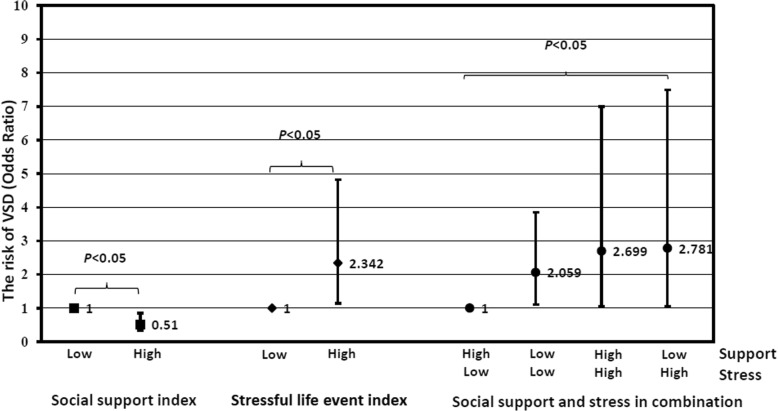
The adjusted odds ratio of high stressful life event was 2.342 (95% CI: 1.348, 4.819) compared with low stressful life event. After crossover analysis, compared with low event & high support, the adjusted odds ratio of low event & low support, high event & high support, and high event & low support were 2.059 (95% CI: 1.104, 3.841), 2.699 (95% CI: 1.042, 6.988) and 2.781 (95% CI: 1.033, 7.489), respectively.
In summary, we observed an increased risk of VSD when pregnant women exposed to stressful life events, however, social support could, to some extent, reduce the risk of stressful life event.
先前的研究表明,母体的主观压力感似乎与后代先天性心脏病的发生有关。为了更好地理解这些发现,我们的研究将讨论母体在围孕期内暴露于应激性生活事件和社会支持(更客观和全面的应激指标)与室间隔缺损(VSD)风险之间的关系,VSD 是最常见的先天性心脏病类型。
我们开展了一项基于医院的病例对照研究,时间为 2016 年 6 月至 2017 年 12 月。我们收集了 202 例 VSD 病例和 262 例对照母亲的 8 个社会支持问题的 3 个方面和 8 个应激性生活事件的自我报告。社会支持分为低、中、高(越高越好),应激性生活事件分为低、中低、高(越高越差)。应用逻辑回归模型估计调整后的比值比和 95%置信区间(95%CI)。
与低应激性生活事件相比,高应激性生活事件的调整后比值比为 2.342(95%CI:1.348,4.819)。经过交叉分析,与低事件高支持相比,低事件低支持、高事件高支持和高事件低支持的调整后比值比分别为 2.059(95%CI:1.104,3.841)、2.699(95%CI:1.042,6.988)和 2.781(95%CI:1.033,7.489)。
综上所述,我们观察到孕妇暴露于应激性生活事件时,VSD 的风险增加,但社会支持在一定程度上可以降低应激性生活事件的风险。