School of Science and Health, Western Sydney University, Sydney, NSW, 2751, Australia.
NICM Health Research Institute, Western Sydney University, Sydney, NSW, 2751, Australia.
BMC Nephrol. 2019 Nov 21;20(1):431. doi: 10.1186/s12882-019-1621-6.
Chronic kidney disease (CKD), including nephrotic syndrome, is a major cause of cardiovascular morbidity and mortality. The literature indicates that CKD is associated with profound lipid disorders due to the dysregulation of lipoprotein metabolism which progresses kidney disease. The objective of this study is to evaluate the protective effects of curcumin on dyslipidaemia associated with adenine-induced chronic kidney disease in rats.
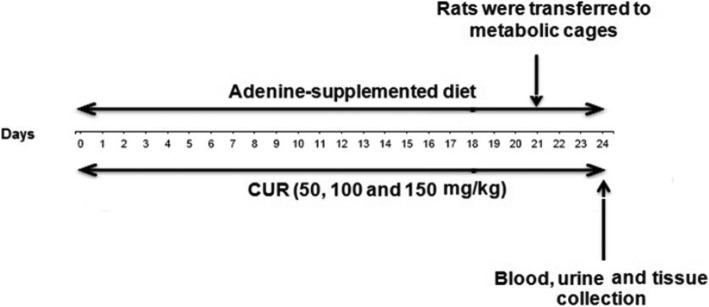
Male SD rats (n = 29) were divided into 5 groups for 24 days: normal control (n = 5, normal diet), CKD control (n = 6, 0.75% w/w adenine-supplemented diet), CUR 50 (n = 6, 50 mg/kg/day curcumin + 0.75% w/w adenine-supplemented diet), CUR 100 (n = 6, 100 mg/kg/day curcumin + 0.75% w/w adenine-supplemented diet), and CUR 150 (n = 6, 150 mg/kg/day curcumin + 0.75% w/w adenine-supplemented diet). The serum and tissue lipid profile, as well as the kidney function test, were measured using commercial diagnostic kits.
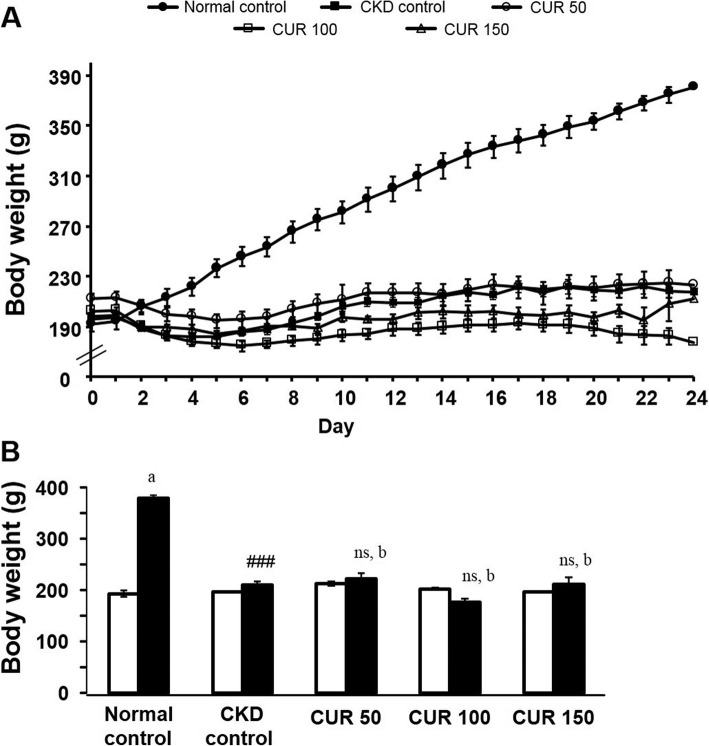
The marked rise in total cholesterol, low-density lipoprotein (LDL) cholesterol, very low-density lipoprotein (VLDL) cholesterol, triglycerides and free fatty acids in serum, as well as hepatic cholesterol, triglyceride and free fatty acids of CKD control rats were significantly protected by curcumin co-treatment (at the dose of 50, 100 and 150 mg/kg). Furthermore, curcumin significantly increased the serum high-density lipoprotein (HDL) cholesterol compared to the CKD control rats but did not attenuate the CKD-induced weight retardation. Mathematical computational analysis revealed that curcumin significantly reduced indicators for the risk of atherosclerotic lesions (atherogenic index) and coronary atherogenesis (coronary risk index). In addition, curcumin improved kidney function as shown by the reduction in proteinuria and improvement in creatinine clearance.
The results provide new scientific evidence for the use of curcumin in CKD-associated dyslipidaemia and substantiates the traditional use of curcumin in preventing kidney damage.
慢性肾病(CKD),包括肾病综合征,是心血管发病率和死亡率的主要原因。文献表明,由于脂蛋白代谢失调,CKD 与严重的脂质紊乱有关,这种失调会导致肾脏疾病的进展。本研究的目的是评估姜黄素对腺嘌呤诱导的大鼠慢性肾病相关血脂异常的保护作用。
雄性 SD 大鼠(n=29)分为 5 组,每组 24 天:正常对照组(n=5,正常饮食)、CKD 对照组(n=6,0.75%w/w 腺嘌呤饮食)、CUR50 组(n=6,50mg/kg/天姜黄素+0.75%w/w 腺嘌呤饮食)、CUR100 组(n=6,100mg/kg/天姜黄素+0.75%w/w 腺嘌呤饮食)和 CUR150 组(n=6,150mg/kg/天姜黄素+0.75%w/w 腺嘌呤饮食)。使用商业诊断试剂盒测量血清和组织脂质谱以及肾功能试验。
CKD 对照组大鼠血清总胆固醇、低密度脂蛋白(LDL)胆固醇、极低密度脂蛋白(VLDL)胆固醇、甘油三酯和游离脂肪酸显著升高,肝胆固醇、甘油三酯和游离脂肪酸也显著升高,而 CUR 联合治疗(50、100 和 150mg/kg)显著保护了这些升高。此外,与 CKD 对照组相比,姜黄素显著增加了血清高密度脂蛋白(HDL)胆固醇,但并未减轻 CKD 引起的体重增长缓慢。数学计算分析表明,姜黄素显著降低了动脉粥样硬化病变(致动脉粥样硬化指数)和冠状动脉粥样形成(冠状动脉风险指数)的风险指标。此外,姜黄素改善了肾功能,表现为蛋白尿减少和肌酐清除率提高。
结果为姜黄素在 CKD 相关血脂异常中的应用提供了新的科学证据,并证实了姜黄素在预防肾脏损伤方面的传统应用。