School of Dentistry, Federal University of Goiás, Praça Universitária, s/n, Faculdade de Odontologia, Setor Universitário, Goiânia-GO, CEP 74605220, Brazil.
BMC Oral Health. 2019 Nov 21;19(1):252. doi: 10.1186/s12903-019-0913-3.
Multimode adhesives incorporate the versatility of adapting to various clinical situations by its capacity to be used in different protocols. This study aimed to evaluate the clinical behavior of composite resin direct restorations (Class I and II) performed with different universal dentin adhesive application protocols comparing adapted FDI and adapted USPHS criteria.
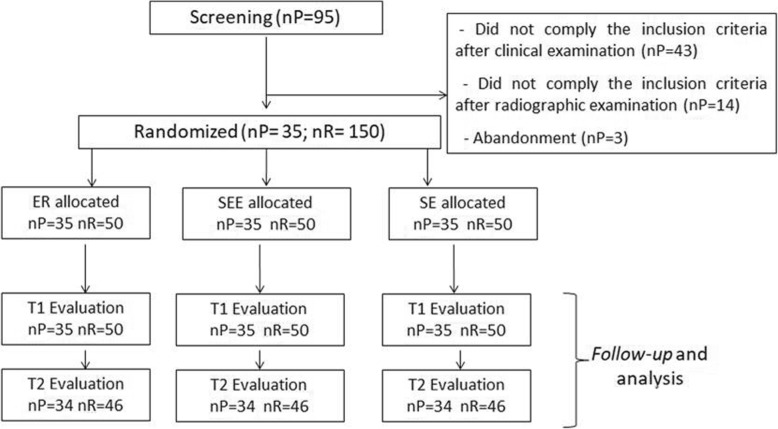
The current study is a randomized, double-blind, split-mouth, and convenience sample controlled clinical trial. The participants (age ≥ 18 years) had restorative need of Class I and/or II due to the presence of carious lesions and/or unsatisfactory restorations in at least three dental elements. Each participant received three application protocols for Scotchbond Universal adhesive (3M ESPE), one in each tooth to be restored: ER = etch-and-rinse + adhesive (n = 50); SEE = selective enamel etch + adhesive (n = 50) and SE = self-etch adhesive (n = 50). All teeth were restored in a similar way using Filtek™ Supreme composite resin (3M ESPE). Restorations were evaluated using the adapted FDI and adapted USPHS criteria, at baseline after 7 to 21 (12.02 ± 5.68) days (T1; n = 50 per group) and after 12 to 20 (15.8 ± 2.7) months (T2; n = 46 per group) by two previously calibrated evaluators (Kappa > 0.80). The statistical tests were performed between groups (Friedman), intragroup (Wilcoxon), and between the criteria considering acceptable and not acceptable restorations (McNemar), α = 0.05.
A statistically significant difference was observed only for the property "superficial staining", between groups at T2 (p = 0.01) for ER (n = 13 with score 2 or more) and SEE (n = 3 with score 2 or more) and intragroup for ER (T1, n = 1 with score 2 or more; T2, n = 13 with score 2 or more, p = 0.001) and SE (T1, n = 0 with score 2 or more; T2, n = 8 with score 2 or more p = 0.007). For the other comparisons between groups, intragroup, and between the adapted FDI and adapted USPHS criteria, there were no statistically significant differences (p ≥ 0.05).
It can be concluded that the different application protocols of the universal adhesive resulted in clinically "acceptable" restorations after 15.8 ± 2.7 months of follow-up. Adapted FDI and adapted USPHS criteria provided similar results to each other.
Number in Brazilian Registry of Clinical Trials (ReBEC): RBR-9p3hdp. Registered 24 May 2015.
多模态胶粘剂通过能够在不同的方案中使用,从而具有适应各种临床情况的多功能性。本研究旨在通过比较适应的 FDI 和适应的 USPHS 标准,评估不同通用牙本质胶粘剂应用方案的复合树脂直接修复(I 类和 II 类)的临床行为。
本研究为随机、双盲、分割口腔和便利样本对照临床试验。参与者(年龄≥18 岁)由于存在龋齿病变和/或至少三个牙齿元素的不满意修复而需要 I 类和/或 II 类修复。每个参与者在要修复的每个牙齿上接受三种 Scotchbond Universal 胶粘剂(3M ESPE)的应用方案:ER(n=50)=蚀刻-冲洗+胶粘剂;SEE(n=50)=选择性牙釉质蚀刻+胶粘剂;SE(n=50)=自酸蚀胶粘剂。所有牙齿均以 Filtek Supreme 复合树脂(3M ESPE)以类似的方式修复。使用适应的 FDI 和适应的 USPHS 标准在基线时(T1;每组 50 个)、7 至 21 天(T1;每组 50 个)和 12 至 20 个月(T2;每组 46 个)后评估修复体。由两位之前经过校准的评估者(Kappa>0.80)进行。对组间(Friedman)、组内(Wilcoxon)和考虑可接受和不可接受修复体的标准之间(McNemar)进行了统计检验,α=0.05。
仅在 T2 时(p=0.01)观察到组间“表面着色”属性存在统计学显著差异(ER 组(n=13 个评分 2 或以上)和 SEE 组(n=3 个评分 2 或以上))和组内 ER(T1,n=1 个评分 2 或以上;T2,n=13 个评分 2 或以上,p=0.001)和 SE(T1,n=0 个评分 2 或以上;T2,n=8 个评分 2 或以上,p=0.007))存在统计学显著差异。对于其他组间、组内和适应的 FDI 与适应的 USPHS 标准之间的比较,无统计学显著差异(p≥0.05)。
可以得出结论,在 15.8±2.7 个月的随访后,通用胶粘剂的不同应用方案产生了临床“可接受”的修复体。适应的 FDI 和适应的 USPHS 标准彼此提供了相似的结果。
巴西临床试验注册处(ReBEC)编号:RBR-9p3hdp。2015 年 5 月 24 日注册。