Population Health Sciences, Bristol Medical School, University of Bristol, Bristol, UK.
Population Health Sciences, Bristol Medical School, University of Bristol, Bristol, UK.
Lancet Infect Dis. 2020 Feb;20(2):240-249. doi: 10.1016/S1473-3099(19)30470-0. Epub 2019 Nov 18.
A 2017 systematic review and meta-analysis of 55 prospective studies found the adjusted risk of HIV acquisition to be at least tripled in individuals with herpes simplex virus type 2 (HSV-2) infection. We aimed to assess the potential contribution of HSV-2 infection to HIV incidence, given an effect of HSV-2 on HIV acquisition.
We used a classic epidemiological formula to estimate the global and regional (WHO regional) population attributable fraction (PAF) and number of incident HIV infections attributable to HSV-2 infection by age (15-24 years, 25-49 years, and 15-49 years), sex, and timing of HSV-2 infection (established vs recently acquired). Estimates were calculated by incorporating HSV-2 and HIV infection data with pooled relative risk (RR) estimates for the effect of HSV-2 infection on HIV acquisition from a systematic review and meta-analysis. Because HSV-2 and HIV have shared sexual and other risk factors, in addition to HSV-related biological factors that increase HIV risk, we only used RR estimates that were adjusted for potential confounders.
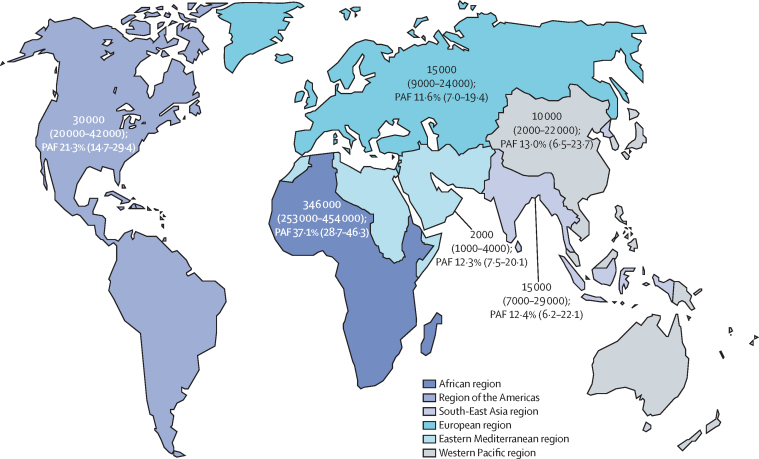
An estimated 420 000 (95% uncertainty interval 317 000-546 000; PAF 29·6% [22·9-37·1]) of 1·4 million sexually acquired incident HIV infections in individuals aged 15-49 years in 2016 were attributable to HSV-2 infection. The contribution of HSV-2 to HIV was largest for the WHO African region (PAF 37·1% [28·7-46·3]), women (34·8% [23·5-45·0]), individuals aged 25-49 years (32·4% [25·4-40·2]), and established HSV-2 infection (26·8% [19·7-34·5]).
A large burden of HIV is likely to be attributable to HSV-2 infection, even if the effect of HSV-2 infection on HIV had been imperfectly measured in studies providing adjusted RR estimates, potentially because of residual confounding. The contribution is likely to be greatest in areas where HSV-2 is highly prevalent, particularly Africa. New preventive interventions against HSV-2 infection could not only improve the quality of life of millions of people by reducing the prevalence of herpetic genital ulcer disease, but could also have an additional, indirect effect on HIV transmission.
WHO.
2017 年一项针对 55 项前瞻性研究的系统评价和荟萃分析发现,单纯疱疹病毒 2 型(HSV-2)感染者感染艾滋病毒的风险至少增加三倍。本研究旨在评估 HSV-2 感染对艾滋病毒发病率的潜在影响,因为 HSV-2 会影响艾滋病毒的获得。
我们使用经典的流行病学公式来估计全球和区域(世界卫生组织区域)的人群归因分数(PAF)和由 HSV-2 感染引起的艾滋病毒感染新发病例数,按年龄(15-24 岁、25-49 岁和 15-49 岁)、性别和 HSV-2 感染时间(已建立和最近获得)进行分层。通过结合 HSV-2 和 HIV 感染数据,并利用系统评价和荟萃分析中关于 HSV-2 感染对 HIV 获得的影响的合并相对风险(RR)估计值,计算了这些估计值。由于 HSV-2 和 HIV 具有共同的性传播和其他危险因素,以及与 HSV 相关的增加 HIV 风险的生物学因素,我们仅使用了针对潜在混杂因素进行了调整的 RR 估计值。
2016 年,在年龄在 15-49 岁的性传播获得性 HIV 感染新发病例中,估计有 42 万例(95%不确定区间为 31.7 万-54.6 万例;PAF 为 29.6%[22.9-37.1%])归因于 HSV-2 感染。HSV-2 对 HIV 的影响在世界卫生组织非洲区域最大(PAF 为 37.1%[28.7-46.3%]),女性(34.8%[23.5-45.0%]),25-49 岁年龄组(32.4%[25.4-40.2%])和已建立的 HSV-2 感染(26.8%[19.7-34.5%])。
即使在为调整后的 RR 估计值提供研究中,HSV-2 感染对 HIV 的影响也没有得到完美测量,那么 HIV 也可能有很大一部分归因于 HSV-2 感染,这可能是因为存在残余混杂因素。在 HSV-2 高度流行的地区,其影响可能最大,特别是在非洲。针对 HSV-2 感染的新预防干预措施不仅可以通过降低疱疹性生殖器溃疡疾病的患病率来提高数百万人的生活质量,而且还可以对 HIV 传播产生额外的间接影响。
世界卫生组织。