Mahmood Mohammed Khalid, Fatih Mohammed Taib, Kurda Handren Ameer, Mahmood Nwsiba Khalid, Shareef Farman Uthman, Faraidun Hemin, Tassery Herve, Tardivo Delphine, Lan Romain, Noori Zana Fuad, Qadir Balen Hamid, Hassan Arman Dlshad
Aix-Marseille University, CNRS, EFS, ADES, Marseille 13000, France.
College of Dentistry, Komar University of Science and technology, Sulaimani 46001, Iraq.
World J Virol. 2024 Dec 25;13(4):99070. doi: 10.5501/wjv.v13.i4.99070.
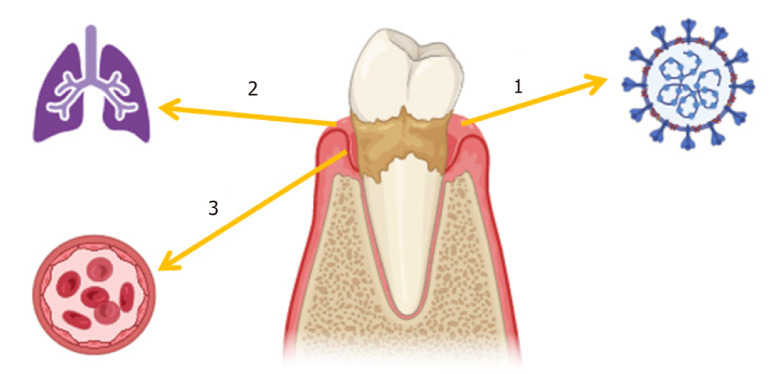
Periodontitis is the inflammation of the supporting structures around the dentition. Several microbial agents, mostly bacteria, have been identified as causative factors for periodontal disease. On the other hand, oral cavity is a rich reservoir for viruses since it contains a wide variety of cell types that can be targeted by viruses. Traditionally, the focus of research about the oral flora has been on bacteria because the most widespread oral diseases, like periodontitis and dental caries, are outcomes of bacterial infection. However, recently and especially after the emergence of coronavirus disease 2019, there is a growing tendency toward including viruses also into the scope of oral microbiome investigations. The global high prevalence of periodontitis and viral infections may point out to a concomitant or synergistic effect between the two. Although the exact nature of the mechanism still is not clearly understood, this could be speculated through the manipulation of the immune system by viruses; hence facilitating the furthermore colonization of the oral tissues by bacteria. This review provides an extensive and detailed update on the role of the most common viruses including herpes family (herpes simplex, varicella-zoster, Epstein-Barr, cytomegalovirus), Human papillomaviruses, Human immunodeficiency virus and severe acute respiratory syndrome coronavirus 2 in the initiation, progression and prognosis of periodontitis.
牙周炎是牙列周围支持组织的炎症。几种微生物因子,主要是细菌,已被确定为牙周病的致病因素。另一方面,口腔是病毒的丰富储存库,因为它包含多种可被病毒靶向的细胞类型。传统上,关于口腔菌群的研究重点一直是细菌,因为最常见的口腔疾病,如牙周炎和龋齿,都是细菌感染的结果。然而,最近,尤其是在2019冠状病毒病出现之后,将病毒也纳入口腔微生物群调查范围的趋势越来越明显。牙周炎和病毒感染在全球的高流行率可能表明两者之间存在协同或增效作用。尽管该机制的确切性质仍不清楚,但可以推测这可能是通过病毒对免疫系统的操纵实现的;从而促进细菌在口腔组织中的进一步定植。本综述广泛而详细地更新了最常见病毒,包括疱疹家族(单纯疱疹病毒、水痘-带状疱疹病毒、爱泼斯坦-巴尔病毒、巨细胞病毒)、人乳头瘤病毒、人类免疫缺陷病毒和严重急性呼吸综合征冠状病毒2在牙周炎的发生、发展和预后中的作用。