Haiminen Niina, Edlund Stefan, Chambliss David, Kunitomi Mark, Weimer Bart C, Ganesan Balasubramanian, Baker Robert, Markwell Peter, Davis Matthew, Huang B Carol, Kong Nguyet, Prill Robert J, Marlowe Carl H, Quintanar André, Pierre Sophie, Dubois Geraud, Kaufman James H, Parida Laxmi, Beck Kristen L
Consortium for Sequencing the Food Supply Chain, San Jose, CA USA.
2IBM T.J. Watson Research Center, Yorktown Heights, NY USA.
NPJ Sci Food. 2019 Nov 19;3:24. doi: 10.1038/s41538-019-0056-6. eCollection 2019.
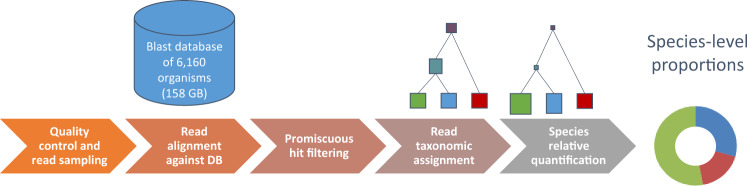
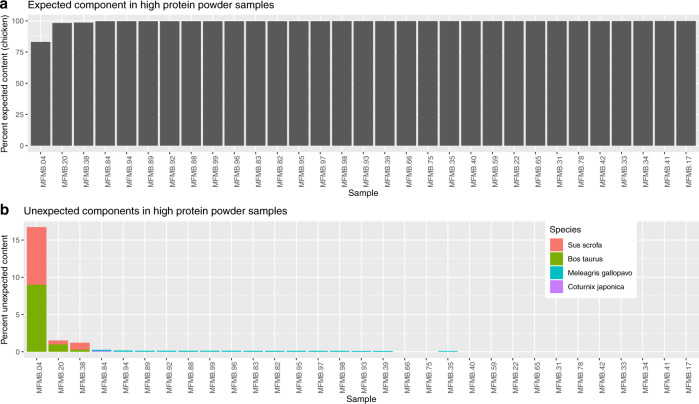
Here we propose that using shotgun sequencing to examine food leads to accurate authentication of ingredients and detection of contaminants. To demonstrate this, we developed a bioinformatic pipeline, FASER (Food Authentication from SEquencing Reads), designed to resolve the relative composition of mixtures of eukaryotic species using RNA or DNA sequencing. Our comprehensive database includes >6000 plants and animals that may be present in food. FASER accurately identified eukaryotic species with 0.4% median absolute difference between observed and expected proportions on sequence data from various sources including sausage meat, plants, and fish. FASER was applied to 31 high protein powder raw factory ingredient total RNA samples. The samples mostly contained the expected source ingredient, chicken, while three samples unexpectedly contained pork and beef. Our results demonstrate that DNA/RNA sequencing of food ingredients, combined with a robust analysis, can be used to find contaminants and authenticate food ingredients in a single assay.
在此我们提出,使用鸟枪法测序来检测食物能够实现成分的准确鉴定以及污染物的检测。为了证明这一点,我们开发了一种生物信息学流程FASER(基于测序读数的食品鉴定),旨在利用RNA或DNA测序解析真核生物物种混合物的相对组成。我们的综合数据库包含可能存在于食物中的6000多种动植物。FASER能够准确鉴定真核生物物种,在来自各种来源(包括香肠肉、植物和鱼类)的序列数据中,观察比例与预期比例之间的中位数绝对差异为0.4%。FASER被应用于31个高蛋白粉末原料工厂成分的总RNA样本。这些样本大多含有预期的来源成分鸡肉,而有三个样本意外地含有猪肉和牛肉。我们的结果表明,食品成分的DNA/RNA测序,结合强大的分析方法,可用于在单一检测中发现污染物并鉴定食品成分。