Emond-Rheault Jean-Guillaume, Jeukens Julie, Freschi Luca, Kukavica-Ibrulj Irena, Boyle Brian, Dupont Marie-Josée, Colavecchio Anna, Barrere Virginie, Cadieux Brigitte, Arya Gitanjali, Bekal Sadjia, Berry Chrystal, Burnett Elton, Cavestri Camille, Chapin Travis K, Crouse Alanna, Daigle France, Danyluk Michelle D, Delaquis Pascal, Dewar Ken, Doualla-Bell Florence, Fliss Ismail, Fong Karen, Fournier Eric, Franz Eelco, Garduno Rafael, Gill Alexander, Gruenheid Samantha, Harris Linda, Huang Carol B, Huang Hongsheng, Johnson Roger, Joly Yann, Kerhoas Maud, Kong Nguyet, Lapointe Gisèle, Larivière Line, Loignon Stéphanie, Malo Danielle, Moineau Sylvain, Mottawea Walid, Mukhopadhyay Kakali, Nadon Céline, Nash John, Ngueng Feze Ida, Ogunremi Dele, Perets Ann, Pilar Ana V, Reimer Aleisha R, Robertson James, Rohde John, Sanderson Kenneth E, Song Lingqiao, Stephan Roger, Tamber Sandeep, Thomassin Paul, Tremblay Denise, Usongo Valentine, Vincent Caroline, Wang Siyun, Weadge Joel T, Wiedmann Martin, Wijnands Lucas, Wilson Emily D, Wittum Thomas, Yoshida Catherine, Youfsi Khadija, Zhu Lei, Weimer Bart C, Goodridge Lawrence, Levesque Roger C
Institute for Integrative and Systems Biology, Université Laval, Québec CityQC, Canada.
McGill University, MontréalQC, Canada.
Front Microbiol. 2017 Jun 2;8:996. doi: 10.3389/fmicb.2017.00996. eCollection 2017.
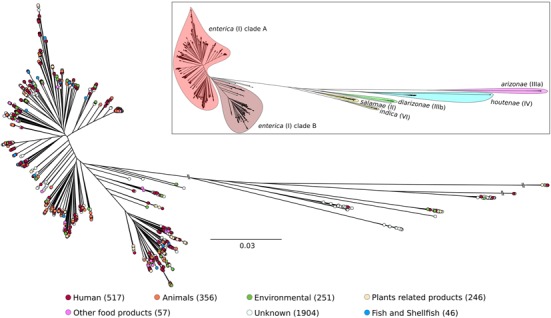
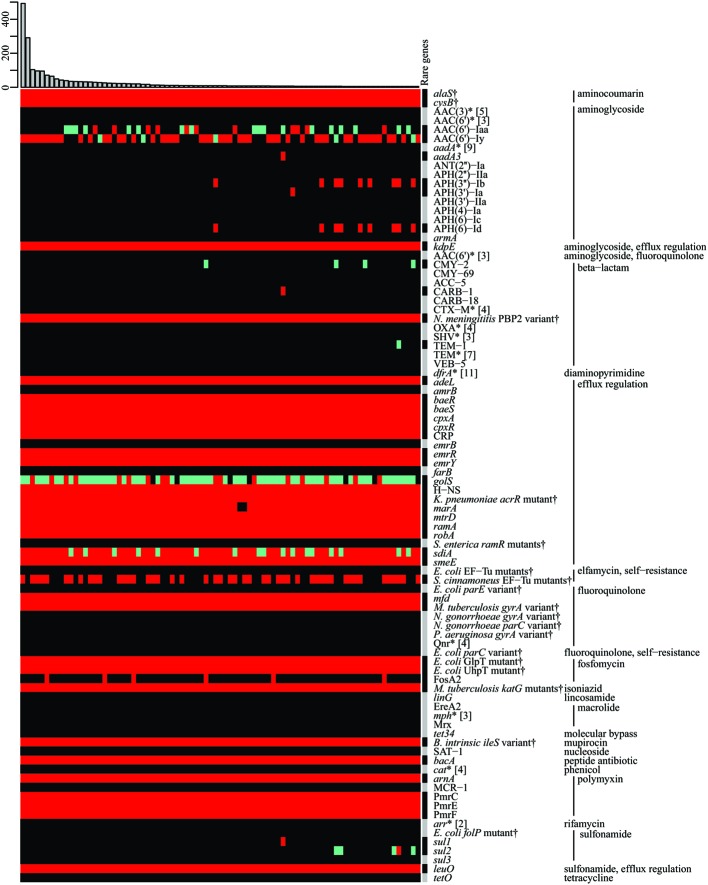
The Syst-OMICS consortium is sequencing 4,500 genomes and building an analysis pipeline for the study of genome evolution, antibiotic resistance and virulence genes. Metadata, including phenotypic as well as genomic data, for isolates of the collection are provided through the Foodborne Syst-OMICS database (SalFoS), at https://salfos.ibis.ulaval.ca/. Here, we present our strategy and the analysis of the first 3,377 genomes. Our data will be used to draw potential links between strains found in fresh produce, humans, animals and the environment. The ultimate goals are to understand how evolves over time, improve the accuracy of diagnostic methods, develop control methods in the field, and identify prognostic markers for evidence-based decisions in epidemiology and surveillance.
系统组学联盟正在对4500个基因组进行测序,并构建一个用于研究基因组进化、抗生素耐药性和毒力基因的分析流程。通过位于https://salfos.ibis.ulaval.ca/的食源性病原体系统组学数据库(SalFoS),提供了该集合中分离株的元数据,包括表型数据和基因组数据。在这里,我们展示了我们的策略以及对前3377个基因组的分析。我们的数据将用于建立在新鲜农产品、人类、动物和环境中发现的菌株之间的潜在联系。最终目标是了解[此处原文缺失相关内容]如何随时间演变,提高诊断方法的准确性,开发现场控制方法,并识别用于流行病学和监测中基于证据决策的预后标志物。