LBE, Univ Montpellier, INRA, Narbonne, France.
Faculty of Engineering and Natural Sciences, Tampere University, Tampere, Finland.
Appl Microbiol Biotechnol. 2020 Jan;104(1):439-449. doi: 10.1007/s00253-019-10203-8. Epub 2019 Nov 21.
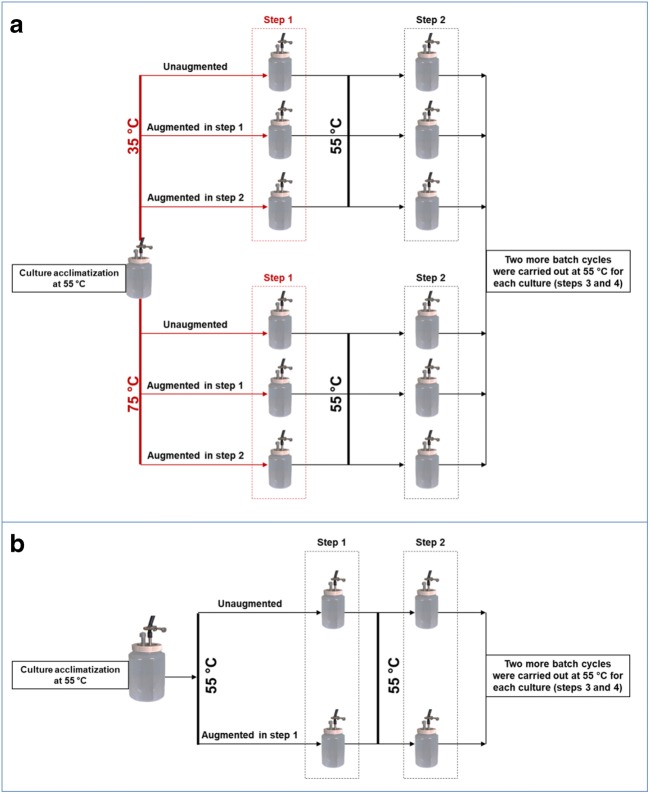
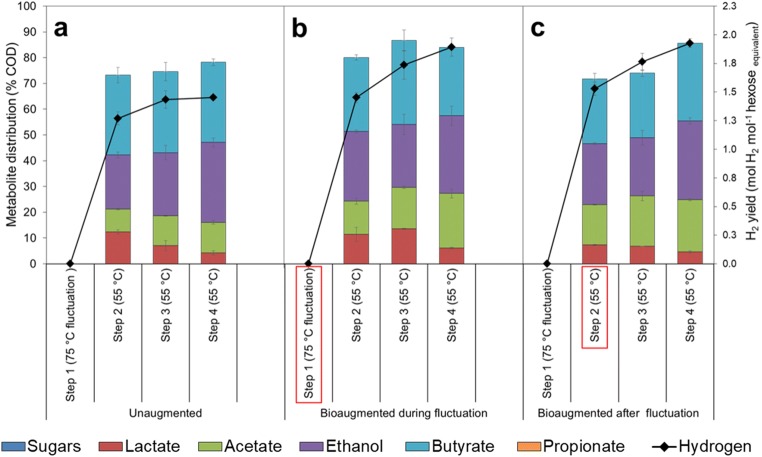
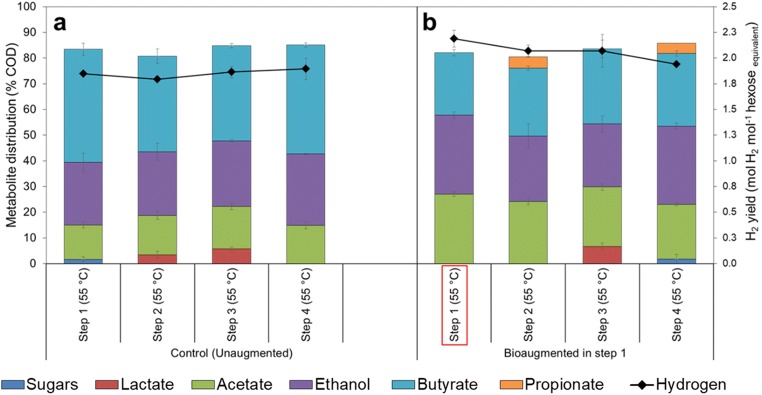
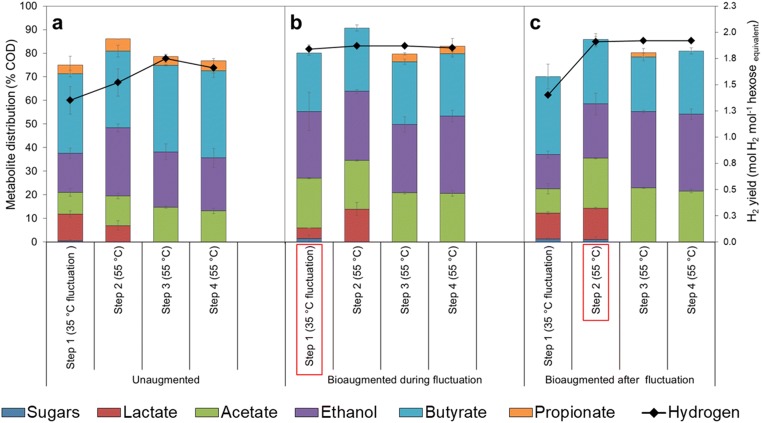
Hydrogen-producing mixed cultures were subjected to a 48-h downward or upward temperature fluctuation from 55 to 35 or 75 °C. Hydrogen production was monitored during the fluctuations and for three consecutive batch cultivations at 55 °C to evaluate the impact of temperature fluctuations and bioaugmentation with synthetic mixed culture of known H producers either during or after the fluctuation. Without augmentation, H production was significantly reduced during the downward temperature fluctuation and no H was produced during the upward fluctuation. H production improved significantly during temperature fluctuation when bioaugmentation was applied to cultures exposed to downward or upward temperatures. However, when bioaugmentation was applied after the fluctuation, i.e., when the cultures were returned to 55 °C, the H yields obtained were between 1.6 and 5% higher than when bioaugmentation was applied during the fluctuation. Thus, the results indicate the usefulness of bioaugmentation in process recovery, especially if bioaugmentation time is optimised.
产氢混合培养物经历了 48 小时从 55°C 到 35°C 或 75°C 的向下或向上温度波动。在波动过程中和在 55°C 下连续进行三个批次培养过程中监测了氢气产生情况,以评估温度波动的影响和通过在波动过程中或之后用已知的产氢合成混合培养物进行生物强化。没有进行生物强化时,向下温度波动过程中氢气产量显著降低,向上波动过程中则没有产生氢气。当应用于经历向下或向上温度的培养物时,温度波动过程中进行生物强化可以显著提高氢气产量。然而,当在波动后(即当培养物返回 55°C 时)进行生物强化时,与在波动过程中进行生物强化相比,获得的氢气产率提高了 1.6%至 5%之间。因此,结果表明生物强化在过程恢复中的有用性,特别是如果优化了生物强化时间。