Department of Chemistry, University of Zurich, Winterthurerstrasse 190, 8057, Zurich, Switzerland.
Institute of Biophysical Chemistry and Center for Biomolecular Magnetic Resonance, Goethe University Frankfurt, Max-von-Laue-Straße 9, 60438, Frankfurt am Main, Germany.
J Biomol NMR. 2020 Jan;74(1):45-60. doi: 10.1007/s10858-019-00289-7. Epub 2019 Nov 21.
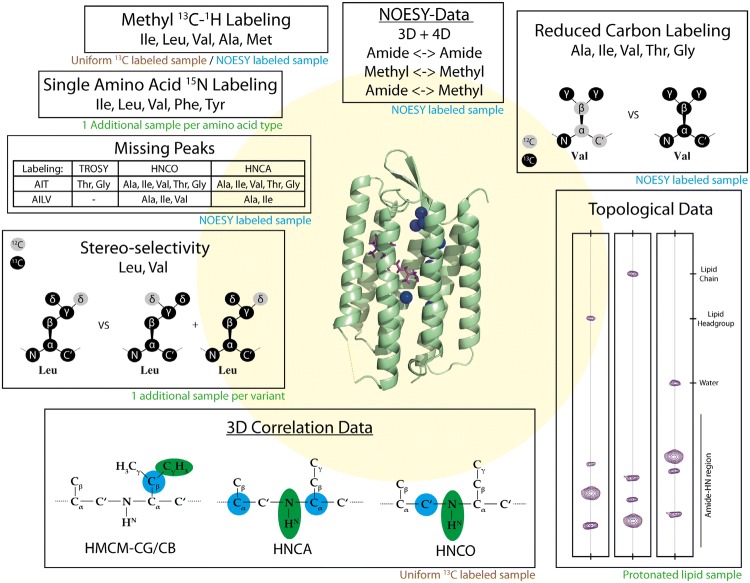
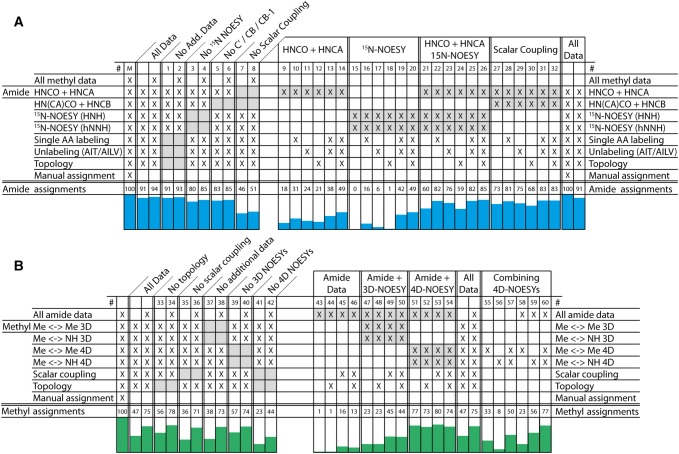
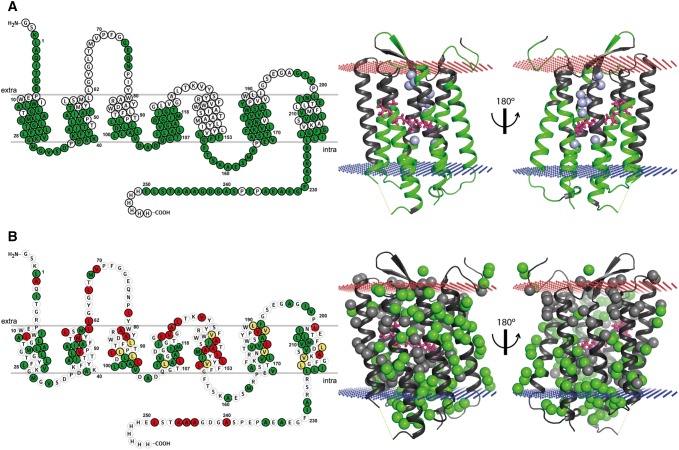
Resonance assignments are challenging for membrane proteins due to the size of the lipid/detergent-protein complex and the presence of line-broadening from conformational exchange. As a consequence, many correlations are missing in the triple-resonance NMR experiments typically used for assignments. Herein, we present an approach in which correlations from these solution-state NMR experiments are supplemented by data from C unlabeling, single-amino acid type labeling, 4D NOESY data and proximity of moieties to lipids or water in combination with a structure of the protein. These additional data are used to edit the expected peaklists for the automated assignment protocol FLYA, a module of the program package CYANA. We demonstrate application of the protocol to the 262-residue proton pump from archaeal bacteriorhodopsin (bR) in lipid nanodiscs. The lipid-protein assembly is characterized by an overall correlation time of 44 ns. The protocol yielded assignments for 62% of all backbone (H, N, C, C, C') resonances of bR, corresponding to 74% of all observed backbone spin systems, and 60% of the Ala, Met, Ile (δ1), Leu and Val methyl groups, thus enabling to assign a large fraction of the protein without mutagenesis data. Most missing resonances stem from the extracellular half, likely due intermediate exchange line-broadening. Further analysis revealed that missing information of the amino acid type of the preceding residue is the largest problem, and that 4D NOESY experiments are particularly helpful to compensate for that information loss.
由于脂质/去污剂-蛋白质复合物的大小以及构象交换引起的谱线增宽,膜蛋白的共振分配具有挑战性。因此,在通常用于分配的三共振 NMR 实验中,许多相关信息缺失。在此,我们提出了一种方法,通过来自这些溶液态 NMR 实验的相关信息,辅以 C 未标记、单氨基酸类型标记、4D NOESY 数据以及部分与脂质或水的接近度,并结合蛋白质结构,来补充数据。这些附加数据用于编辑自动分配协议 FLYA 的预期峰列表,该协议是程序包 CYANA 的一个模块。我们证明了该协议在脂质纳米盘中古菌菌视紫红质(bR)的 262 残基质子泵中的应用。脂质-蛋白质组装的整体相关时间为 44ns。该方案产生了 bR 所有骨架(H、N、C、C、C')共振的 62%的分配,对应于所有观察到的骨架自旋系统的 74%,以及 Ala、Met、Ile(δ1)、Leu 和 Val 甲基的 60%,从而能够在没有诱变数据的情况下分配很大一部分蛋白质。大多数缺失的共振源于细胞外半部分,可能是由于中间交换线增宽所致。进一步分析表明,缺失的前一个残基的氨基酸类型信息是最大的问题,并且 4D NOESY 实验特别有助于弥补该信息的缺失。