Division of Infectious Diseases, Department of Pediatrics, McGovern Medical School, Houston, TX, USA.
Center for Antimicrobial Resistance and Microbial Genomics, University of Texas Health Sciences Center at Houston, Houston, TX, USA.
Microb Genom. 2019 Nov;5(11). doi: 10.1099/mgen.0.000316.
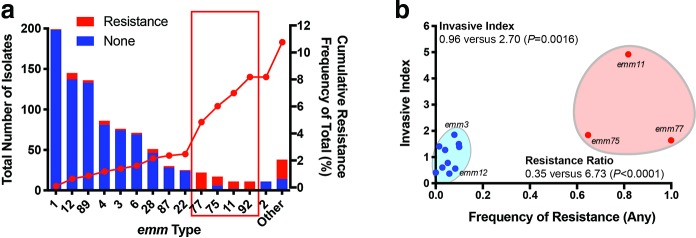
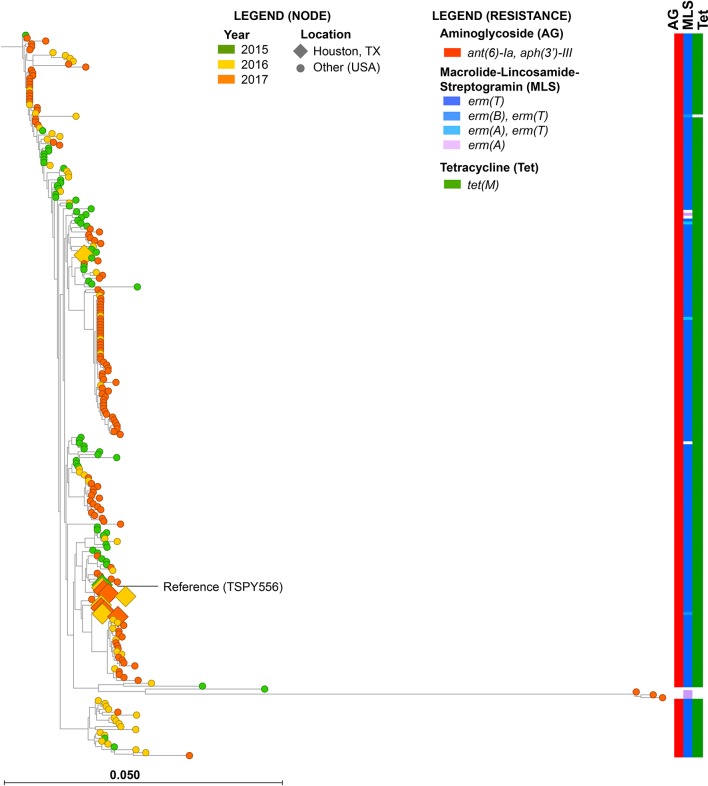
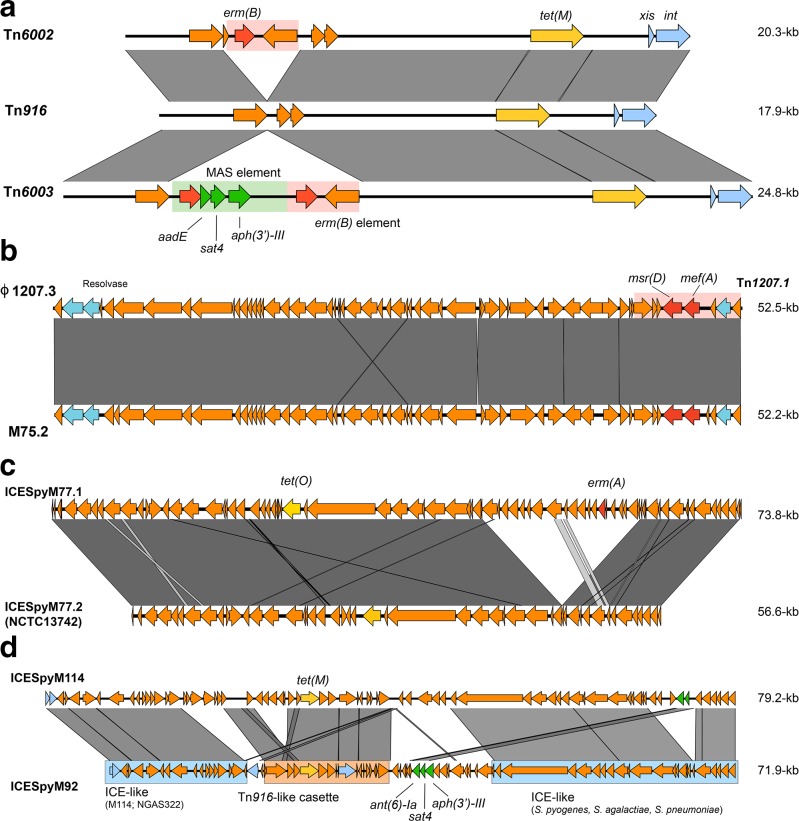
Despite universal susceptibility to β-lactams, resistance to second-line antimicrobials (e.g. erythromycin) is increasingly common among group A (GAS). To better understand the frequency of regional GAS antimicrobial resistance, we screened a previously described GAS strain collection from Houston, TX, USA, for resistance to commonly used antimicrobials. A total of 100/929 (10.8 %) showed resistance to at least one antimicrobial. Tetracycline resistance was identified in 52 (5.6 %) GAS strains. The cumulative frequency of erythromycin and clindamycin resistance [macrolide (M) and macrolide-lincosamide-streptogramin (MLS) phenotypes] was greatest among invasive GAS strains (9.9 %) compared to that of strains derived from any other infection type (5.9 %, =0.045). We identified types 11, 75, 77 and 92 as the only types with high (e.g. >50 %) within- type resistance and contributing to the majority (24/26; 92 %) of erythromycin/clindamycin resistance in invasive GAS. High-frequency resistance types were also significantly overrepresented in invasive GAS strains as indicated by invasive index. We performed whole-genome sequencing to define genetic elements associated with resistance among types 11, 75, 77 and 92. Diverse mobile elements contributed to GAS resistance including transposons, integrative conjugative elements, prophage and a plasmid. Phylogenetic analysis suggests recent clonal emergence of GAS strains. Our findings indicate that less frequently encountered GAS types disproportionately contribute to resistance phenotypes, are defined by diverse mobile genetic elements and may favour invasive disease.
尽管普遍易受β-内酰胺类抗生素影响,但 A 组链球菌(GAS)对二线抗菌药物(如红霉素)的耐药性日益常见。为了更好地了解区域性 GAS 抗菌药物耐药性的频率,我们筛选了来自美国德克萨斯州休斯顿的一个先前描述的 GAS 菌株库,以检测其对常用抗菌药物的耐药性。共有 100/929(10.8%)株至少对一种抗菌药物表现出耐药性。52 株(5.6%)GAS 菌株对四环素耐药。与其他任何感染类型(5.9%,=0.045)相比,侵袭性 GAS 菌株的红霉素和克林霉素耐药率(大环内酯(M)和大环内酯-林可酰胺-链阳性菌素(MLS)表型)最高(9.9%)。我们发现 11 型、75 型、77 型和 92 型是唯一具有高(例如>50%)同种内耐药性的 型,并且导致大多数(24/26;92%)侵袭性 GAS 的红霉素/克林霉素耐药。高频率耐药 型在侵袭性 GAS 菌株中也显著过表达,这表明侵袭指数。我们进行了全基因组测序,以确定与 11 型、75 型、77 型和 92 型耐药相关的遗传元件。多样化的移动元件导致 GAS 耐药,包括转座子、整合性 conjugative 元件、噬菌体和质粒。系统发育分析表明,GAS 菌株最近出现了克隆性进化。我们的研究结果表明,较少见的 GAS 型不成比例地导致耐药表型,由多样化的移动遗传元件定义,并且可能有利于侵袭性疾病。