Beijing Neurosurgical Institute, Beijing Tiantan Hospital, Capital Medical University, Beijing, China.
Beijing Municipal Key Laboratory of Clinical Epidemiology, Beijing, China.
Sci Rep. 2019 Nov 22;9(1):17330. doi: 10.1038/s41598-019-53848-1.
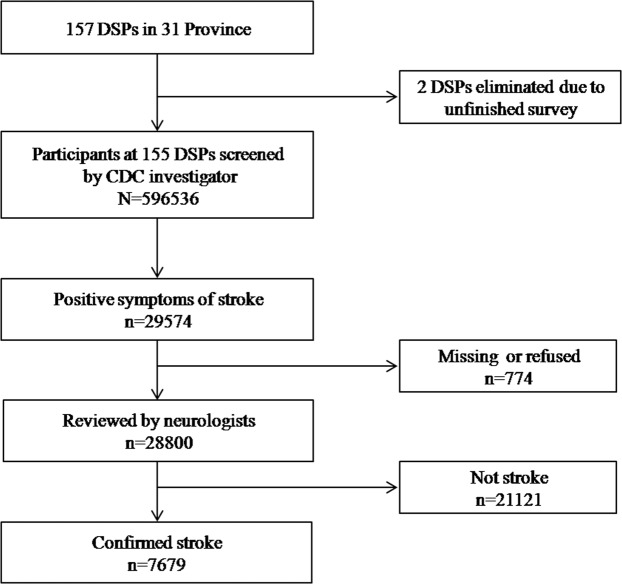
Accurate and up-to-date provincial and regional-level stroke prevalence estimates are important for research planning and targeted strategies for stroke prevention and management. However, recent and comprehensive evaluation is lacking over the past 30 years in China. This study aimed to examine the geographical variations in stroke prevalence based on data from the National Epidemiological Survey of Stroke in China (NESS-China) and demonstrate urban-rural transition and trend over three decades. The stroke prevalence (prevalence day, August 31, 2013) was estimated using the world standard population. The stroke prevalence was 873.4 per 100,000 population, and varied from 218.0 in Sichuan to 1768.9 in Heilongjiang. Stroke prevalence exhibited a noticeable north-south gradient (1097.1, 917.7, and 619.4 in the north, middle, and the south, respectively; P < 0.001) and showed a 2.0-fold, 1.5-fold, and 1.2-fold increase in rural areas in the north, the middle, and the south, respectively, from 1985 to 2013. Overall, stroke prevalence was higher in the rural regions than in the urban (945.4 versus 797.5, P < 0.001) regions. However, the converse was depicted in 12 provinces. A noticeable geographical variation in stroke prevalence was observed and was evolving overtime in China. It is imperative that effective public health policies and interventions be implemented, especially in those regions with higher prevalence.
准确且最新的省级和地区卒中患病率估计对于研究规划和有针对性的卒中预防及管理策略至关重要。然而,中国近 30 年来缺乏最新且全面的评估。本研究旨在基于中国国家卒中流行病学调查(NESS-China)的数据,检验卒中患病率的地理差异,并展示 30 年来的城乡转变和趋势。采用世界标准人口来估计卒中患病率(患病率日为 2013 年 8 月 31 日)。卒中患病率为 873.4/100000 人口,从四川的 218.0 到黑龙江的 1768.9 不等。卒中患病率呈现显著的南北梯度(北部、中部和南部分别为 1097.1、917.7 和 619.4;P<0.001),且从 1985 年到 2013 年,农村地区的患病率分别增加了 2.0 倍、1.5 倍和 1.2 倍。总体而言,农村地区的卒中患病率高于城市地区(945.4 比 797.5,P<0.001)。然而,在 12 个省份却呈现相反的情况。中国的卒中患病率存在显著的地理差异,且随着时间的推移呈演变趋势。必须实施有效的公共卫生政策和干预措施,特别是在那些患病率较高的地区。