Department of Botany and Plant Pathology and the Purdue Center for Plant Biology, Purdue University, West Lafayette, IN, USA.
MSU-DOE Plant Research Laboratory and the Plant Resilience Institute, Michigan State University, East Lansing, MI, USA.
Am J Bot. 2020 Feb;107(2):250-261. doi: 10.1002/ajb2.1385. Epub 2019 Nov 24.
Despite myriad examples of local adaptation, the phenotypes and genetic variants underlying such adaptive differentiation are seldom known. Recent work on freezing tolerance and local adaptation in ecotypes of Arabidopsis thaliana from Italy and Sweden provides an essential foundation for uncovering the genotype-phenotype-fitness map for an adaptive response to a key environmental stress.
We examined the consequences of a naturally occurring loss-of-function (LOF) mutation in an Italian allele of the gene that encodes the transcription factor CBF2, which underlies a major freezing-tolerance locus. We used four lines with a Swedish genetic background, each containing a LOF CBF2 allele. Two lines had introgression segments containing the Italian CBF2 allele, and two contained deletions created using CRISPR-Cas9. We used a growth chamber experiment to quantify freezing tolerance and gene expression before and after cold acclimation.
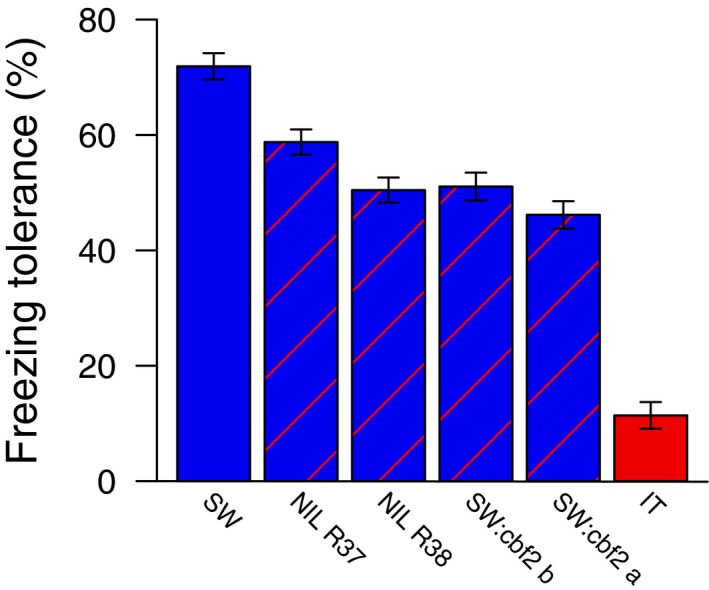
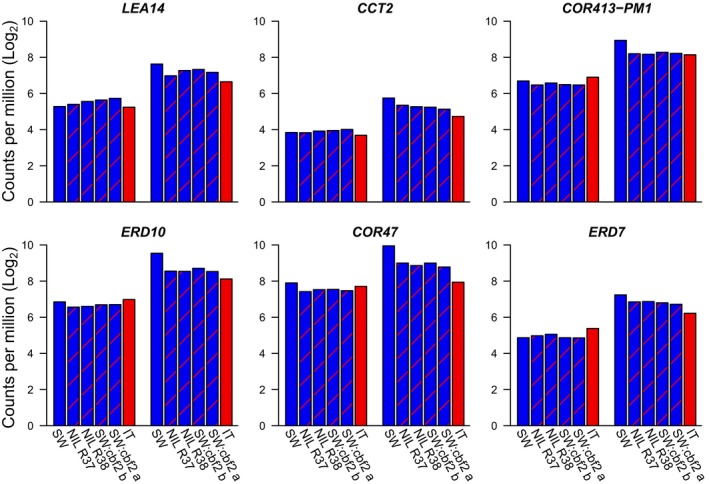
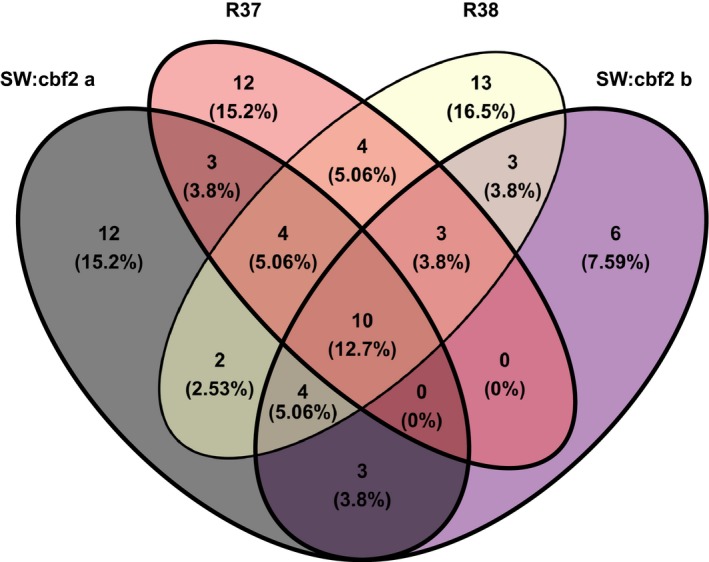
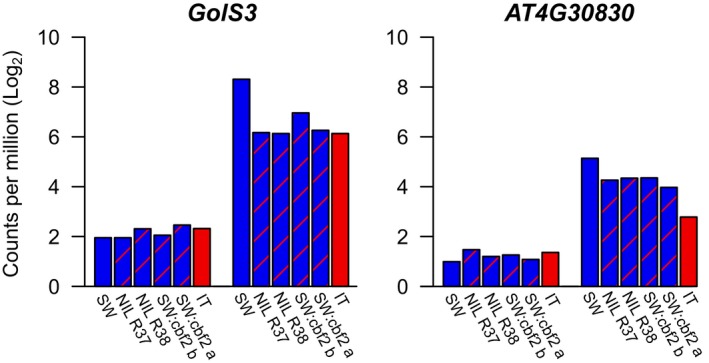
Freezing tolerance was lower in the Italian (11%) compared to the Swedish (72%) ecotype, and all four experimental CBF2 LOF lines had reduced freezing tolerance compared to the Swedish ecotype. Differential expression analyses identified 10 genes for which all CBF2 LOF lines, and the IT ecotype had similar patterns of reduced cold responsive expression compared to the SW ecotype.
We identified 10 genes that are at least partially regulated by CBF2 that may contribute to the differences in cold-acclimated freezing tolerance between the Italian and Swedish ecotypes. These results provide novel insight into the molecular and physiological mechanisms connecting a naturally occurring sequence polymorphism to an adaptive response to freezing conditions.
尽管有无数地方适应的例子,但很少知道导致这种适应性分化的表型和遗传变异。最近关于来自意大利和瑞典的拟南芥生态型的抗冻性和地方适应的研究为揭示适应关键环境胁迫的基因型-表型-适应性图谱提供了重要基础。
我们研究了在编码转录因子 CBF2 的基因的意大利等位基因中自然发生的功能丧失(LOF)突变的后果,该等位基因是一个主要的抗冻性位点的基础。我们使用了四个具有瑞典遗传背景的品系,每个品系都含有一个 LOF CBF2 等位基因。两个品系具有包含意大利 CBF2 等位基因的基因渗入片段,而两个品系则含有使用 CRISPR-Cas9 创建的缺失。我们使用生长室实验在冷驯化前后量化了抗冻性和基因表达。
意大利(11%)生态型的抗冻性低于瑞典(72%)生态型,与瑞典生态型相比,所有四个实验性 CBF2 LOF 品系的抗冻性都降低了。差异表达分析确定了 10 个基因,所有 CBF2 LOF 品系和 IT 生态型与 SW 生态型相比,冷响应表达的模式相似。
我们确定了 10 个至少部分受 CBF2 调控的基因,这些基因可能有助于解释意大利和瑞典生态型之间冷驯化抗冻性的差异。这些结果为连接自然发生的序列多态性与对冷冻条件的适应性反应的分子和生理机制提供了新的见解。