New York City Department of Health and Mental Hygiene, New York, New York.
New York University School of Medicine, New York.
Arthritis Rheumatol. 2020 May;72(5):849-859. doi: 10.1002/art.41175. Epub 2020 Apr 1.
Autoimmune disease is an emerging condition among persons exposed to the September 11, 2001 attack on the World Trade Center (WTC). Components of the dust cloud resulting from the collapse of the WTC have been associated with development of a systemic autoimmune disease, as has posttraumatic stress disorder (PTSD). We undertook this study to determine whether dust exposure and PTSD were associated with an increased risk of systemic autoimmune disease in a 9/11-exposed cohort.
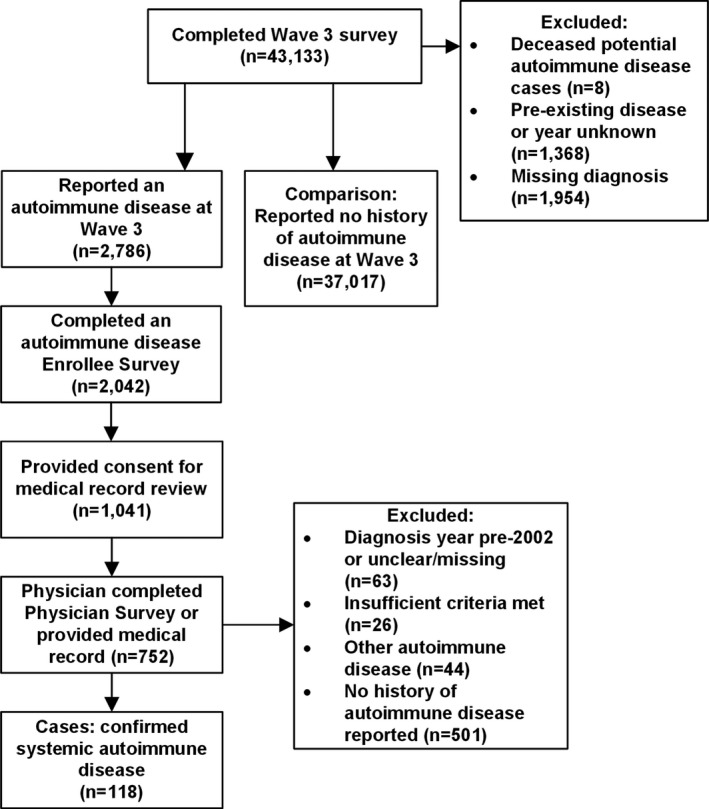
Among 43,133 WTC Health Registry enrollees, 2,786 self-reported having a post-9/11 systemic autoimmune disease. We obtained informed consent to review medical records to validate systemic autoimmune disease diagnoses for 1,041 enrollees. Diagnoses of systemic autoimmune diseases were confirmed by classification criteria, rheumatologist diagnosis, or having been prescribed systemic autoimmune disease medication. Controls were enrollees who denied having an autoimmune disease diagnosis (n = 37,017). We used multivariable log-binomial regression to examine the association between multiple 9/11 exposures and risk of post-9/11 systemic autoimmune disease, stratifying by responders (rescue, recovery, and clean-up workers) and community members (e.g., residents, area workers).
We identified 118 persons with systemic autoimmune disease. Rheumatoid arthritis was most frequent (n = 71), followed by Sjӧgren's syndrome (n = 22), systemic lupus erythematosus (n = 20), myositis (n = 9), mixed connective tissue disease (n = 7), and scleroderma (n = 4). Among 9/11 responders, those with intense dust cloud exposure had almost twice the risk of systemic autoimmune disease (adjusted risk ratio 1.86 [95% confidence interval 1.02-3.40]). Community members with PTSD had a nearly 3-fold increased risk of systemic autoimmune disease.
Intense dust cloud exposure among responders and PTSD among community members were associated with a statistically significant increased risk of new-onset systemic autoimmune disease. Clinicians treating 9/11 survivors should be aware of the potential increased risk of systemic autoimmune disease in this population.
自身免疫性疾病是暴露于 2001 年 9 月 11 日袭击世界贸易中心(WTC)的人群中出现的一种新兴疾病。WTC 倒塌产生的尘云的成分与全身性自身免疫性疾病的发生有关,创伤后应激障碍(PTSD)也是如此。我们进行这项研究是为了确定在 9/11 暴露人群中,灰尘暴露和 PTSD 是否与全身性自身免疫性疾病的风险增加有关。
在 43133 名 WTC 健康登记处的参与者中,有 2786 人自报在 9/11 后患有全身性自身免疫性疾病。我们获得了知情同意,以审查医疗记录,以验证 1041 名参与者的全身性自身免疫性疾病诊断。通过分类标准、风湿病学家诊断或开出处方自身免疫性疾病药物来确认自身免疫性疾病的诊断。对照组为否认自身免疫性疾病诊断的参与者(n=37017)。我们使用多变量对数二项式回归来检查多种 9/11 暴露与 9/11 后全身性自身免疫性疾病风险之间的关联,按应答者(救援、恢复和清理人员)和社区成员(例如,居民、地区工人)进行分层。
我们发现了 118 名患有全身性自身免疫性疾病的患者。类风湿关节炎最为常见(n=71),其次是干燥综合征(n=22)、系统性红斑狼疮(n=20)、肌炎(n=9)、混合性结缔组织病(n=7)和硬皮病(n=4)。在 9/11 应答者中,尘云暴露强烈的人患全身性自身免疫性疾病的风险几乎增加了一倍(调整后的风险比 1.86[95%置信区间 1.02-3.40])。社区中患有 PTSD 的人患全身性自身免疫性疾病的风险增加了近 3 倍。
应答者中尘云暴露强烈以及社区成员中 PTSD 与新发性全身性自身免疫性疾病的风险显著增加相关。治疗 9/11 幸存者的临床医生应意识到该人群中全身性自身免疫性疾病的潜在风险增加。