Zhang Shi-Chao, Hu Zu-Quan, Long Jin-Hua, Zhu Gui-Ming, Wang Yun, Jia Yi, Zhou Jing, Ouyang Yan, Zeng Zhu
Immune Cells and Antibody Engineering Research Center of Guizhou Province, Key Laboratory of Biology and Medical Engineering, Guizhou Medical University, Guiyang 550025, China.
Engineering Research Center of Medical Biotechnology, School of Biology and Engineering, Guizhou Medical University, Guiyang 550025, China.
J Cancer. 2019 Oct 15;10(24):6175-6184. doi: 10.7150/jca.35901. eCollection 2019.
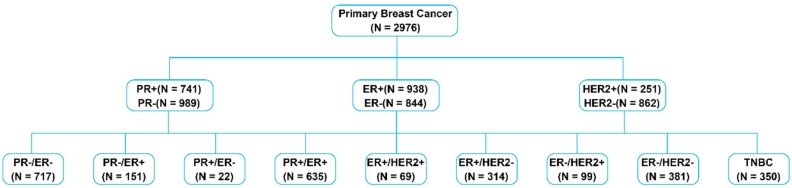
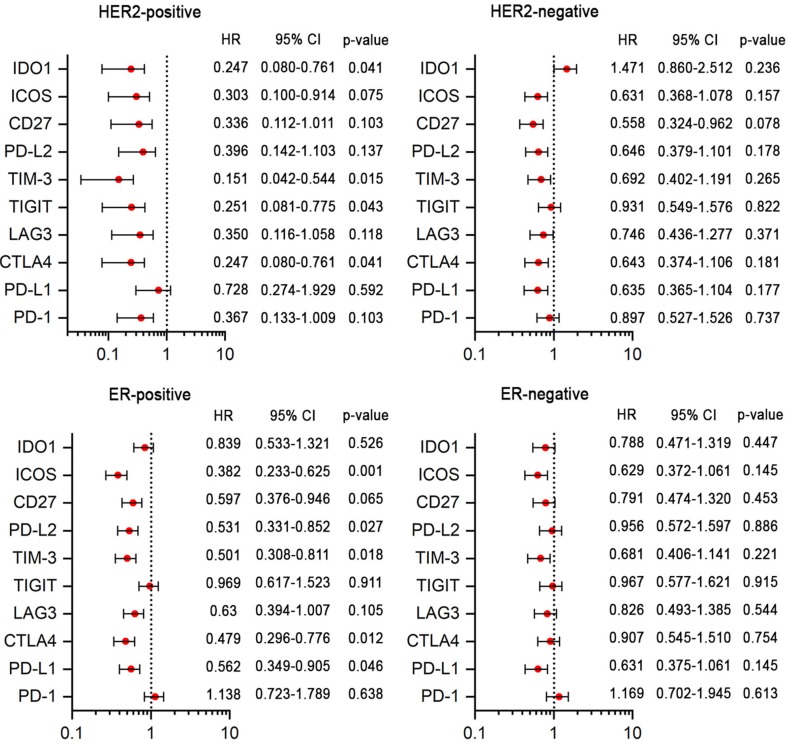
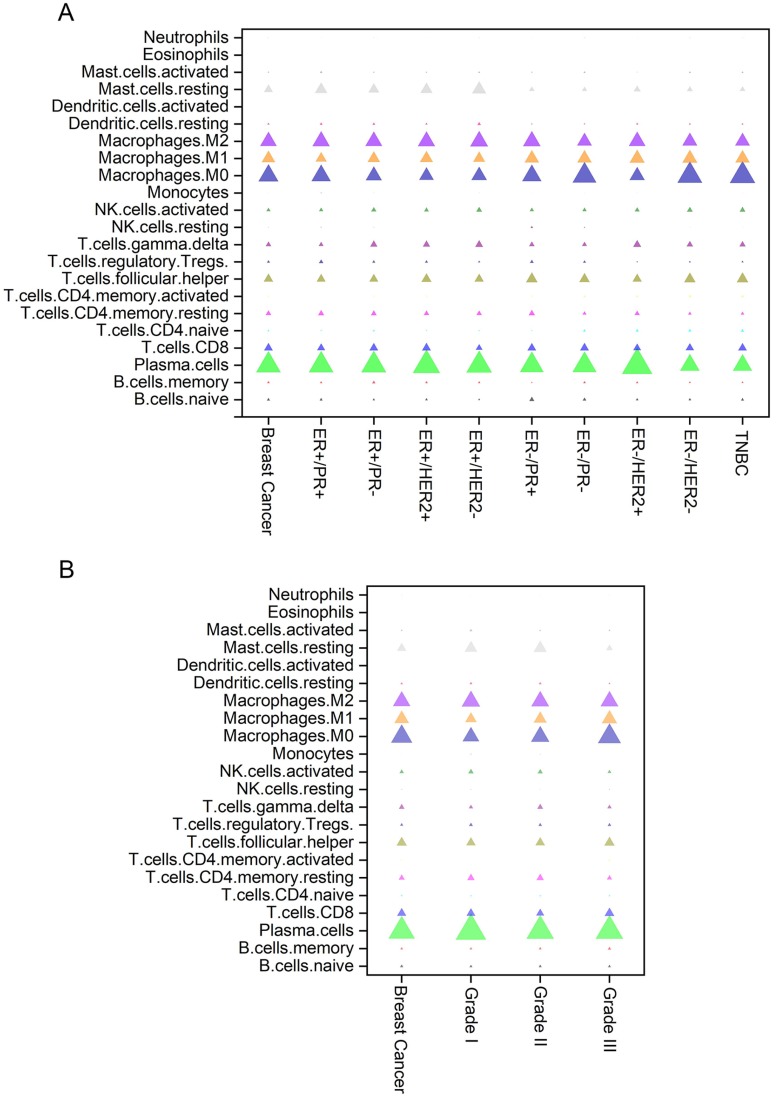
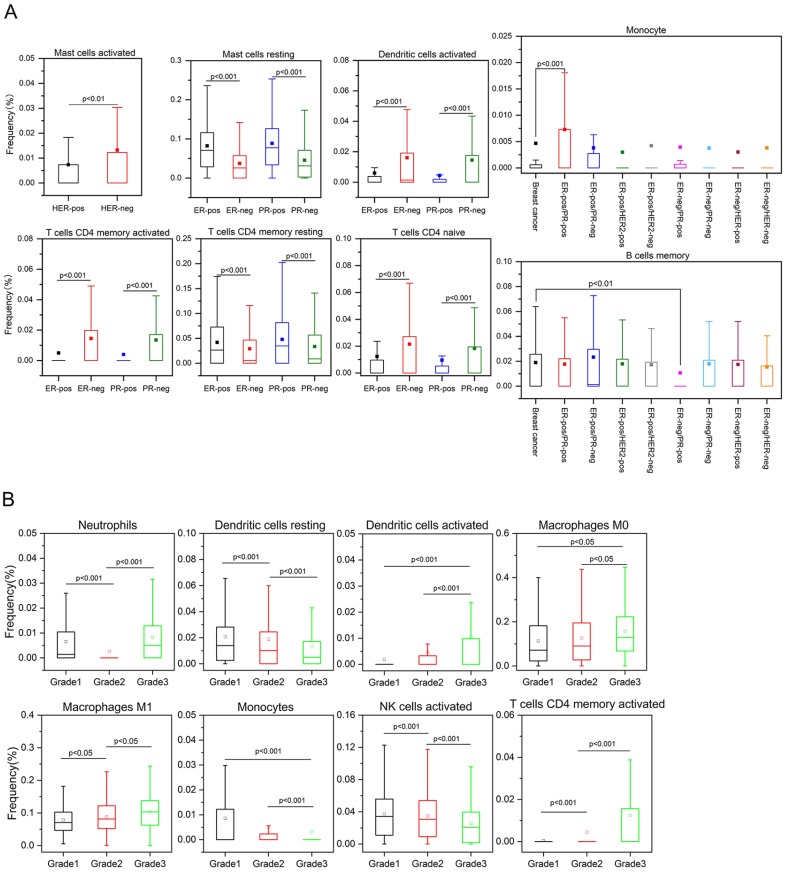
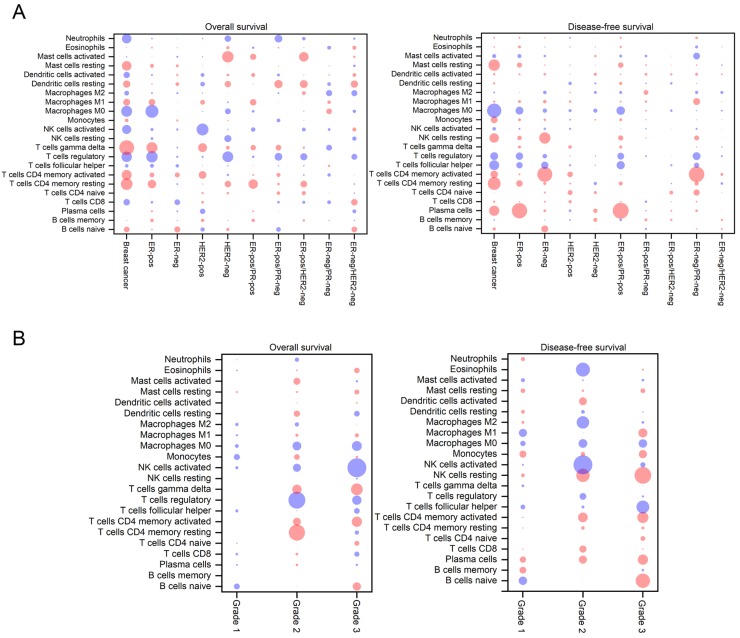
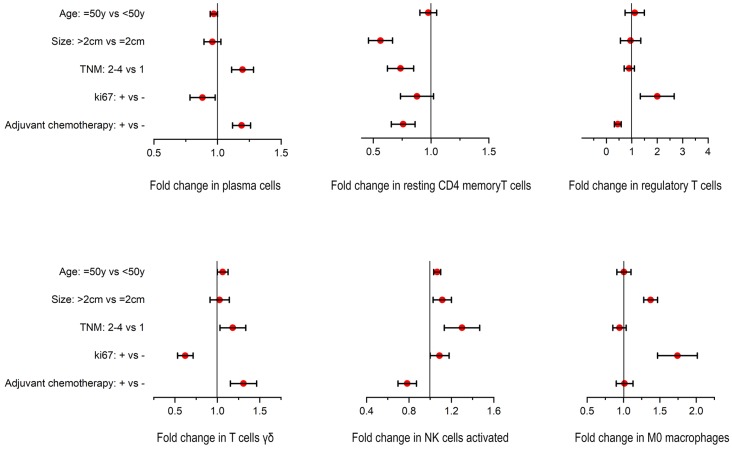
The immune infiltration of tumors is closely related to clinical outcomes. The composition of tumor-infiltrating immune cells (TIICs) can serve as biomarkers for predicting response to treatment and survival in different patient subgroups in terms of chemotherapy and immunotherapy. This study is focused on investigating the clinical implications of TIICs in breast cancer patients. We performed several analyses of gene expression profiles in 2976 nonmetastatic tumor samples. CIBERSORT was used to estimate the proportion of 22 immune cell types to analyze their correlation with overall survival (OS) and disease-free survival (DFS) in different breast cancer subtypes and stages. Our results showed that a higher fraction of plasma cells in estrogen receptor (ER)-positive breast cancer patients indicated an increase in DFS (hazard ratio [HR]=0.66, 95% confidence interval [CI] 0.540.82, <0.01), while a decreased OS was correlated with a greater number of M0 macrophages (HR=2.02, 95% CI 1.273.30, =0.01) and regulatory T cells (HR=1.90, 95% CI 1.203.02, =0.02). In ER-negative or progesterone receptor (PR)-negative subtypes or in a combined subtype, the increase in activated memory CD4 T cells was correlated with increased DFS (HR=0.46, 95% CI 0.330.63, <0.01). In all breast cancer patients, a higher proportion of M0 macrophages indicated a decreased DFS (HR=1.67, 95% CI 1.222.27, <0.01), while increased OS was associated with relatively larger fractions of resting memory CD4 T cells (HR=0.70, 95% CI 0.550.90, =0.02) and γδ T cells (HR=0.66, 95% CI 0.51~0.85, <0.01). Therefore, this study revealed that the composition of TIICs is different in patients with various subtypes of breast cancer and is directly related to prognosis, suggesting that TIICs are important participants in tumor progression and may, potentially be used for future diagnosis and treatment.
肿瘤的免疫浸润与临床结局密切相关。肿瘤浸润免疫细胞(TIICs)的组成可作为生物标志物,用于预测不同患者亚组在化疗和免疫治疗方面的治疗反应及生存情况。本研究聚焦于调查TIICs在乳腺癌患者中的临床意义。我们对2976例非转移性肿瘤样本的基因表达谱进行了多项分析。使用CIBERSORT估计22种免疫细胞类型的比例,以分析它们与不同乳腺癌亚型和分期的总生存期(OS)及无病生存期(DFS)的相关性。我们的结果显示,雌激素受体(ER)阳性乳腺癌患者中浆细胞比例较高表明DFS增加(风险比[HR]=0.66,95%置信区间[CI]0.540.82,P<0.01),而OS降低与更多的M0巨噬细胞(HR=2.02,95%CI 1.273.30,P=0.01)和调节性T细胞(HR=1.90,95%CI 1.203.02,P=0.02)相关。在ER阴性或孕激素受体(PR)阴性亚型或联合亚型中,活化记忆性CD4 T细胞增加与DFS增加相关(HR=0.46,95%CI 0.330.63,P<0.01)。在所有乳腺癌患者中,较高比例的M0巨噬细胞表明DFS降低(HR=1.67,95%CI 1.222.27,P<0.01),而OS增加与相对较高比例的静息记忆性CD4 T细胞(HR=0.70,95%CI 0.550.90,P=0.02)和γδ T细胞(HR=0.66,95%CI 0.51~0.85,P<0.01)相关。因此,本研究表明不同亚型乳腺癌患者的TIICs组成不同且与预后直接相关,提示TIICs是肿瘤进展的重要参与者,可能用于未来的诊断和治疗。