Enteric Diseases Group, Murdoch Children's Research Institute, Seattle, Washington.
Melbourne School of Population and Global Health, Seattle, Washington.
J Infect Dis. 2020 Mar 16;221(7):1070-1078. doi: 10.1093/infdis/jiz333.
VP4 [P] genotype binding specificities of rotaviruses and differential expression of histo-blood group antigens (HBGAs) between populations may contribute to reduced efficacy against severe rotavirus disease. P[6]-based rotavirus vaccines could broaden protection in such settings, particularly in Africa, where the Lewis-negative phenotype and P[6] rotavirus strains are common.
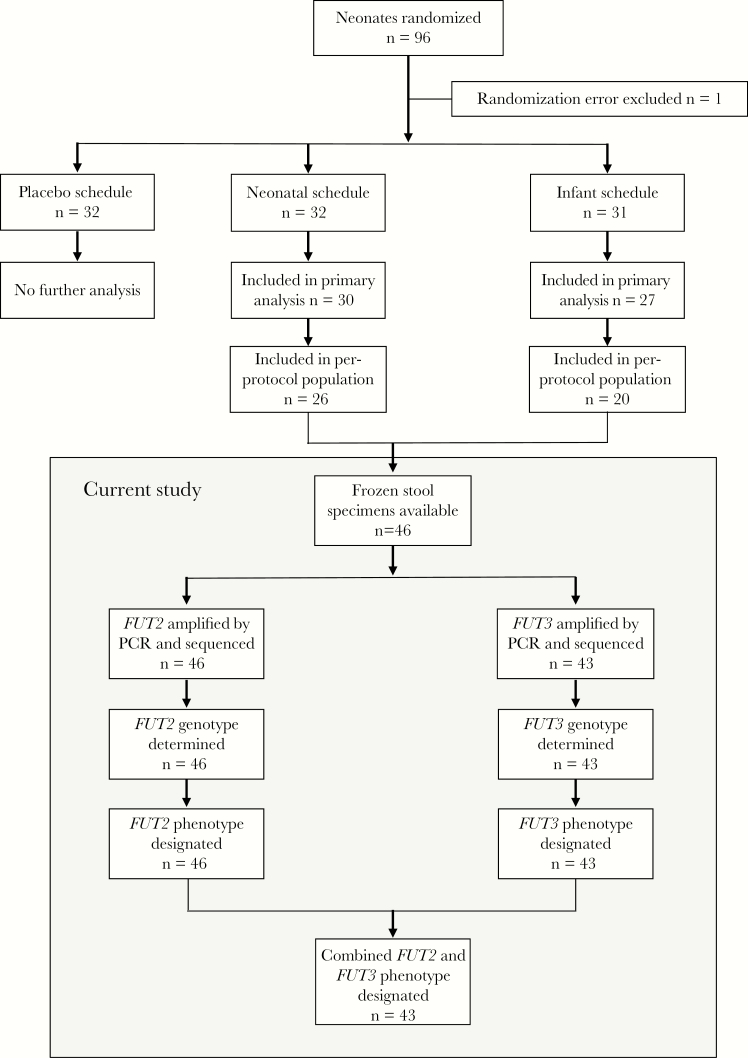
The association between HBGA status and G3P[6] rotavirus vaccine (RV3-BB) take was investigated in a phase 2A study of RV3-BB vaccine involving 46 individuals in Dunedin, New Zealand, during 2012-2014. FUT2 and FUT3 genotypes were determined from DNA extracted from stool specimens, and frequencies of positive cumulative vaccine take, defined as an RV3-BB serum immune response (either immunoglobulin A or serum neutralizing antibody) and/or stool excretion of the vaccine strain, stratified by HBGA status were determined.
RV3-BB produced positive cumulative vaccine take in 29 of 32 individuals (91%) who expressed a functional FUT2 enzyme (the secretor group), 13 of 13 (100%) who were FUT2 null (the nonsecretor group), and 1 of 1 with reduced FUT2 activity (i.e., a weak secretor); in 37 of 40 individuals (93%) who expressed a functional FUT3 enzyme (the Lewis-positive group) and 3 of 3 who were FUT3 null (the Lewis-negative group); and in 25 of 28 Lewis-positive secretors (89%), 12 of 12 Lewis-positive nonsecretors (100%), 2 of 2 Lewis-negative secretors, and 1 of 1 Lewis-negative weak secretor.
RV3-BB produced positive cumulative vaccine take irrespective of HBGA status. RV3-BB has the potential to provide an improved level of protection in settings where P[6] rotavirus disease is endemic, irrespective of the HBGA profile of the population.
轮状病毒 VP4[P]基因型与人群中组织血型抗原(HBGA)的差异表达可能导致针对严重轮状病毒病的疗效降低。基于 P[6]的轮状病毒疫苗可以在这种情况下扩大保护范围,特别是在非洲,那里刘易斯阴性表型和 P[6]轮状病毒株很常见。
在 2012 年至 2014 年期间,在新西兰达尼丁进行的一项关于 RV3-BB 疫苗的 2A 期研究中,调查了 HBGA 状态与 G3P[6]轮状病毒疫苗(RV3-BB)接种之间的关系。从粪便标本中提取的 DNA 确定了 FUT2 和 FUT3 基因型,并确定了按 HBGA 状态分层的 RV3-BB 疫苗累积接种阳性率(定义为 RV3-BB 血清免疫反应(免疫球蛋白 A 或血清中和抗体)和/或疫苗株粪便排泄)。
在 32 名表达功能性 FUT2 酶的个体(分泌组)中,29 名(91%)产生了 RV3-BB 阳性累积疫苗接种,在 13 名 FUT2 缺失的个体(100%)中产生了 RV3-BB 阳性累积疫苗接种,在 1 名 FUT2 活性降低的个体(即弱分泌者)中产生了 1 名 RV3-BB 阳性累积疫苗接种;在 40 名表达功能性 FUT3 酶的个体(刘易斯阳性组)中,37 名(93%)产生了 RV3-BB 阳性累积疫苗接种,在 3 名 FUT3 缺失的个体(刘易斯阴性组)中产生了 3 名 RV3-BB 阳性累积疫苗接种;在 28 名刘易斯阳性分泌者中的 25 名(89%),在 12 名刘易斯阳性非分泌者中的 12 名(100%),在 2 名刘易斯阴性分泌者中的 2 名和在 1 名刘易斯阴性弱分泌者中的 1 名中产生了 RV3-BB 阳性累积疫苗接种。
无论 HBGA 状态如何,RV3-BB 均能产生阳性累积疫苗接种。RV3-BB 有可能在 P[6]轮状病毒病流行的地区提供更好的保护水平,而与人群的 HBGA 特征无关。