Department of Community Health Sciences, CUNY Graduate School of Public Health and Health Policy, New York, NY.
CUNY Institute for Implementation Science in Population Health, New York, NY.
J Acquir Immune Defic Syndr. 2019 Dec;82 Suppl 3(Suppl 3):S253-S260. doi: 10.1097/QAI.0000000000002217.
In 2014, Grov et al published a comprehensive review cataloguing both men who have sex with men's (MSM's) sexual behavior transitions in online environments from the 1990s through 2013, as well as researchers' efforts in tandem to use the internet to engage MSM into research, treatment, and prevention.
In this article, we discuss historical events and research having occurred in the half decade since the Grov et al publication.
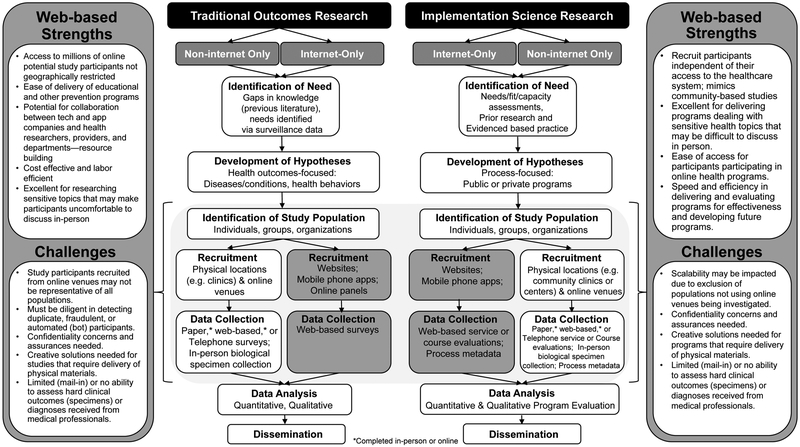
Notable transitions include MSM's expanded use of geosocial networking apps, as well as other forms of social media accessed primarily through mobile devices, as well as the addition of biomedical prevention strategies (eg, pre-exposure prophylaxis and undetectable = untransmittable) to the proverbial HIV prevention toolkit. In tandem, researchers have rapidly expanded their employment of internet-mediated methods for the recruitment and engagement of key populations for HIV research, treatment, and prevention. In this article, we discuss methodological considerations for using the internet to conduct HIV prevention research with MSM: (1) sources of recruitment (eg, geosocial apps, Facebook, crowdsourced online panels); (2) design (eg, cross sectional, longitudinal, diaries); (3) incentives (including disincentivizing fraudulent participants and/or spam bots); (4) confidentiality; and (5) representativeness.
We conclude by discussing future directions in HIV prevention research in light of forthcoming technologies such as fifth generation (5G) mobile networks, combined use of self-collected biological data alongside self-report, and the utility of metadata and metaresearch to document, evaluate, and inform best practices.
2014 年,Grov 等人发表了一篇全面综述,其中列举了 1990 年代至 2013 年期间,男男性行为者(MSM)在网络环境中性行为转变的情况,以及研究人员为了让 MSM 参与研究、治疗和预防而同步利用互联网所做出的努力。
在本文中,我们讨论了自 Grov 等人发表文章以来的过去五年中发生的历史事件和研究进展。
值得注意的转变包括 MSM 更广泛地使用地理位置社交网络应用程序,以及其他主要通过移动设备访问的社交媒体形式,以及将生物医学预防策略(例如,暴露前预防和检测不到即无法传播)添加到传统的 HIV 预防工具包中。与此同时,研究人员迅速扩大了使用互联网中介方法来招募和参与 HIV 研究、治疗和预防的关键人群。在本文中,我们讨论了使用互联网进行 MSM 艾滋病预防研究的方法学考虑因素:(1)招募来源(例如地理位置社交应用程序、Facebook、众包在线面板);(2)设计(例如横断面、纵向、日记);(3)激励措施(包括防止欺诈参与者和/或垃圾邮件机器人);(4)保密性;(5)代表性。
我们最后讨论了在即将到来的技术(如第五代(5G)移动网络、自我采集生物数据与自我报告的结合使用,以及元数据和元研究在记录、评估和提供最佳实践方面的效用)背景下,HIV 预防研究的未来方向。