Reich Dieter, Berger Andreas, von Balthazar Maria, Chartier Marion, Sherafati Mahboubeh, Schönenberger Jürg, Manafzadeh Sara, Staedler Yannick M
Department of Botany and Biodiversity Research, Division of Evolutionary and Systematic Botany, University of Vienna, Rennweg 14, Vienna, 1030, Austria.
Department of Botany and Biodiversity Research, Division of Structural and Functional Botany, University of Vienna, Rennweg 14, Vienna, 1030, Austria.
New Phytol. 2020 Apr;226(1):267-280. doi: 10.1111/nph.16337. Epub 2020 Jan 8.
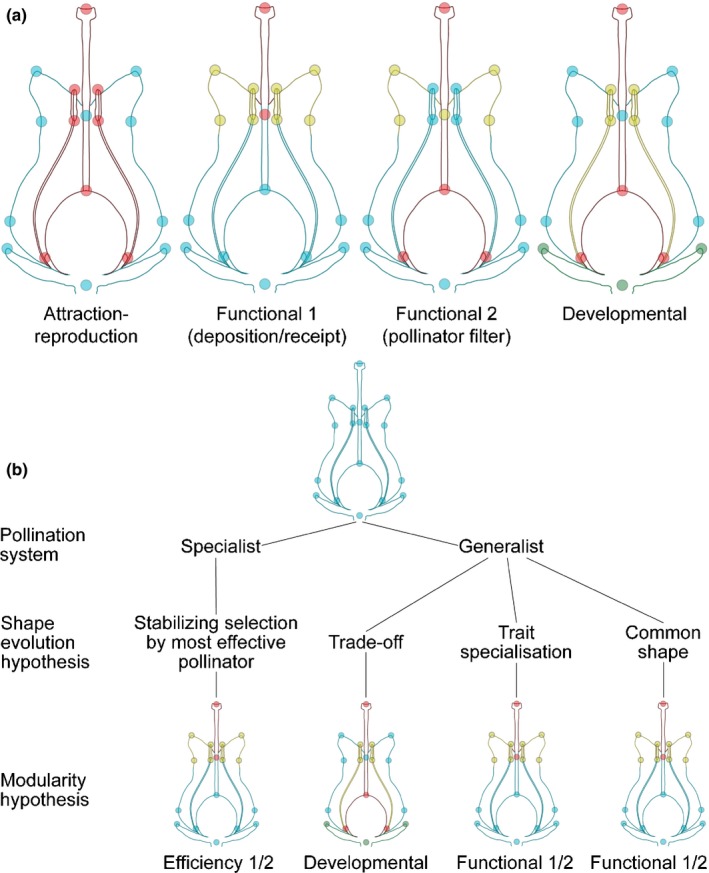
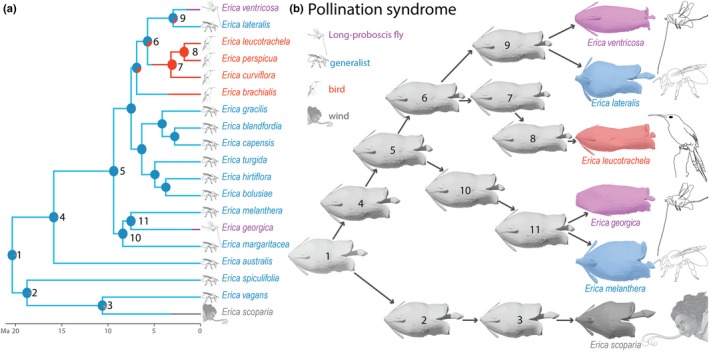
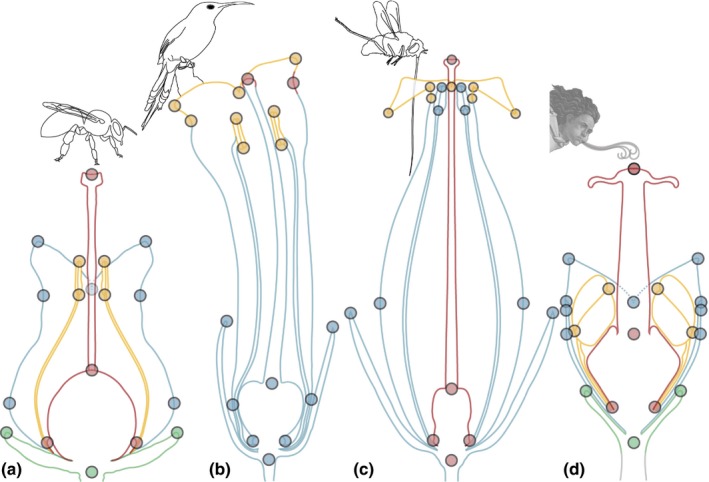
Flowers have been hypothesized to contain either modules of attraction and reproduction, functional modules (pollination-effecting parts) or developmental modules (organ-specific). Do pollination specialization and syndromes influence floral modularity? In order to test these hypotheses and answer this question, we focused on the genus Erica: we gathered 3D data from flowers of 19 species with diverse syndromes via computed tomography, and for the first time tested the above-mentioned hypotheses via 3D geometric morphometrics. To provide an evolutionary framework for our results, we tested the evolutionary mode of floral shape, size and integration under the syndromes regime, and - for the first time - reconstructed the high-dimensional floral shape of their most recent common ancestor. We demonstrate that the modularity of the 3D shape of generalist flowers depends on development and that of specialists is linked to function: modules of pollen deposition and receipt in bird syndrome, and access-restriction to the floral reward in long-proboscid fly syndrome. Only size and shape principal component 1 showed multiple-optima selection, suggesting that they were co-opted during evolution to adapt flowers to novel pollinators. Whole floral shape followed an Ornstein-Uhlenbeck (selection-driven) evolutionary model, and differentiated relatively late. Flower shape modularity thus crucially depends on pollinator specialization and syndrome.
有假说认为,花包含吸引和繁殖模块,即功能模块(影响授粉的部分)或发育模块(器官特异性)。授粉特化和综合症会影响花的模块化吗?为了验证这些假说并回答这个问题,我们聚焦于欧石南属:我们通过计算机断层扫描收集了19种具有不同综合症的花的三维数据,并首次通过三维几何形态测量学验证了上述假说。为我们的结果提供一个进化框架,我们在综合症机制下测试了花的形状、大小和整合的进化模式,并且首次重建了它们最近共同祖先的高维花形。我们证明,泛化花三维形状的模块化取决于发育,而特化花的模块化与功能相关:在鸟类综合症中是花粉沉积和接收模块,在长喙蝇综合症中是对花的报酬的访问限制模块。只有大小和形状主成分1显示出多峰选择,这表明它们在进化过程中被用于使花适应新的传粉者。整个花形遵循奥恩斯坦-乌伦贝克(选择驱动)进化模型,并且分化相对较晚。因此,花形模块化关键取决于传粉者特化和综合症。