Fiala Ondrej, Ostasov Pavel, Sorejs Ondrej, Liska Vaclav, Buchler Tomas, Poprach Alexandr, Finek Jindrich
Department of Oncology and Radiotherapy, Medical School and University Hospital in Pilsen, Charles University, alej Svobody 80, 30460 Pilsen, Czech Republic.
Biomedical Center, Faculty of Medicine in Pilsen, Charles University, alej Svobody 76, 32300 Pilsen, Czech Republic.
Cancers (Basel). 2019 Nov 25;11(12):1856. doi: 10.3390/cancers11121856.
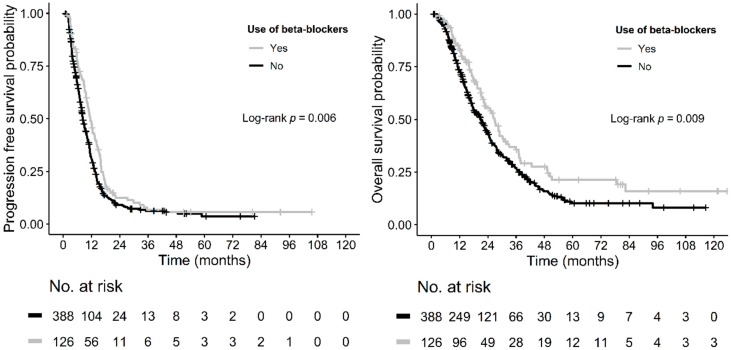
Beta-adrenergic signalling plays an important role in several cancer-related processes, including angiogenesis. The impact of beta-blocker use on prognosis of cancer patients treated with antiangiogenic agents is unclear. The aim of this study was to evaluate the association between the incidental use of beta-blockers and the outcomes of patients with metastatic colorectal cancer (mCRC) treated with bevacizumab-based therapy. Clinical data from 514 mCRC patients treated with bevacizumab between 2005 and 2019 were analysed retrospectively. The association of progression-free survival (PFS) and overall survival (OS) with the incidental use of beta-blockers and other common antihypertensive drugs was assessed. The median PFS and OS for patients using beta-blockers was 11.40 (95% confidence interval (CI) 10.10-13.61) months and 26.8 (95% CI 22.2-32.2) months compared with 8.30 (95% CI 7.80-9.57) and 21.0 (95% CI 17.8-23.8) months for patients not using beta-blockers ( 0.006 and 0.009, respectively). In the Cox multivariate analysis, the use of beta-blockers was a significant factor predicting both PFS (hazard ratio (HR) = 0.763 (95% CI 0.606-0.960), 0.021) and OS (HR = 0.730 (95% CI 0.560-0.951), 0.020). The results of the present retrospective study suggest that there is a significant association between the use of beta-blockers and favourable outcomes of mCRC patients treated with bevacizumab-based therapy.
β-肾上腺素能信号传导在包括血管生成在内的多个癌症相关过程中发挥重要作用。β受体阻滞剂的使用对接受抗血管生成药物治疗的癌症患者预后的影响尚不清楚。本研究的目的是评估β受体阻滞剂的偶然使用与接受贝伐单抗治疗的转移性结直肠癌(mCRC)患者结局之间的关联。回顾性分析了2005年至2019年间接受贝伐单抗治疗的514例mCRC患者的临床资料。评估了无进展生存期(PFS)和总生存期(OS)与β受体阻滞剂及其他常用降压药物偶然使用之间的关联。使用β受体阻滞剂的患者的中位PFS和OS分别为11.40(95%置信区间(CI)10.10 - 13.61)个月和26.8(95%CI 22.2 - 32.2)个月,而未使用β受体阻滞剂的患者分别为8.30(95%CI 7.80 - 9.57)个月和21.0(95%CI 17.8 - 23.8)个月(P值分别为0.006和0.009)。在Cox多变量分析中,使用β受体阻滞剂是预测PFS(风险比(HR)= 0.763(95%CI 0.606 - 0.960),P = 0.021)和OS(HR = 0.730(95%CI 0.560 - 0.951),P = 0.020)的显著因素。本回顾性研究结果表明,β受体阻滞剂的使用与接受贝伐单抗治疗的mCRC患者的良好结局之间存在显著关联。