Murad Abdulaziz, Hyde Natalie, Chang Shanton, Lederman Reeva, Bosua Rachelle, Pirotta Marie, Audehm Ralph, Yates Christopher J, Briggs Andrew M, Gorelik Alexandra, Chiang Cherie, Wark John D
School of Computing and Information Systems, University of Melbourne, Melbourne, Australia.
Deakin University, Geelong, Australia.
J Med Internet Res. 2019 Nov 27;21(11):e14545. doi: 10.2196/14545.
Health care practitioners (HPs), in particular general practitioners (GPs), are increasingly adopting Web-based social media platforms for continuing professional development (CPD). As GPs are restricted by time, distance, and demanding workloads, a health virtual community of practice (HVCoP) is an ideal solution to replace face-to-face CPD with Web-based CPD. However, barriers such as time and work schedules may limit participation in an HVCoP. Furthermore, it is difficult to gauge whether GPs engage actively or passively in HVCoP knowledge-acquisition for Web-based CPD, as GPs' competencies are usually measured with pre- and posttests.
This study investigated a method for measuring the engagement features needed for an HVCoP (the Community Fracture Capture [CFC] Learning Hub) for learning and knowledge sharing among GPs for their CPD activity.
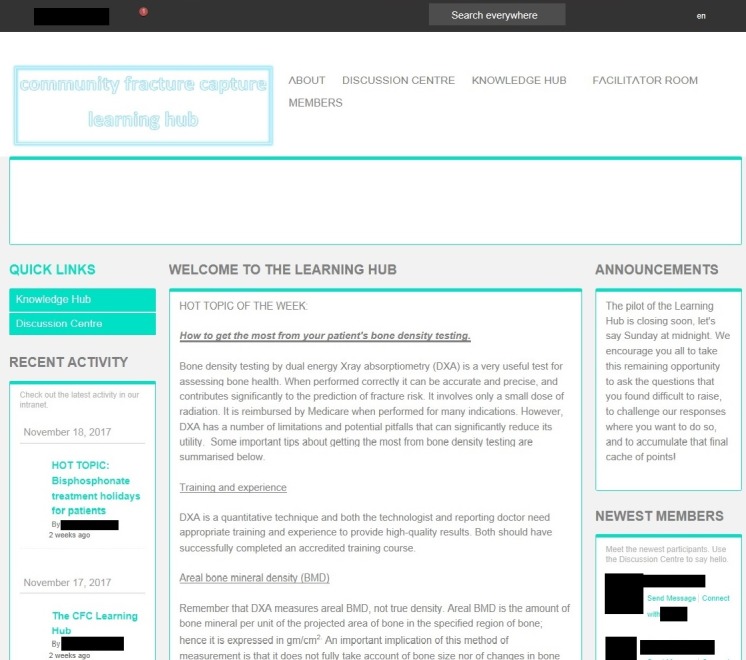
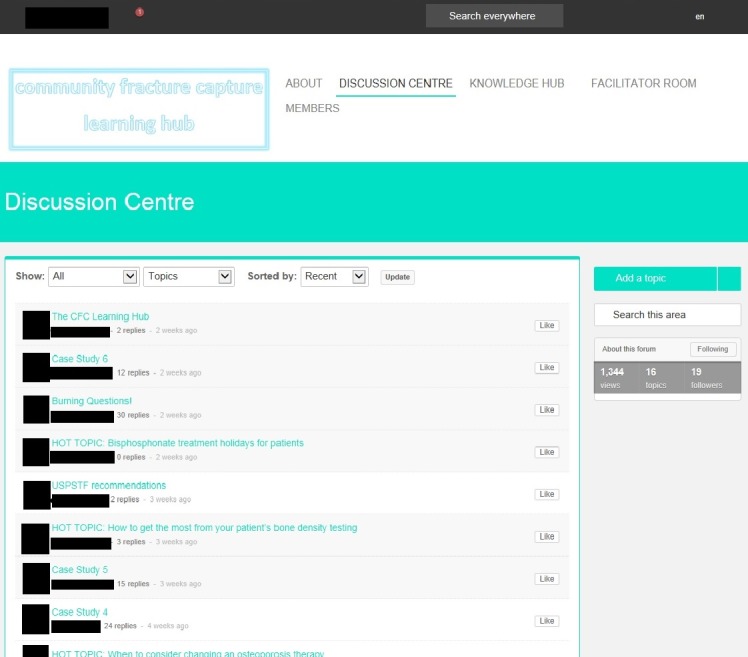
A prototype CFC Learning Hub was developed using an Igloo Web-based social media software platform and involved a convenience sample of GPs interested in bone health topics. This Hub, a secure Web-based community site, included 2 key components: an online discussion forum and a knowledge repository (the Knowledge Hub). The discussion forum contained anonymized case studies (contributed by GP participants) and topical discussions (topics that were not case studies). Using 2 complementary tools (Google Analytics and Igloo Statistical Tool), we characterized individual participating GPs' engagement with the Hub. We measured the GP participants' behavior by quantifying the number of online sessions of the participants, activities undertaken within these online sessions, written posts made per learning topic, and their time spent per topic. We calculated time spent in both active and passive engagement for each topic.
Seven GPs participated in the CFC Learning Hub HVCoP from September to November 2017. The complementary tools successfully captured the GP participants' engagement in the Hub. GPs were more active in topics in the discussion forum that had direct clinical application as opposed to didactic, evidence-based discussion topics (ie, topical discussions). From our knowledge hub, About Osteoporosis and Prevention were the most engaging topics, whereas shared decision making was the least active topic.
We showcased a novel complementary analysis method that allowed us to quantify the CFC Learning Hub's usage data into (1) sessions, (2) activities, (3) active or passive time spent, and (4) posts made to evaluate the potential engagement features needed for an HVCoP focused on GP participants' CPD process. Our design and evaluation methods for ongoing use and engagement in this Hub may be useful to evaluate future learning and knowledge-sharing projects for GPs and may allow for extension to other HPs' environments. However, owing to the limited number of GP participants in this study, we suggest that further research with a larger cohort should be performed to validate and extend these findings.
医疗保健从业者(HPs),尤其是全科医生(GPs),越来越多地采用基于网络的社交媒体平台进行持续专业发展(CPD)。由于全科医生受到时间、距离和繁重工作量的限制,健康虚拟实践社区(HVCoP)是用基于网络的CPD取代面对面CPD的理想解决方案。然而,时间和工作安排等障碍可能会限制对HVCoP的参与。此外,由于通常通过前后测试来衡量全科医生的能力,因此很难判断他们在基于网络的CPD的HVCoP知识获取中是积极参与还是被动参与。
本研究调查了一种测量HVCoP(社区骨折捕获[CFC]学习中心)所需参与特征的方法,该学习中心用于全科医生之间的学习和知识共享以开展其CPD活动。
使用基于Igloo网络的社交媒体软件平台开发了一个CFC学习中心原型,研究对象为对骨骼健康主题感兴趣的全科医生的便利样本。这个学习中心是一个安全的基于网络的社区网站,包括两个关键组成部分:一个在线讨论论坛和一个知识库(知识中心)。讨论论坛包含匿名案例研究(由全科医生参与者提供)和主题讨论(非案例研究的主题)。使用两种互补工具(谷歌分析和Igloo统计工具),我们对参与的全科医生个体与学习中心的互动进行了特征描述。我们通过量化参与者的在线会话次数、这些在线会话中进行的活动、每个学习主题的书面帖子数量以及他们在每个主题上花费的时间来衡量全科医生参与者的行为。我们计算了每个主题在主动和被动参与中花费的时间。
2017年9月至11月,7名全科医生参与了CFC学习中心的HVCoP。这些互补工具成功捕捉到了全科医生参与者在学习中心的参与情况。与说教式的循证讨论主题(即主题讨论)相比,全科医生在讨论论坛中具有直接临床应用的主题上更活跃。在我们的知识库中,“关于骨质疏松症和预防”是最具吸引力的主题,而“共同决策”是最不活跃的主题。
我们展示了一种新颖的互补分析方法,该方法使我们能够将CFC学习中心的使用数据量化为:(1)会话,(2)活动,(3)主动或被动花费的时间,以及(4)发布的帖子,以评估专注于全科医生参与者CPD过程的HVCoP所需的潜在参与特征。我们对该学习中心持续使用和参与的设计及评估方法,可能有助于评估未来针对全科医生的学习和知识共享项目,并且可能适用于扩展到其他医疗保健从业者的环境。然而,由于本研究中全科医生参与者数量有限,我们建议进行更大样本量的进一步研究以验证和扩展这些发现。