Faculty of Pharmacy, Division of Pharmacology and Pharmacotherapy, Clinical Pharmacy Group, University of Helsinki, Viikinkaari 5 E, P.O. BOX 56, 00014, Helsinki, Finland.
1st Pharmacy of Lohja, Laurinkatu 37-41 A, 08100, Turku, Finland.
BMC Geriatr. 2019 Nov 27;19(1):332. doi: 10.1186/s12877-019-1353-2.
As populations are aging, a growing number of home care clients are frail and use multiple, complex medications. Combined with the lack of coordination of care this may pose uncontrolled polypharmacy and potential patient safety risks. The aim of this study was to assess the impact of a care coordination intervention on medication risks identified in drug regimens of older home care clients over a one-year period.
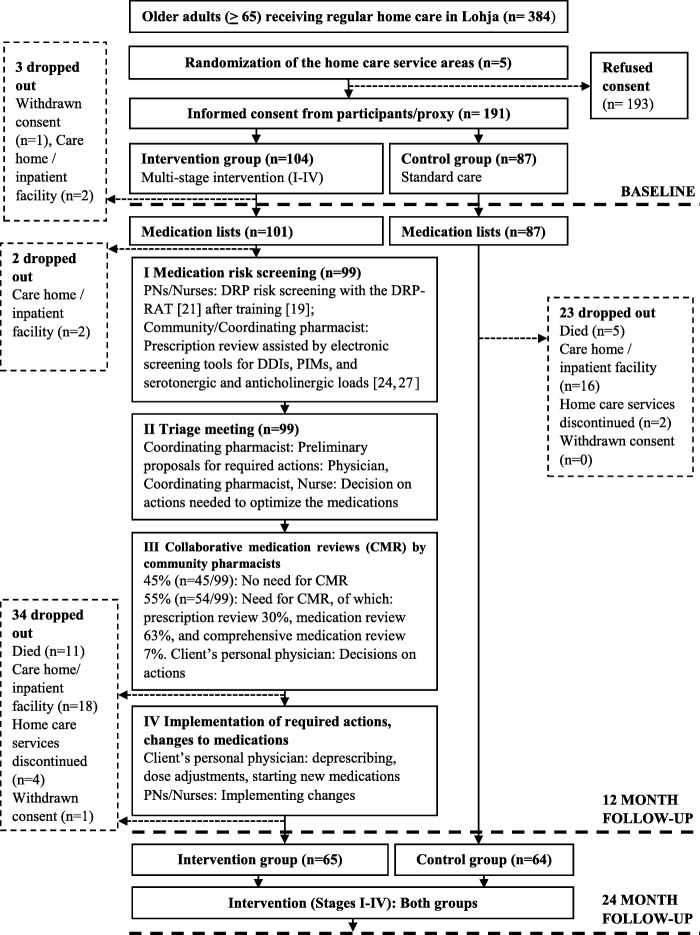
Two-arm, parallel, cluster randomized controlled trial with baseline and follow-up assessment at 12 months. The study was conducted in Primary Care in Lohja, Finland: all 5 home care units, the public healthcare center, and a private community pharmacy.
All consented home care clients aged > 65 years, using at least one prescription medicine who were assessed at baseline and at 12 months.
Practical nurses were trained to make the preliminary medication risk assessment during home visits and report findings to the coordinating pharmacist. The coordinating pharmacist prepared the cases for the triage meeting with the physician and home care nurse to decide on further actions. Each patient's physician made the final decisions on medication changes needed. Outcomes were measured as changes in medication risks: use of potentially inappropriate medications and psychotropics; anticholinergic and serotonergic load; drug-drug interactions.
Participants (n = 129) characteristics: mean age 82.8 years, female 69.8%, mean number of prescription medicines in use 13.1. The intervention did not show an impact on the medication risks between the original intervention group and the control group in the intention to treat analysis, but the per protocol analysis indicated tendency for effectiveness, particularly in optimizing central nervous system medication use. Half (50.0%) of the participants with a potential need for medication changes, agreed on in the triage meeting, had none of the medication changes actually implemented.
The care coordination intervention used in this study indicated tendency for effectiveness when implemented as planned. Even though the outcome of the intervention was not optimal, the value of this paper is in discussing the real world experiences and challenges of implementing new practices in home care.
ClinicalTrials.gov (NCT02545257). Registered September 9 2015.
随着人口老龄化,越来越多的家庭护理客户身体虚弱,同时使用多种复杂的药物。加上护理协调的缺乏,这可能导致无法控制的多种药物并用,并可能带来患者安全风险。本研究的目的是评估在为期一年的时间内,对家庭护理客户的药物方案中发现的药物风险进行护理协调干预的效果。
采用基线和 12 个月时随访的两臂、平行、集群随机对照试验。该研究在芬兰 Lohja 的初级保健中进行:所有 5 个家庭护理单位、公共医疗中心和一家私人社区药房。
所有同意参加的年龄大于 65 岁、正在使用至少一种处方药且在基线和 12 个月时接受评估的家庭护理客户。
初级保健护士接受培训,以便在家庭访视期间进行初步药物风险评估,并将评估结果报告给协调药剂师。协调药剂师为与医生和家庭护理护士进行的分诊会议准备病例,以决定进一步的行动。每位患者的医生做出需要改变药物的最终决定。测量结果是药物风险的变化:潜在不适当药物和精神药物的使用;抗胆碱能和 5-羟色胺负荷;药物-药物相互作用。
参与者(n=129)的特征:平均年龄 82.8 岁,女性占 69.8%,平均使用处方药物 13.1 种。意向治疗分析显示,干预对原始干预组和对照组的药物风险没有影响,但方案分析表明干预具有有效性的趋势,特别是在优化中枢神经系统药物使用方面。在分诊会议上达成一致需要药物改变的参与者有一半(50.0%)实际上没有进行任何药物改变。
按照计划实施的护理协调干预表明有效果的趋势。尽管干预的结果并不理想,但本文的价值在于讨论在家庭护理中实施新实践的现实世界经验和挑战。
ClinicalTrials.gov(NCT02545257)。2015 年 9 月 9 日注册。