Institute for Memory Impairments and Neurological Disorders, University of California, Irvine, Irvine, CA, USA.
Department of Statistics, University of California, Irvine, Irvine, CA, USA.
Alzheimers Res Ther. 2019 Nov 27;11(1):92. doi: 10.1186/s13195-019-0544-6.
Alzheimer's disease (AD) clinical trials require enrollment of a participant and a study partner, whose role includes assessing participant cognitive and functional performance. AD trials now investigate early stages of the disease, when participants are not cognitively impaired. This gives rise to the question of whether study partners or participants provide more information in these trials.
We used data from the AD Cooperative Study Prevention Instrument Project (ADCS-PI) to compare participant and study partner predictions of the participant's current and future cognitive state. We used the Cognitive Function Instrument (CFI) as a measure of evaluation of the participant's cognitive status and the modified ADCS Preclinical Alzheimer's Cognitive Composite (mADCS-PACC) as an objective measure of cognition. Stratifying by cognitive status and study partner type and adjusting for other predictors of the participant's cognitive state, we used random forests along with estimated mean variable importance (eMVI) to assess how well each member of the dyad can predict cognitive state at current and later visits. We also fit linear regression models at each time point and for each scenario.
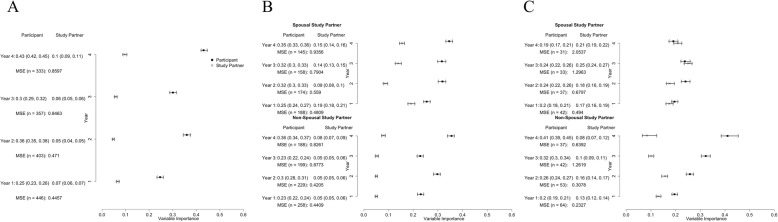
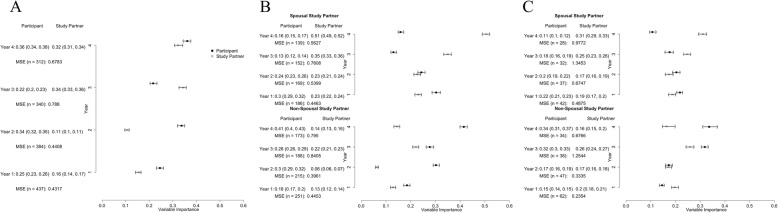
Participants were better at predicting future cognitive status compared to their study partners regardless of study partner type, though the difference between participants and partners was greatest for non-spousal dyads in the lowest-performing quartile. Cross-sectional assessments differed substantially by dyad type. Within the lowest cognitive performance quartile, participants having a non-spousal study partner outperformed their partners in assessing cognition at later times. Spousal partners, in contrast, outperformed participants later in the study in predicting current cognitive performance.
These results indicate that participants tend to be better at predicting future cognition compared to their study partners regardless of the study partner type. When assessing current cognition, however, spousal study partners perform better at later time points and non-spousal study partners do not provide as much information regarding participant cognitive state.
阿尔茨海默病(AD)临床试验需要招募参与者和研究伙伴,其角色包括评估参与者的认知和功能表现。AD 试验现在研究疾病的早期阶段,此时参与者的认知没有受损。这就提出了一个问题,即在这些试验中,是研究伙伴还是参与者提供了更多信息。
我们使用 AD 合作研究预防工具项目(ADCS-PI)的数据,比较参与者和研究伙伴对参与者当前和未来认知状态的预测。我们使用认知功能工具(CFI)作为评估参与者认知状态的指标,使用改良的 ADCS 临床前阿尔茨海默认知综合指标(mADCS-PACC)作为认知的客观指标。根据认知状态和研究伙伴类型进行分层,并调整参与者认知状态的其他预测因素,我们使用随机森林和估计平均变量重要性(eMVI)来评估每个对偶成员在当前和以后的访问中预测认知状态的能力。我们还在每个时间点和每个场景下拟合线性回归模型。
无论研究伙伴类型如何,参与者在预测未来认知状态方面都优于他们的研究伙伴,尽管在表现最差的四分位数中,非配偶对偶成员之间的差异最大。横断面评估因对偶类型而异。在认知表现最低的四分位数内,参与者的非配偶研究伙伴在以后的时间评估认知方面表现优于他们的伙伴。相比之下,配偶伙伴在研究后期预测当前认知表现方面优于参与者。
这些结果表明,无论研究伙伴类型如何,参与者在预测未来认知方面往往优于他们的研究伙伴。然而,在评估当前认知时,配偶研究伙伴在以后的时间点表现更好,而非配偶研究伙伴对参与者认知状态的信息提供较少。