Department of Immunology, School of Medicine, UConn Health, 263 Farmington Ave, Farmington, CT, 06030, USA.
Shenzhen Key Laboratory for Neuronal Structural Biology, Biomedical Research Institute, Shenzhen Peking University - The Hong Kong University of Science and Technology Medical Center, Shenzhen, China.
J Immunother Cancer. 2019 Nov 27;7(1):324. doi: 10.1186/s40425-019-0757-z.
The IL-17 family cytokines are potent drivers of colorectal cancer (CRC) development. We and others have shown that IL-17 mainly signals to tumor cells to promote CRC, but the underlying mechanism remains unclear. IL-17 also dampens Th1-armed anti-tumor immunity, in part by attracting myeloid cells to tumor. Whether IL-17 controls the activity of adaptive immune cells in a more direct manner, however, is unknown.
Using mouse models of sporadic or inducible colorectal cancers, we ablated IL-17RA in the whole body or specifically in colorectal tumor cells. We also performed adoptive bone marrow reconstitution to knockout CXCR3 in hematopoietic cells. Histological and immunological experimental methods were used to reveal the link among IL-17, chemokine production, and CRC development.
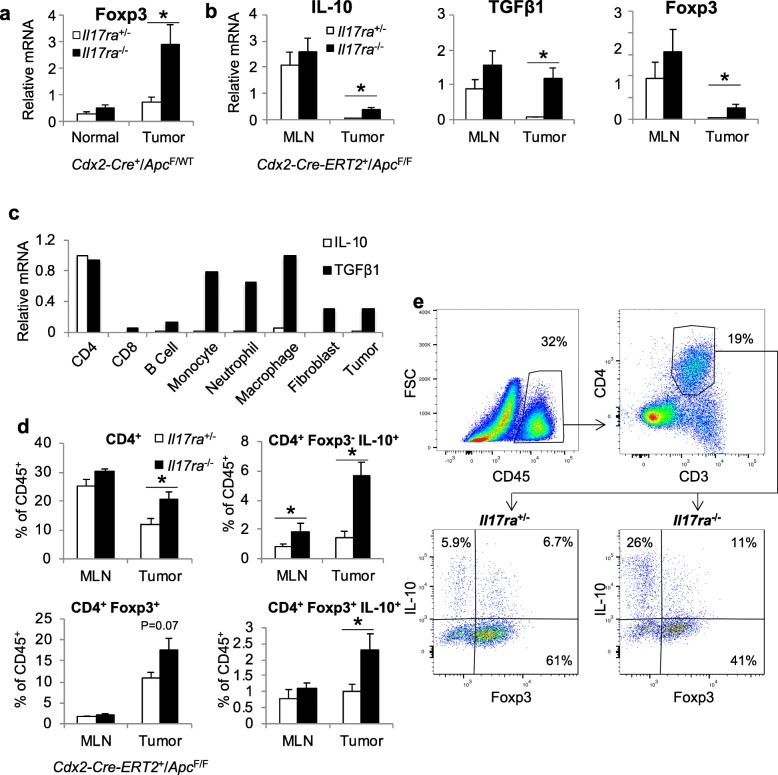
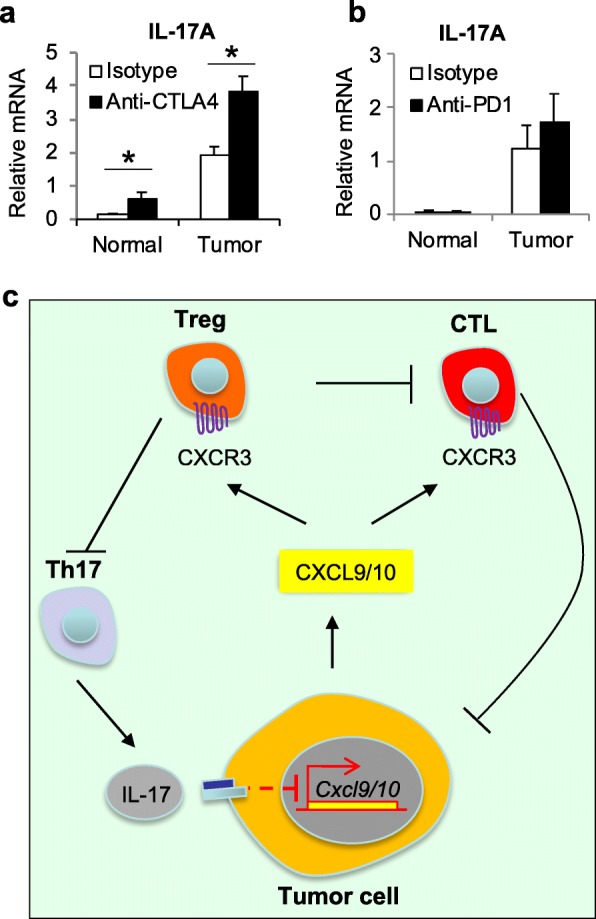
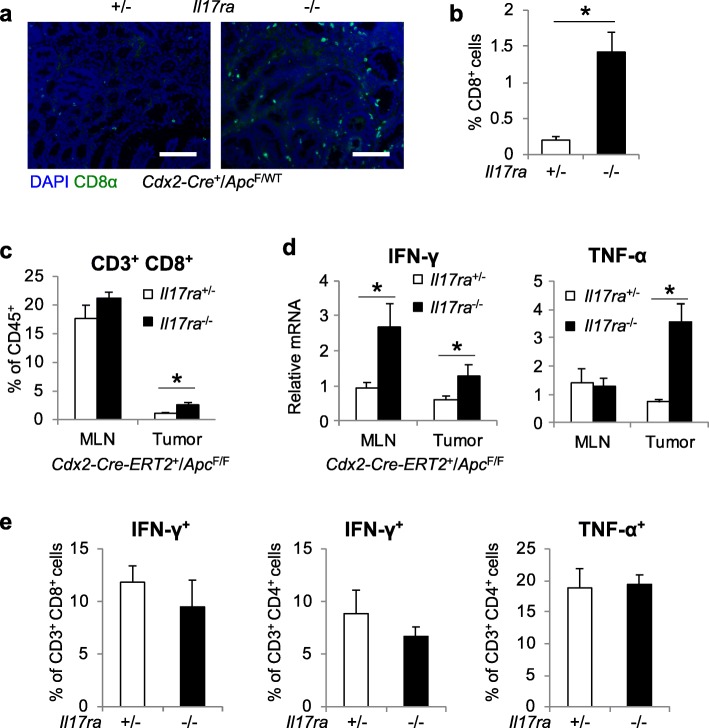
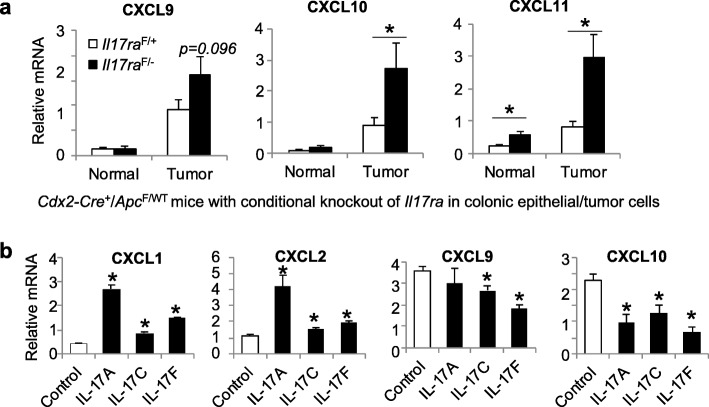
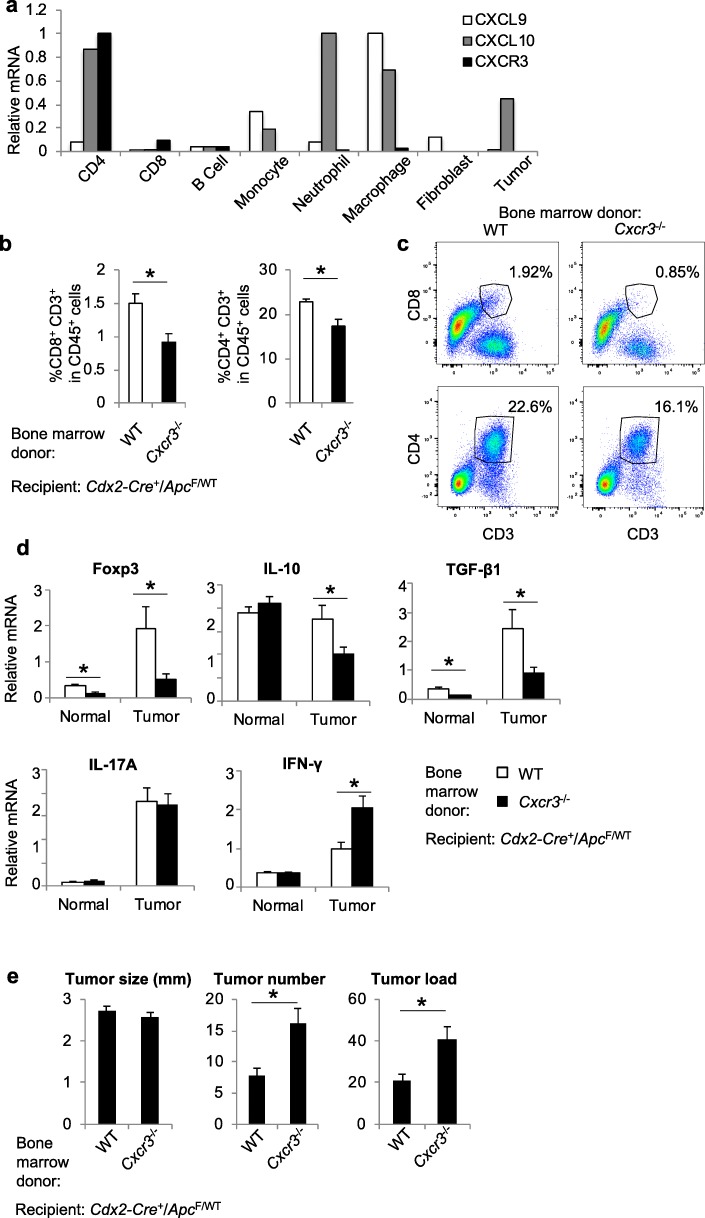
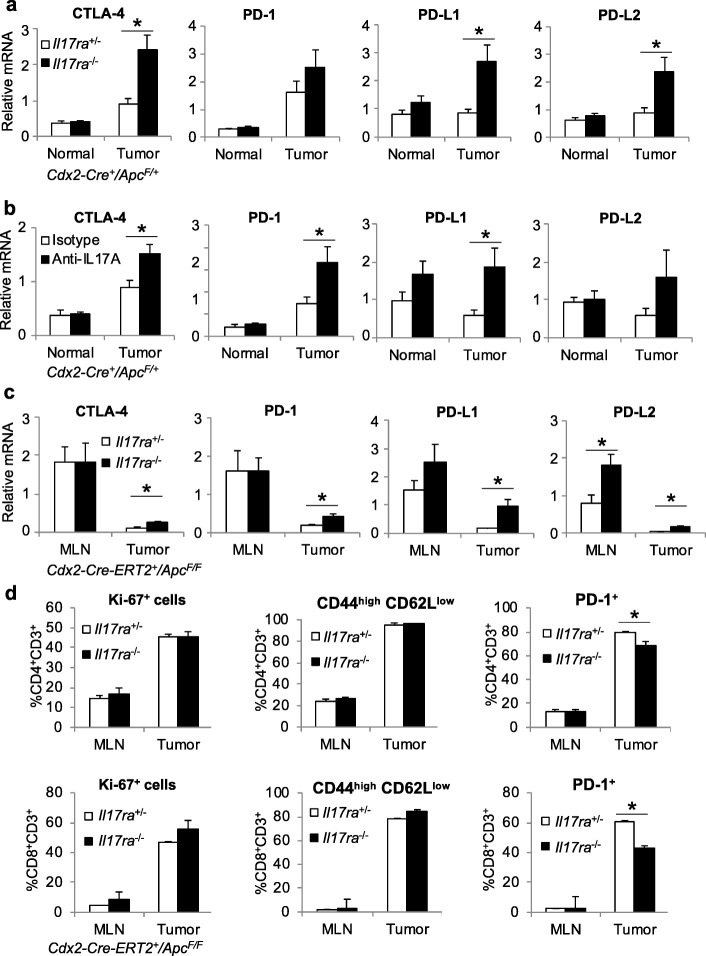
Loss of IL-17 signaling in mouse CRC resulted in marked increase in the recruitment of CD8 cytotoxic T lymphocytes (CTLs) and regulatory T cells (Tregs), starting from early stage CRC lesions. This is accompanied by the increased expression of anti-inflammatory cytokines IL-10 and TGF-β. IL-17 signaling also inhibits the production of T cell attracting chemokines CXCL9 and CXCL10 by tumor cells. Conversely, the inability of hematopoietic cells to respond to CXCL9/10 resulted in decreased tumor infiltration by CTLs and Tregs, decreased levels of IL-10 and TGF-β, and increased numbers of tumor lesions. Blockade of IL-17 signaling resulted in increased expression of immune checkpoint markers. On the other hand, treatment of mouse CRC with anti-CTLA-4 antibody led to increased expression of pro-tumor IL-17.
IL-17 signals to colorectal tumor cells and inhibits their production of CXCL9/10 chemokines. By doing so, IL-17 inhibits the infiltration of CD8 CTLs and Tregs to CRC, thus promoting CRC development. Cancer immunotherapy may be benefited by the use of anti-IL-17 agents as adjuvant therapies, which serve to block both IL-17-mediated tumor promotion and T cell exclusion.
IL-17 家族细胞因子是促进结直肠癌(CRC)发展的有力驱动因素。我们和其他人已经表明,IL-17 主要通过向肿瘤细胞发出信号来促进 CRC,但潜在机制仍不清楚。IL-17 还通过吸引髓样细胞进入肿瘤来抑制 Th1 武装的抗肿瘤免疫。然而,IL-17 是否以更直接的方式控制适应性免疫细胞的活性尚不清楚。
使用散发性或诱导性结直肠癌的小鼠模型,我们在全身或专门在结直肠肿瘤细胞中敲除了 IL-17RA。我们还进行了过继性骨髓重建以敲除造血细胞中的 CXCR3。使用组织学和免疫学实验方法揭示了 IL-17、趋化因子产生和 CRC 发展之间的联系。
在小鼠 CRC 中丧失 IL-17 信号导致从早期 CRC 病变开始,CD8 细胞毒性 T 淋巴细胞(CTL)和调节性 T 细胞(Treg)的募集明显增加。这伴随着抗炎细胞因子 IL-10 和 TGF-β 的表达增加。IL-17 信号还抑制肿瘤细胞产生 T 细胞吸引趋化因子 CXCL9 和 CXCL10。相反,造血细胞无法对 CXCL9/10 做出反应导致 CTL 和 Treg 浸润肿瘤减少,IL-10 和 TGF-β 水平降低,肿瘤病变增多。阻断 IL-17 信号导致免疫检查点标志物表达增加。另一方面,用抗 CTLA-4 抗体治疗小鼠 CRC 导致促肿瘤 IL-17 的表达增加。
IL-17 向结直肠肿瘤细胞发出信号,并抑制其 CXCL9/10 趋化因子的产生。通过这种方式,IL-17 抑制 CD8 CTL 和 Treg 浸润 CRC,从而促进 CRC 发展。癌症免疫疗法可能受益于使用抗 IL-17 药物作为辅助疗法,这些药物既能阻断 IL-17 介导的肿瘤促进作用,又能阻止 T 细胞排斥作用。