Li Hong-Shuai, Tang Ruo, Shi Hua-Shan, Qin Zi-Jian, Zhang Xiao-Yang, Sun Yun-Fei, Wei Zhi-Gong, Ma Chao-Fan, Yang Liu, Chen Ye, Liu Zhe-Ran, Zhu Li-Li, Yang Wen, Yang Li, Xu Ai-Ning, Zhang Zhuo, Liao Shu-Qing, Shi Jin-Shui, Deng Jian-Jun, He Xiao-Zhong, Peng Xing-Chen
Department of Biotherapy, Cancer Center, and National Clinical Research Center for Geriatrics, West China Hospital of Sichuan University, Chengdu, China.
Sichuan Clinical Research Center of Biotherapy, Chengdu, China.
Signal Transduct Target Ther. 2025 Mar 3;10(1):82. doi: 10.1038/s41392-025-02184-0.
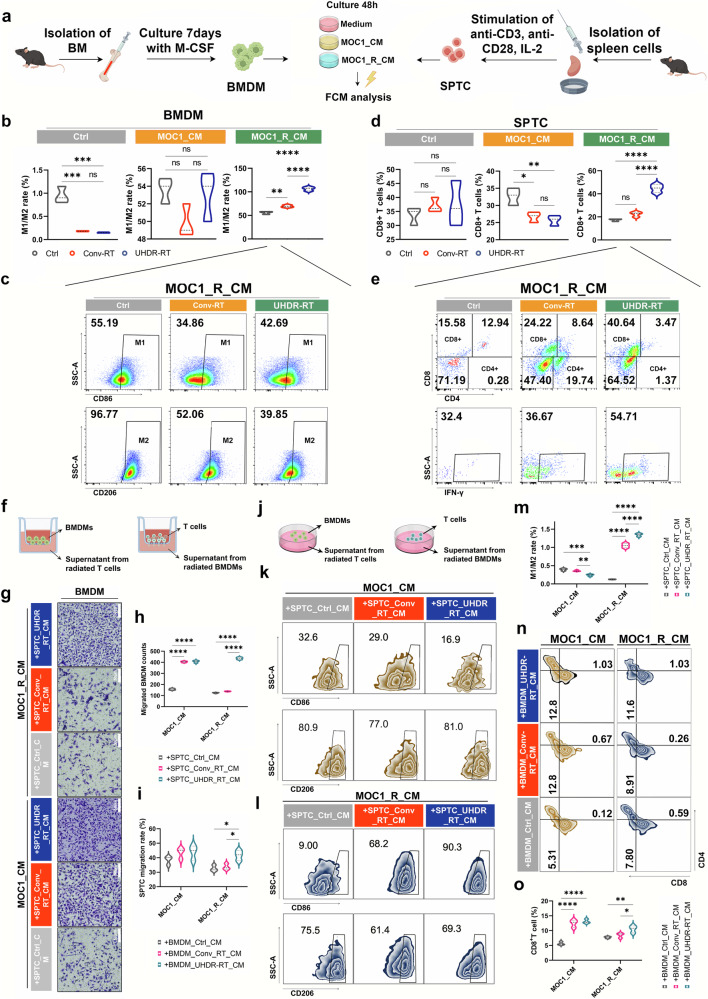
Radiotherapy (RT) resistance in head and neck squamous cell carcinoma (HNSCC) significantly hampers local control and patient prognosis. This study investigated the efficacy and molecular mechanisms of high-energy X-ray-based ultra-high dose rate radiotherapy (UHDR-RT) in overcoming RT resistance. The established RT-resistant HNSCC cell lines and animal models were subjected to UHDR-RT or conventional RT (Conv-RT) via a high-power rhodotron accelerator. Cellular assays assessed the malignant phenotype, viability, and degree of DNA damage, whereas in vivo evaluations focused on tumor proliferation and the tumor immune microenvironment (TiME). Transcriptome sequencing and Olink proteomics were employed to explore the underlying mechanisms involved. In vitro experiments indicated that UHDR-RT suppressed radioresistant cell proliferation and invasion, while promoting apoptosis and exacerbating DNA damage. In contrast, its efficacy in radiosensitive cells was comparable to that of Conv-RT. In vivo studies using patient-derived xenograft nude mice models demonstrated that UHDR-RT only partially reversed RT resistance. Transcriptomic and proteomic analyses of C57BL/6J mice models revealed the predominant role of TiME modulating in reversing radioresistance. Immunofluorescence and flow cytometry confirmed increased CD8 T cells and an increased M1/M2 macrophage ratio post-UHDR-RT. Mechanistically, UHDR-RT activated CD8 T cells, which stimulated M1 macrophages through paracrine IFN-γ signaling, thereby enhancing TiME activation. Furthermore, the activated M1 macrophages secreted CXCL9, which in turn reactivated CD8 T cells, forming a feedforward loop that amplified TiME activation. This study elucidates the dual role of UHDR-RT in directly inducing DNA damage and modulating the TiME, highlighting its potential in treating radioresistant HNSCC.
头颈部鳞状细胞癌(HNSCC)中的放疗(RT)抗性显著阻碍局部控制和患者预后。本研究调查了基于高能X射线的超高剂量率放疗(UHDR-RT)在克服放疗抗性方面的疗效和分子机制。通过高功率回旋加速器对已建立的放疗抗性HNSCC细胞系和动物模型进行UHDR-RT或传统放疗(Conv-RT)。细胞实验评估恶性表型、活力和DNA损伤程度,而体内评估则侧重于肿瘤增殖和肿瘤免疫微环境(TiME)。采用转录组测序和Olink蛋白质组学来探索其中涉及的潜在机制。体外实验表明,UHDR-RT抑制放疗抗性细胞的增殖和侵袭,同时促进凋亡并加剧DNA损伤。相比之下,其在放疗敏感细胞中的疗效与Conv-RT相当。使用患者来源的异种移植裸鼠模型进行的体内研究表明,UHDR-RT仅部分逆转放疗抗性。对C57BL/6J小鼠模型的转录组和蛋白质组分析揭示了TiME调节在逆转放疗抗性中的主要作用。免疫荧光和流式细胞术证实,UHDR-RT后CD8 T细胞增加,M1/M2巨噬细胞比例增加。机制上,UHDR-RT激活CD8 T细胞,后者通过旁分泌IFN-γ信号刺激M1巨噬细胞,从而增强TiME激活。此外,活化的M1巨噬细胞分泌CXCL9,进而重新激活CD8 T细胞,形成一个前馈回路,放大TiME激活。本研究阐明了UHDR-RT在直接诱导DNA损伤和调节TiME方面的双重作用,突出了其在治疗放疗抗性HNSCC中的潜力。