Programa de Pós-Graduação em Saúde Coletiva, Centro de Ciências da Saúde, Universidade de Fortaleza, Fortaleza, CE, Brasil.
Serviço de Emergência Cardiológica, Hospital Dr. Carlos Alberto Studart Gomes, Secretaria da Saúde do Estado do Ceará, Fortaleza, CE, Brasil.
Braz J Med Biol Res. 2019 Nov 25;52(12):e8658. doi: 10.1590/1414-431X20198658. eCollection 2019.
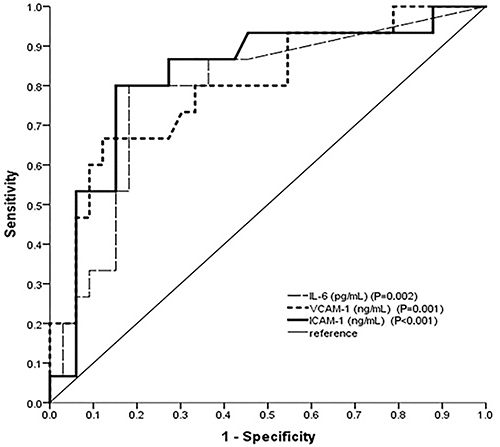
Acute coronary syndromes are associated with a high prevalence of complications including heart failure (HF). The aim of this study was to investigate the association of novel biomarkers with the occurrence of post-acute myocardial infarction (AMI) HF. A prospective study was conducted with patients admitted to the emergency department with ST-segment elevation myocardial infarction (STEMI). Blood and urine samples were collected for analysis of traditional and novel biomarkers, including interleukin-6, vascular cell adhesion molecule 1 (VCAM-1), and intercellular adhesion molecule-1 (ICAM-1). We compared the levels of these biomarkers between patients with and without post-STEMI HF. A total of 48 patients were assessed, with a prevalence of males. Fifteen patients (31.2%) had post-STEMI HF. Patients with HF had higher mean values of IL-6, VCAM-1, and ICAM-1 compared to those who did not develop HF (57.06 vs 14.03 pg/mL, P=0.001; 1719.58 vs 1304.34 ng/mL, P=0.001; and 1594.20 vs 1158.74 ng/mL, P<0.001, respectively). The three biomarkers were shown to be good predictors of post-STEMI HF (IL-6: AUC 0.786, P=0.002; VCAM-1: AUC 0.797, P=0.001; and ICAM-1: AUC 0.825, P<0.0001), with the respective cutoff points being calculated based on the best sensitivity and specificity indexes (IL-6: 8.67 pg/mL; VCAM-1: 1501.42 ng/mL; and ICAM-1: 1262.38 ng/mL). Of the three biomarkers, only VCAM-1 and ICAM-1 had a direct linear association between them (r=0.470, P<0.0001). IL-6, VCAM-1, and ICAM-1 were associated with the development of new post-AMI HF symptoms, but only VCAM-1 and ICAM-1 correlated with each other, possibly because they have the same pathophysiological mechanism of action.
急性冠状动脉综合征与包括心力衰竭(HF)在内的多种并发症的高发病率相关。本研究的目的是探讨新型生物标志物与急性心肌梗死后(AMI)HF 的发生之间的关系。这是一项对因 ST 段抬高型心肌梗死(STEMI)而入住急诊部的患者进行的前瞻性研究。采集血液和尿液样本,用于分析包括白细胞介素-6(IL-6)、血管细胞黏附分子 1(VCAM-1)和细胞间黏附分子 1(ICAM-1)在内的传统和新型生物标志物。我们比较了这些标志物在有和没有 STEMI 后 HF 患者之间的水平。共评估了 48 例患者,男性患者占多数。15 例(31.2%)患者发生 STEMI 后 HF。与未发生 HF 的患者相比,HF 患者的 IL-6、VCAM-1 和 ICAM-1 平均值较高(57.06 与 14.03 pg/mL,P=0.001;1719.58 与 1304.34 ng/mL,P=0.001;1594.20 与 1158.74 ng/mL,P<0.001)。这三种生物标志物均能很好地预测 STEMI 后 HF(IL-6:AUC 0.786,P=0.002;VCAM-1:AUC 0.797,P=0.001;ICAM-1:AUC 0.825,P<0.0001),最佳灵敏度和特异性指数对应的截断值分别为(IL-6:8.67 pg/mL;VCAM-1:1501.42 ng/mL;ICAM-1:1262.38 ng/mL)。在这三种生物标志物中,只有 VCAM-1 和 ICAM-1 之间存在直接线性关联(r=0.470,P<0.0001)。IL-6、VCAM-1 和 ICAM-1 与新发 AMI 后 HF 症状的发生有关,但只有 VCAM-1 和 ICAM-1 之间存在相关性,这可能是因为它们具有相同的病理生理作用机制。