Tianjin Medical University, Tianjin, China.
Department of Cardiology, Cangzhou Central Hospital of Tianjin Medical University, Cangzhou, China.
J Clin Lab Anal. 2022 Oct;36(10):e24685. doi: 10.1002/jcla.24685. Epub 2022 Aug 31.
Vascular cell adhesion molecule-1 (VCAM-1) and intercellular adhesion molecule-1 (ICAM-1) modulate atherosclerosis by promoting leukocyte infiltration, neutrophil recruitment, endothelial cell proliferation, etc., which may directly or indirectly facilitate the occurrence of major adverse cardiac events (MACE). This study intended to investigate the value of VCAM-1 and ICAM-1 for predicting MACE in ST-segment elevation myocardial infarction (STEMI) patients.
Totally, 373 STEMI patients receiving the percutaneous coronary intervention and 50 health controls (HCs) were included. Serum VCAM-1 and ICAM-1 were detected by ELISA. Meanwhile, MACE was recorded during a median follow-up of 18 (range: 1-46) months in STEMI patients.
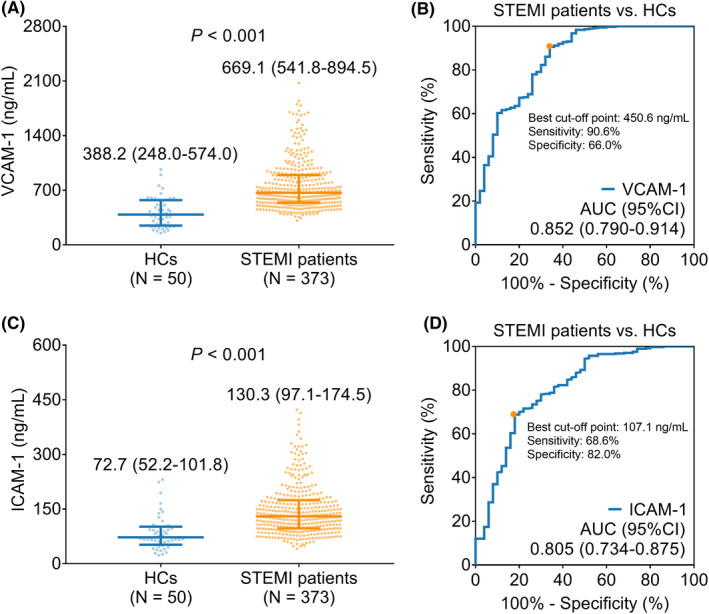
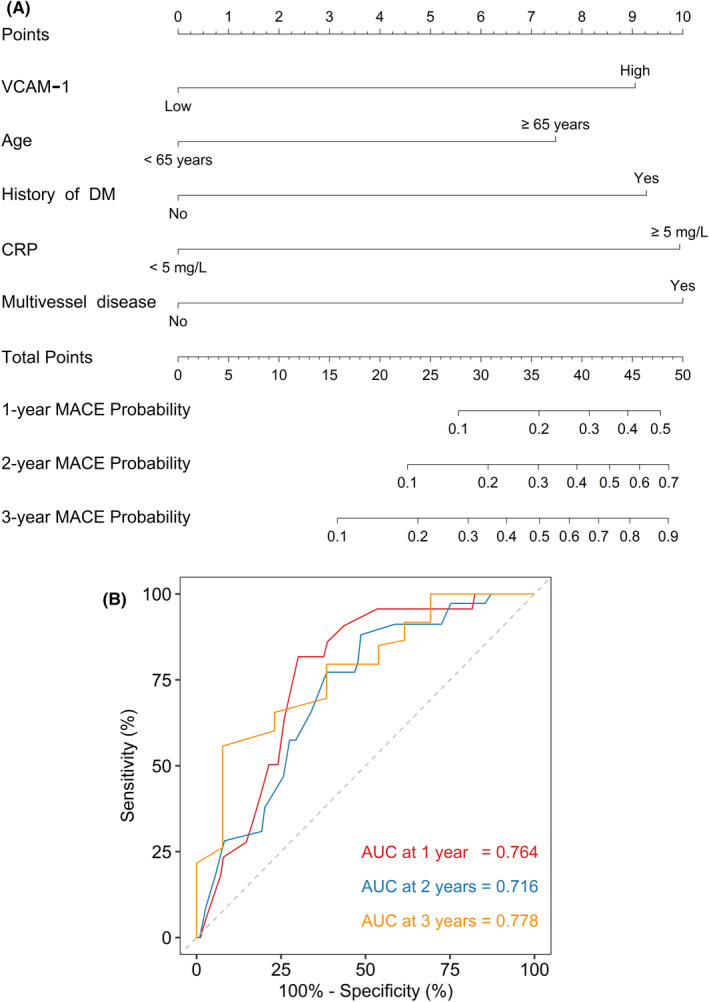
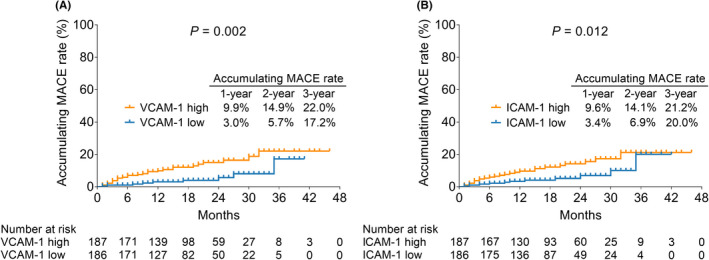
Vascular cell adhesion molecule-1 and ICAM-1 were raised in STEMI patients compared with HCs (both p < 0.001). VCAM-1 (p = 0.002) and ICAM-1 (p = 0.012) high were linked with raised accumulating MACE rate in STEMI patients. Notably, VCAM-1 high (hazard ratio [HR] = 2.339, p = 0.031), age ≥ 65 years (HR = 2.019, p = 0.039), history of diabetes mellitus (DM) (HR = 2.395, p = 0.011), C-reactive protein (CRP) ≥ 5 mg/L (HR = 2.550, p = 0.012), multivessel disease (HR = 2.561, p = 0.007) independently predicted MACE risk in STEMI patients. Furthermore, a nomogram-based prediction model combining these factors was established, exhibiting an acceptable value for estimating 1, 2, and 3-year MACE risk, with AUC of 0.764, 0.716, and 0.778, respectively, in STEMI patients.
This study confirms the value of VCAM-1 and ICAM-1 measurement in predicting MACE risk in STEMI patients. Moreover, VCAM-1 plus other traditional prognostic factors (such as age, history of DM, CRP, and multivessel disease) cloud further improve the predictive accuracy of MACE risk in STEMI patients.
血管细胞黏附分子-1(VCAM-1)和细胞间黏附分子-1(ICAM-1)通过促进白细胞浸润、中性粒细胞募集、内皮细胞增殖等作用调节动脉粥样硬化,这可能直接或间接促进主要不良心脏事件(MACE)的发生。本研究旨在探讨 VCAM-1 和 ICAM-1 对 ST 段抬高型心肌梗死(STEMI)患者发生 MACE 的预测价值。
共纳入 373 例接受经皮冠状动脉介入治疗的 STEMI 患者和 50 例健康对照者(HCs)。采用 ELISA 法检测血清 VCAM-1 和 ICAM-1。同时,对 STEMI 患者进行中位 18(范围:1-46)个月的随访,记录 MACE 事件。
与 HCs 相比,STEMI 患者的 VCAM-1 和 ICAM-1 升高(均 p<0.001)。VCAM-1(p=0.002)和 ICAM-1(p=0.012)高与 STEMI 患者累积 MACE 发生率升高相关。值得注意的是,VCAM-1 高(风险比[HR] = 2.339,p=0.031)、年龄≥65 岁(HR = 2.019,p=0.039)、糖尿病病史(DM)(HR = 2.395,p=0.011)、C 反应蛋白(CRP)≥5mg/L(HR = 2.550,p=0.012)、多血管病变(HR = 2.561,p=0.007)是 STEMI 患者发生 MACE 的独立预测因素。此外,建立了一个基于列线图的预测模型,该模型结合了这些因素,对 STEMI 患者 1、2、3 年发生 MACE 的风险有较好的评估价值,AUC 分别为 0.764、0.716 和 0.778。
本研究证实了 VCAM-1 和 ICAM-1 测量在预测 STEMI 患者 MACE 风险中的价值。此外,VCAM-1 联合其他传统预后因素(如年龄、DM 病史、CRP 和多血管病变)可进一步提高 STEMI 患者发生 MACE 风险的预测准确性。