Bacteriophage Therapy and Phage Bio-control Laboratory, Department of Microbiology, Faculty of Natural and Agricultural Sciences, North-West University, Private Bag X2046, Mmabatho 2745, South Africa.
Center for Animal Health Studies, Faculty of Natural and Agricultural Sciences, North-West University, Private Bag X2046, Mmabatho 2745, South Africa.
Toxins (Basel). 2019 Nov 26;11(12):692. doi: 10.3390/toxins11120692.
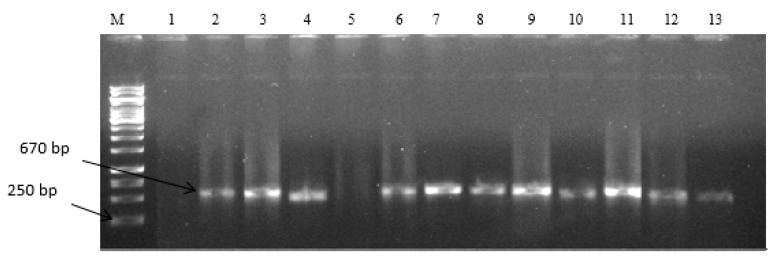
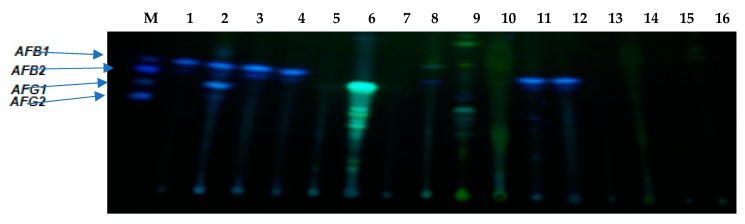
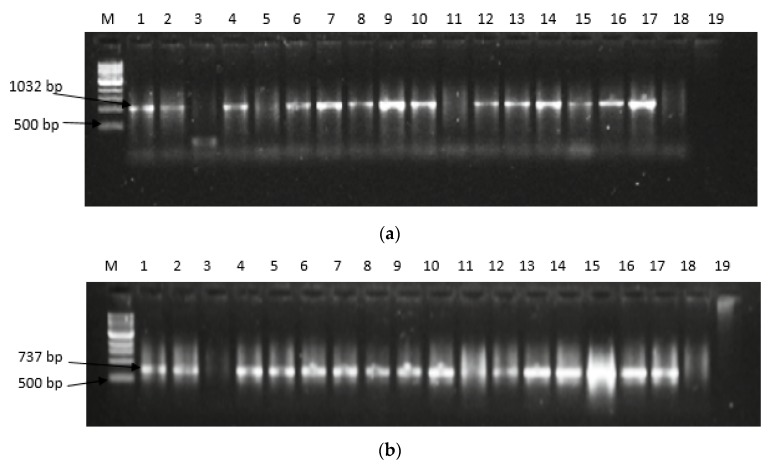
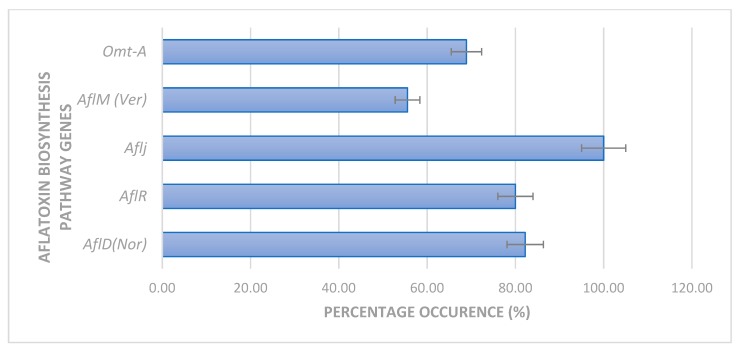
This study investigated the aflatoxin production potentials of selected fungi using a polyphasic approach. Internally transcribed spacer region of the fungi was amplified using the polymerase chain reaction. Forty-five strains were further assessed for aflatoxin production using the conventional methods such as growth on yeast extract sucrose, β-cyclodextrin neutral red desiccated coconut agar (β-CNRDCA); expression of the aflatoxin regulatory genes and the use of both thin-layer chromatography (TLC) and high-performance liquid chromatography (HPLC). A large proportion (82.22%) of the isolates harbored the -1 gene while 55.56%, 68.89%, and 80% possessed the -1, -A, and R genes, respectively. All 100% the isolates harbored the J gene. Twenty-three isolates were positive for aflatoxin production based on the yeast extract sucrose medium (YES) test; ammonium vapor test (51%), yellow pigment production (75.5%), and β-CNRDCA tests; and blue/green fluorescence (57.7%). Based on TLC detection 42.2% produced aflatoxins while in the HPLC, total aflatoxin (AFTOT) production concentrations ranged from 6.77-71,453 µg/g. Detectable aflatoxin B1 (AFB1) concentrations obtained from the HPLC ranged between 3.76 and 70,288 µg/g; 6.77 and 242.50 µg/g for aflatoxin B2 (AFB2); 1.87 and 745.30 µg/g for aflatoxin G1 (AFG1); and 1.67 and 768.52 µg/g for aflatoxin G2 (AFG2). AFTOT contamination levels were higher than European Union tolerable limits (4 µg/kg). The regression coefficient was one ( = 1) while significant differences exist in the aflatoxin concentrations of ( ≤ 0.05). This study reports the potentials of previously known as a non-aflatoxin producer to produce AFG1, AFG2, AFB1, and AFB2 toxins. species in feedlots of animals reared for food are capable of producing aflatoxins which could pose hazards to health.
本研究采用多相方法研究了选定真菌的黄曲霉毒素产生潜力。使用聚合酶链反应扩增真菌的内部转录间隔区。进一步使用传统方法(如在酵母提取物蔗糖、β-环糊精中性红干燥椰子琼脂(β-CNRDCA)上生长;表达黄曲霉毒素调控基因以及使用薄层色谱(TLC)和高效液相色谱(HPLC))评估了 45 株菌株的黄曲霉毒素产生能力。很大一部分(82.22%)分离株携带-1 基因,而 55.56%、68.89%和 80%分别携带-1、-A 和 R 基因。所有 100%的分离株都携带 J 基因。根据酵母提取物蔗糖培养基(YES)试验,23 株分离株呈黄曲霉毒素阳性;氨气蒸气试验(51%)、黄色色素产生(75.5%)和β-CNRDCA 试验;以及蓝/绿荧光(57.7%)。基于 TLC 检测,42.2%产生黄曲霉毒素,而在 HPLC 中,总黄曲霉毒素(AFTOT)的产生浓度范围为 6.77-71,453 µg/g。从 HPLC 中获得的可检测黄曲霉毒素 B1(AFB1)浓度范围为 3.76-70,288 µg/g;6.77-242.50 µg/g 为黄曲霉毒素 B2(AFB2);1.87-745.30 µg/g 为黄曲霉毒素 G1(AFG1);1.67-768.52 µg/g 为黄曲霉毒素 G2(AFG2)。AFTOT 污染水平高于欧盟可容忍限度(4 µg/kg)。回归系数为 1(=1),而( ≤ 0.05)中黄曲霉毒素浓度存在显著差异。本研究报告了先前被认为是非黄曲霉毒素产生者的 产生 AFG1、AFG2、AFB1 和 AFB2 毒素的潜力。在用于食物的动物饲养场的饲料中, 物种能够产生黄曲霉毒素,这可能对健康构成危害。