State Key Laboratory of Genetic Resources and Evolution, Kunming Institute of Zoology, Chinese Academy of Sciences, Kunming, 650223, Yunnan, China.
Kunming College of Life Science, University of the Chinese Academy of Sciences, Kunming, 650223, Yunnan, China.
Genome Biol. 2019 Nov 28;20(1):258. doi: 10.1186/s13059-019-1866-1.
Brain aging is a complex process that depends on the precise regulation of multiple brain regions; however, the underlying molecular mechanisms behind this process remain to be clarified in non-human primates.
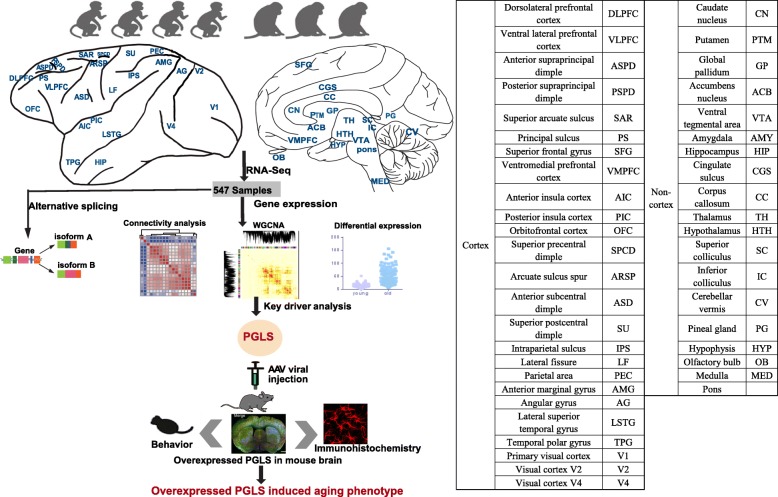
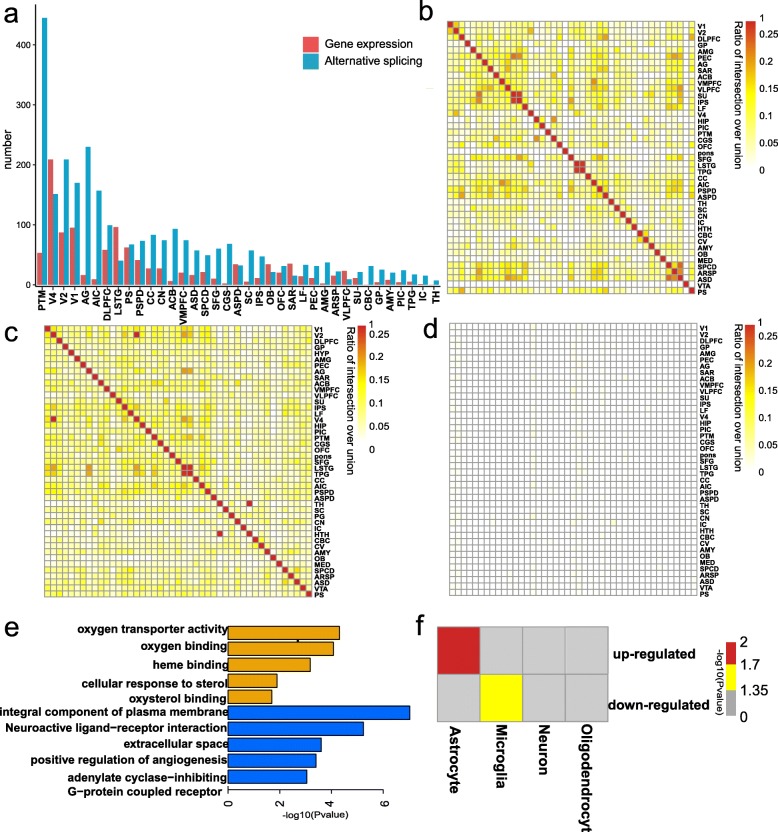
Here, we explore non-human primate brain aging using 547 transcriptomes originating from 44 brain areas in rhesus macaques (Macaca mulatta). We show that expression connectivity between pairs of cerebral cortex areas as well as expression symmetry between the left and right hemispheres both decrease after aging. Although the aging mechanisms across different brain areas are largely convergent, changes in gene expression and alternative splicing vary at diverse genes, reinforcing the complex multifactorial basis of aging. Through gene co-expression network analysis, we identify nine modules that exhibit gain of connectivity in the aged brain and uncovered a hub gene, PGLS, underlying brain aging. We further confirm the functional significance of PGLS in mice at the gene transcription, molecular, and behavioral levels.
Taken together, our study provides comprehensive transcriptomes on multiple brain regions in non-human primates and provides novel insights into the molecular mechanism of healthy brain aging.
大脑衰老过程是一个复杂的过程,依赖于多个脑区的精确调控;然而,在非人类灵长类动物中,这一过程背后的潜在分子机制仍有待阐明。
在这里,我们使用源自食蟹猴(Macaca mulatta)44 个脑区的 547 个转录组来探索非人类灵长类动物的大脑衰老。我们表明,大脑皮层区域之间的表达连接性以及左右半球之间的表达对称性都随着衰老而降低。尽管不同脑区的衰老机制在很大程度上是趋同的,但基因表达和可变剪接的变化在不同基因上存在差异,这强化了衰老的复杂多因素基础。通过基因共表达网络分析,我们鉴定了九个在老年大脑中表现出连接性增加的模块,并发现了一个枢纽基因 PGLS,它是大脑衰老的基础。我们进一步在基因转录、分子和行为水平上证实了 PGLS 在小鼠中的功能意义。
综上所述,我们的研究提供了非人类灵长类动物多个脑区的综合转录组图谱,并为健康大脑衰老的分子机制提供了新的见解。