Conflict Medicine Program, Global Health Institute, American University of Beirut, Beirut, 1107 2020, Lebanon.
School of Politics & International Relations, Queen Mary University of London, London, E1 4NS, UK.
Global Health. 2019 Nov 28;15(1):81. doi: 10.1186/s12992-019-0525-3.
In conflict settings, research capacities have often been de-prioritized as resources are diverted to emergency needs, such as addressing elevated morbidity, mortality and health system challenges directly and/or indirectly associated to war. This has had an adverse long-term impact in such protracted conflicts such as those found in the Middle East and North Africa region (MENA), where research knowledge and skills have often been compromised. In this paper, we propose a conceptual framework for health research capacity strengthening that adapts existing models and frameworks in low- and middle-income countries and uses our knowledge of the MENA context to contextualise them for conflict settings.
The framework was synthesized using "best fit" framework synthesis methodology. Relevant literature, available in English and Arabic, was collected through PubMed, Google Scholar and Google using the keywords: capacity building; capacity strengthening; health research; framework and conflict. Grey literature was also assessed.
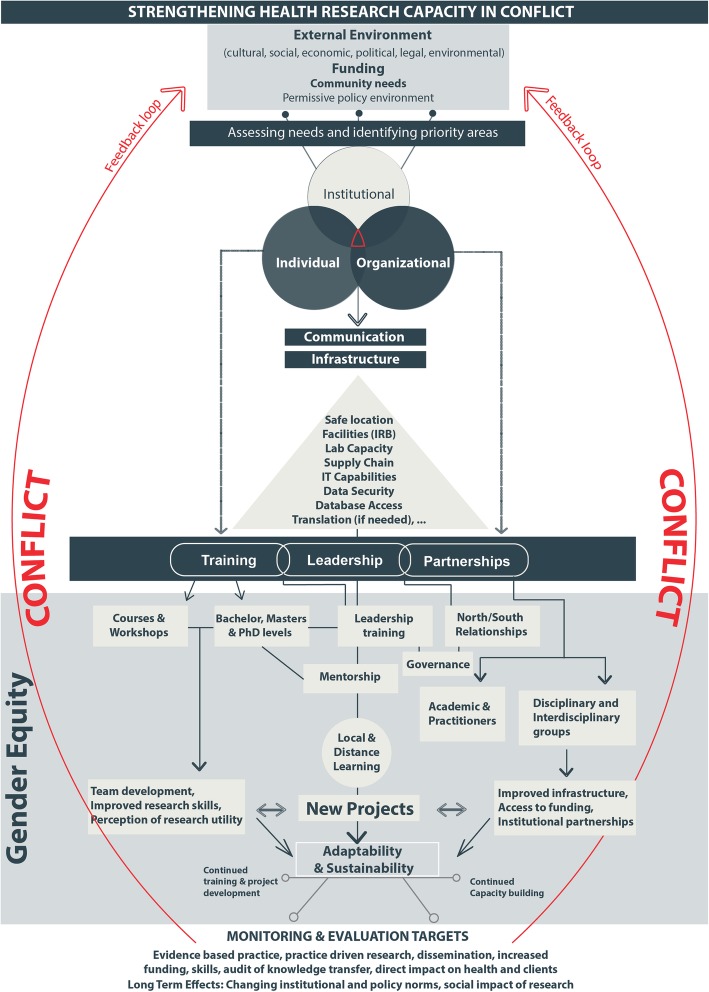
The framework is composed of eight principal themes: "structural levels", "the influence of the external environment", "funding, community needs and policy environment", "assessing existing capacity and needs", "infrastructure and communication", "training, leadership and partnership", "adaptability and sustainability", and "monitoring and evaluation"; with each theme being supported by examples from the MENA region. Our proposed framework takes into consideration safety, infrastructure, communication and adaptability as key factors that affect research capacity strengthening in conflict. As it is the case more generally, funding, permissible political environments and sustainability are major determinants of success for capacity strengthening for health research programmes, though these are significantly more challenging in conflict settings. Nonetheless, health research capacity strengthening should remain a priority.
The model presented is the first framework that focuses on strengthening health research capacity in conflict with a focus on the MENA region. It should be viewed as a non-prescriptive reference tool for health researchers and practitioners, from various disciplines, involved in research capacity strengthening to evaluate, use, adapt and improve. It can be further extended to include representative indicators and can be later evaluated by assessing its efficacy for interventions in conflict settings.
在冲突环境下,资源往往被转移到紧急需求上,例如直接和/或间接应对与战争相关的发病率、死亡率和卫生系统挑战,因此研究能力常常被置于次要地位。这种情况对中东和北非地区(MENA)等长期冲突产生了不利的长期影响,在这些地区,研究知识和技能常常受到影响。在本文中,我们提出了一个健康研究能力建设的概念框架,该框架适应了中低收入国家现有的模式和框架,并利用我们对 MENA 背景的了解对其进行了调整,以适应冲突环境。
该框架采用“最佳契合度”框架综合方法合成。通过 PubMed、Google Scholar 和 Google 使用关键词:能力建设;能力加强;健康研究;框架和冲突,收集了英语和阿拉伯语的相关文献。还评估了灰色文献。
该框架由八个主要主题组成:“结构层次”、“外部环境的影响”、“资金、社区需求和政策环境”、“评估现有能力和需求”、“基础设施和沟通”、“培训、领导力和伙伴关系”、“适应性和可持续性”以及“监测和评估”;每个主题都有来自 MENA 地区的例子支持。我们提出的框架考虑了安全、基础设施、沟通和适应性等关键因素,这些因素会影响冲突中的研究能力建设。一般来说,资金、允许的政治环境和可持续性是健康研究计划能力建设成功的主要决定因素,但在冲突环境下,这些因素更具挑战性。尽管如此,健康研究能力建设仍应是一个优先事项。
提出的模型是第一个专注于加强冲突中健康研究能力的框架,重点是 MENA 地区。它应被视为从事研究能力建设的各学科健康研究人员和从业人员的非规定性参考工具,用于评估、使用、调整和改进。它可以进一步扩展到包括代表性指标,并可以通过评估其在冲突环境中的干预效果来进行后续评估。