Unanue Wenceslao, Gomez Mella Marcos Esteban, Cortez Diego Alejandro, Bravo Diego, Araya-Véliz Claudio, Unanue Jesús, Van Den Broeck Anja
Escuela de Negocios, Universidad Adolfo Ibáñez, Santiago, Chile.
Escuela de Psicología, Universidad Adolfo Ibáñez, Santiago, Chile.
Front Psychol. 2019 Nov 8;10:2480. doi: 10.3389/fpsyg.2019.02480. eCollection 2019.
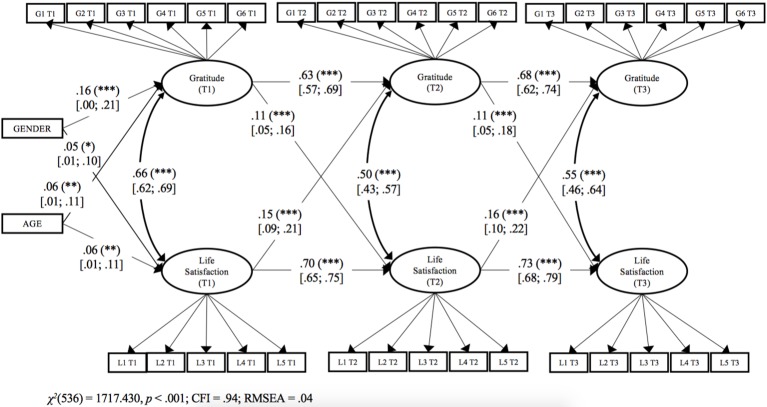
Gratitude and life satisfaction are associated with several indicators of a good life (e.g., health, pro-social behavior, and relationships). However, how gratitude and life satisfaction relate to each other over time has remained unknown until now. Although a substantial body of research has tested the link from gratitude to life satisfaction, the reverse association remains unexplored. In addition, recent cross-cultural research has questioned the link between gratitude and subjective well-being in non-Western countries, suggesting that the benefits of gratitude may only prevail in Western societies. However, previous cross-cultural studies have only compared western (e.g., American) and eastern (e.g., Asian) cultures, but this simple contrast does not adequately capture the diversity in the world. To guide further theory and practice, we therefore extended previous cross-sectional and experimental studies, by testing the bi-directional longitudinal link between gratitude and life satisfaction in a Latin American context, aiming to establish temporal precedence. We assessed two adult samples from Chile, using three-wave cross-lagged panel designs with 1 month (Study 1, = 725) and 3 months (Study 2, = 1,841) between waves. Both studies show, for the first time, that gratitude and life satisfaction mutually predict each other over time. The reciprocal relationships suggest the existence of a virtuous circle of human well-being: higher levels of gratitude increase life satisfaction, which in turn increases gratitude, leading to a positive spiral. Key theoretical and practical implications for the dynamics of human flourishing and field of positive psychology are discussed.
感恩与生活满意度与美好生活的几个指标相关(例如,健康、亲社会行为和人际关系)。然而,到目前为止,感恩与生活满意度如何随时间相互关联仍不为人所知。尽管大量研究检验了从感恩到生活满意度的联系,但反向关联仍未得到探索。此外,最近的跨文化研究对非西方国家感恩与主观幸福感之间的联系提出了质疑,表明感恩的益处可能仅在西方社会盛行。然而,以往的跨文化研究仅比较了西方(如美国)和东方(如亚洲)文化,但这种简单对比并不能充分体现世界的多样性。因此,为了指导进一步的理论和实践,我们扩展了以往的横断面研究和实验研究,通过在拉丁美洲背景下检验感恩与生活满意度之间的双向纵向联系,旨在确定时间先后顺序。我们使用三波交叉滞后面板设计,对来自智利的两个成年人样本进行了评估,两波之间的时间间隔分别为1个月(研究1,n = 725)和3个月(研究2,n = 1841)。两项研究首次表明,感恩与生活满意度随时间相互预测。这种相互关系表明存在人类幸福的良性循环:更高水平的感恩会提高生活满意度,而生活满意度反过来又会增加感恩,从而形成一个积极的螺旋上升。本文讨论了对人类繁荣动态和积极心理学领域的关键理论和实践意义。