Puranitee Pongtong, Saetang Siam, Sumrithe Sutida, Busari Jamiu O, van Mook Walther N K A, Heeneman Sylvia
Ramathibodi Hospital, Faculty of Medicine, Mahidol University, Bangkok, Thailand.
Department of Educational Development & Research, Faculty of Health, Medicine & Life Sciences (FHML), Maastricht University (UM), The Netherlands.
Int J Med Educ. 2019 Nov 29;10:223-229. doi: 10.5116/ijme.5dc6.8228.
To examine the psychometric properties of the Maslach Burnout Inventory-Student Survey (MBI-SS) Thai version and to determine the frequency of burnout and correlation between burnout and associated factors.
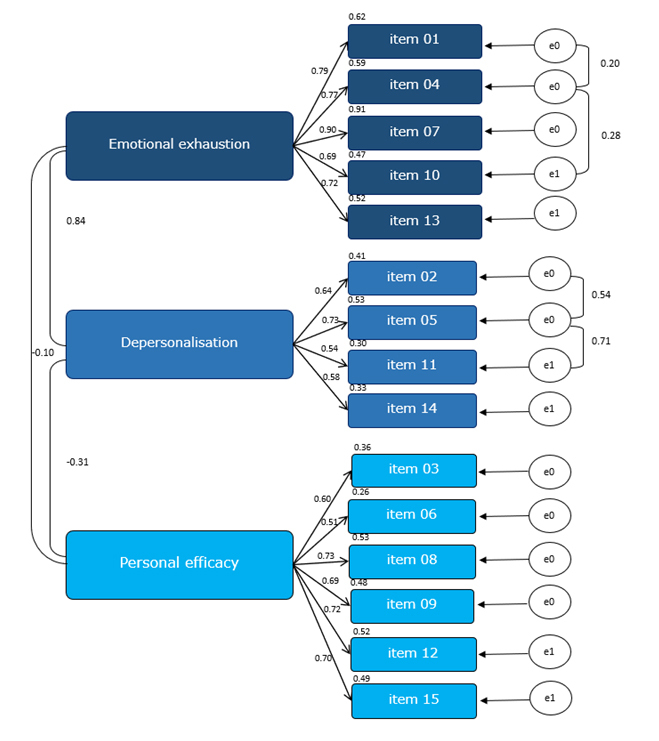
A cross-sectional study was conducted among undergraduate medical students using convenience sampling (n=545, 76.1% response rate, female 52.1%). Data were collected by a self-report survey. The MBI-SS was translated in Thai and tested for internal consistency using Cronbach's coefficient alpha. A confirmatory factor analysis was performed using as fit indices of the chi-square and degree of freedom ratio (χ/df), Comparative Fit Index (CFI), the Goodness of Fit Index (GFI), the Non-normed Fit Index (NNFI), Akaike information criterion (AIC) and the Root Mean Square Error of Approximation (RMSEA). Spearman and Kendall's tau-b were used to identify correlations between burnout, depression and other factors.
Interrater reliability was acceptable with Kappa of 0.83. Confirmatory factor analysis demonstrated good fit indices (χ/df=197.62/83, CFI=0.97, GFI=0.95, NNFI=0.96, AIC=271.62 and RMSEA=0.06). Burnout had a weak, positive association with the PHQ-9 (r=0.294, df=2, p< 0.001). The screening depression score had a significant, modest positive association with emotional exhaustion (r=0.469, df=4, p<0.001) and cynicism (r=0.411, df=4, p< 0.001), and a weak inverse association with professional efficacy (r=-0.273, df=4, p< 0.001).
The Thai version of the MBI-SS had adequate psychometric properties among Thai medical students and can be used to assess burnout among undergraduate medical students in Thailand. Burnout was associated with risk for depression. Further studies on other associated factors contributing to depression are suggested.
检验中文版马氏倦怠量表-学生问卷(MBI-SS)的心理测量特性,并确定倦怠的发生率以及倦怠与相关因素之间的相关性。
采用便利抽样法对本科医学生进行横断面研究(n = 545,应答率76.1%,女性占52.1%)。通过自填式调查问卷收集数据。MBI-SS被翻译成泰语,并使用克朗巴哈系数α检验其内部一致性。采用卡方与自由度比(χ/df)、比较拟合指数(CFI)、拟合优度指数(GFI)、非规范拟合指数(NNFI)、赤池信息准则(AIC)和近似均方根误差(RMSEA)作为拟合指标进行验证性因素分析。使用斯皮尔曼相关系数和肯德尔tau-b系数来确定倦怠、抑郁与其他因素之间的相关性。
评分者间信度可接受,卡帕值为0.83。验证性因素分析显示拟合指标良好(χ/df = 197.62/83,CFI = 0.97,GFI = 0.95,NNFI = 0.96,AIC = 271.62,RMSEA = 0.06)。倦怠与患者健康问卷-9(PHQ-9)呈弱正相关(r = 0.294,自由度 = 2,p < 0.001)。筛查抑郁得分与情感耗竭(r = 0.469,自由度 = 4,p < 0.001)和玩世不恭态度(r = 0.411,自由度 = 4,p < 0.001)呈显著中度正相关,与职业效能呈弱负相关(r = -0.273,自由度 = 4,p < 0.001)。
泰语版MBI-SS在泰国医学生中具有足够的心理测量特性,可用于评估泰国本科医学生的倦怠情况。倦怠与抑郁风险相关。建议进一步研究导致抑郁的其他相关因素。