Kim Jisu, Park Jonghoon, Kim Nahyun, Park Hun-Young, Lim Kiwon
1Department of Sports Medicine and Science, Konkuk University, Gwangjin-gu, Seoul Korea.
2Physical Activity and Performance Institute (PAPI), Konkuk University, Gwangjin-gu, Seoul Korea.
Nutr Metab (Lond). 2019 Nov 27;16:82. doi: 10.1186/s12986-019-0406-z. eCollection 2019.
Androgen hormone levels are strongly associated with obesity in adult mammals, especially with advanced age. We investigated androgen receptor inhibition on fat metabolism and long-chain fatty acid (LCFA) transport proteins in skeletal muscle during exercise.
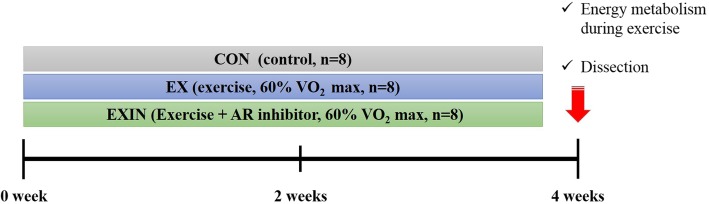
Male ICR mice were randomly divided into three groups: CON (control), EX (exercise), and EXIN (exercise + androgen receptor inhibition). EX and EXIN groups were trained on a treadmill five times a week. After 4 weeks, the fat metabolism of each group was measured using open-circuit calorimetry during 1 hour of exercise. After the metabolism measurement, the expression levels of LCFA transport proteins (FAT/CD36, CPTI) were analyzed in skeletal muscle.
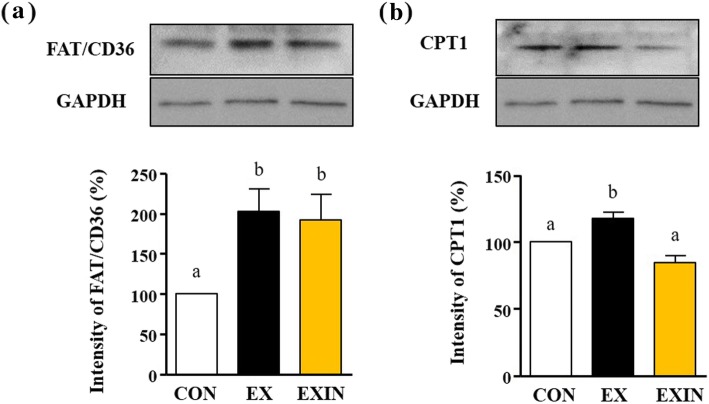
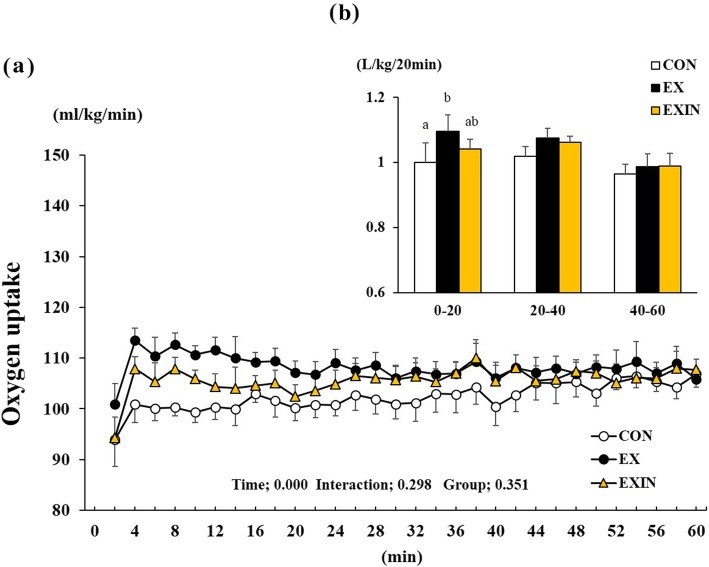
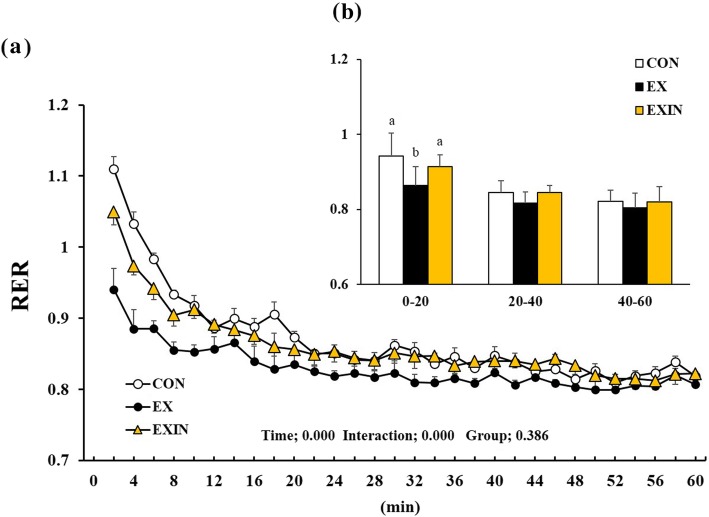
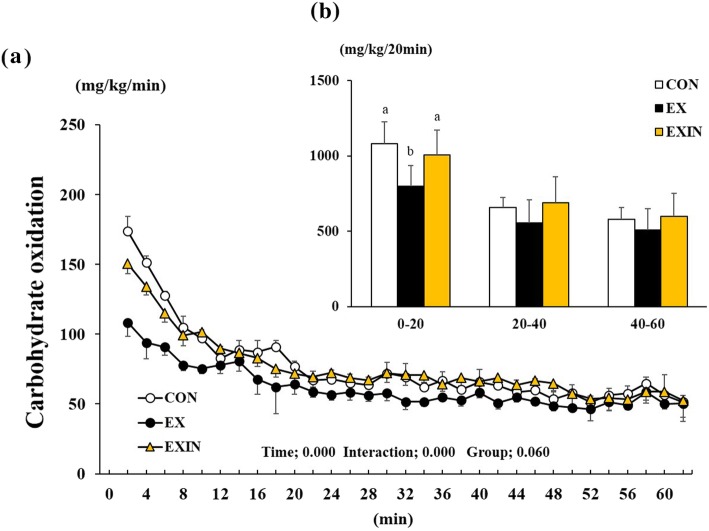
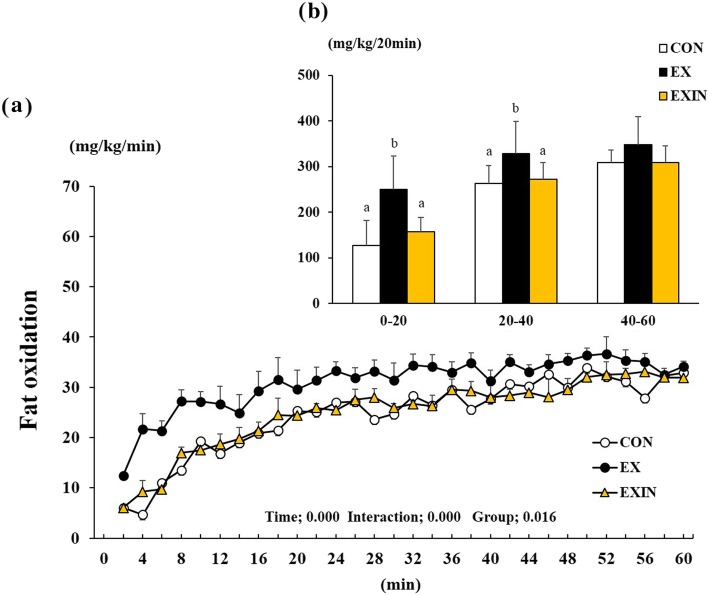
Weight gain and final body weight were significantly lower in the EX group than in either the CON or EXIN groups. Conversely, food intake was significantly higher in the EX group than it was in the CON and EXIN groups. The total weight (CON; 2.07 ± 0.6, EX; 1.64 ± 0.2, EXIN; 1.95 ± 0.2) of the abdominal adipose tissue were significantly lower in the EX group than in the CON and EXIN groups ( < 0.05). However, there was no different between the CON and EXIN group. Oxygen uptake and fat oxidation during exercise tended to be lower (12%) in the EXIN group than in the EX group. Total fat oxidation in the EXIN group was significantly lower during the initial 20-min ( < 0.003) and 40-min ( < 0.041) phases compared to that in the EX group. In addition, the level of FAT/CD36 protein in the EX and EXIN groups was approximately double that in the CON group ( < 0.001, < 0.001). CPTI expression in the EX group was higher than that in the EX group ( < 0.0069) as well as in the CON group.
Exercise training increases the expression of LCFA transport proteins (FAT/CD36, CPTI). Blocking androgen receptors can decreases the expression of CPTI in the skeletal muscle, which reduces fat metabolism. Thus, reducing sex hormones or suppressing the sensitivity of AR receptors can inhibit energy efficiency and fat metabolism by suppressing CPTI.
雄激素水平与成年哺乳动物的肥胖密切相关,尤其是在高龄阶段。我们研究了运动期间雄激素受体抑制对骨骼肌脂肪代谢和长链脂肪酸(LCFA)转运蛋白的影响。
将雄性ICR小鼠随机分为三组:CON(对照组)、EX(运动组)和EXIN(运动+雄激素受体抑制组)。EX组和EXIN组每周在跑步机上训练五次。4周后,在运动1小时期间使用开路量热法测量每组的脂肪代谢。代谢测量后,分析骨骼肌中LCFA转运蛋白(FAT/CD36、CPTI)的表达水平。
EX组的体重增加和最终体重显著低于CON组和EXIN组。相反,EX组的食物摄入量显著高于CON组和EXIN组。EX组腹部脂肪组织的总重量(CON组;2.07±0.6,EX组;1.64±0.2,EXIN组;1.95±0.2)显著低于CON组和EXIN组(<0.05)。然而,CON组和EXIN组之间没有差异。EXIN组运动期间的摄氧量和脂肪氧化倾向于比EX组低(12%)。与EX组相比,EXIN组在最初20分钟(<0.003)和40分钟(<0.041)阶段的总脂肪氧化显著降低。此外,EX组和EXIN组中FAT/CD36蛋白水平约为CON组的两倍(<0.001,<0.001)。EX组中CPTI的表达高于EX组(<0.0069)以及CON组。
运动训练可增加LCFA转运蛋白(FAT/CD36、CPTI)的表达。阻断雄激素受体可降低骨骼肌中CPTI的表达,从而减少脂肪代谢。因此,降低性激素或抑制AR受体的敏感性可通过抑制CPTI来抑制能量效率和脂肪代谢。