
二氢睾酮在小鼠急性跑步运动期间全身能量利用中的作用。
Role of dihydrotestosterone in whole-body energy utilization during acute running exercise in mice.
作者信息
Kim Nahyun, Kim Jisu, Lim Kiwon, Park Jonghoon
出版信息
J Exerc Nutrition Biochem. 2018 Jun 30;22(2):7-11. doi: 10.20463/jenb.2018.0010.
PURPOSE
Dihydrotestosterone (DHT) plays an important role in various processes that utilize energy, including fat and carbohydrate oxidation. The purpose of this study was to determine the effect of inhibiting DHT formation during mid-intensity running exercise on energy expenditure and fat and carbohydrate oxidation in the whole body using a calorimetric chamber.
METHODS
Twelve ICR adult male mice, 9 weeks of age, were randomized into two groups: CON (n = 6, no treatment with exercise) and CONIN (n = 6, DHT inhibitor treatment with exercise, SRD5A1A2 is an enzyme involved in the metabolism of free testosterone into DHT). Inhibitor was administered to the CONIN group intraperitoneally, while the CON group was treated with vehicle (corn oil 2 mg/kg). After 3 days of administration of the inhibitor or vehicle, exercise was performed at 60-70% VO2max for 30 min on a treadmill in a calorimetric chamber. The O2 uptake, CO2 production, carbohydrate and fat oxidation, and respiratory exchange ratio (RER) during 30-min exercise were measured using a calorimeter.
RESULTS
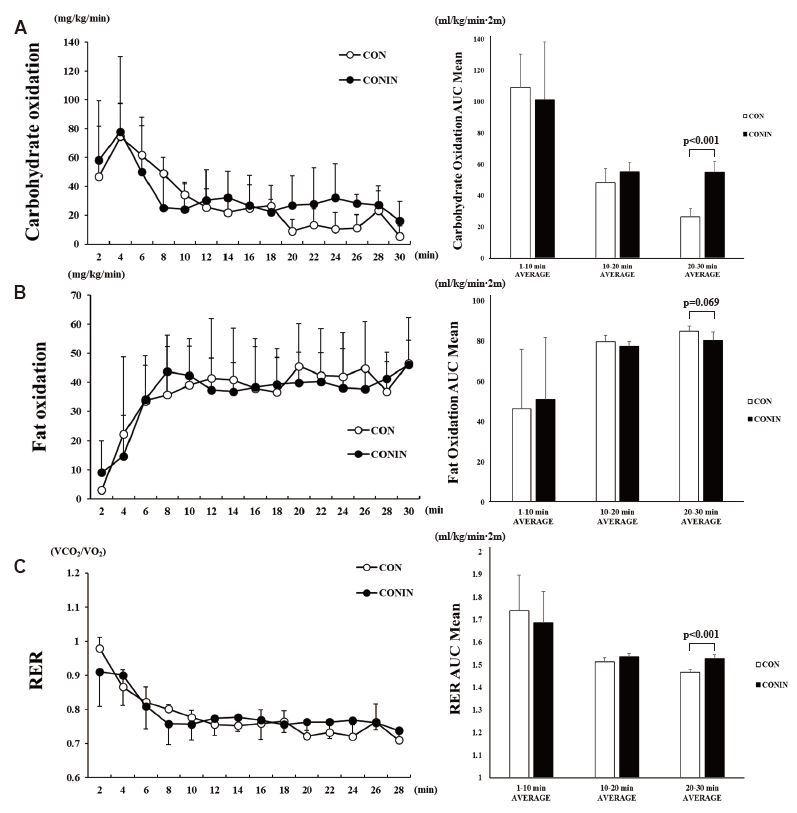
During a single bout of exercise, the CONIN group showed a significantly higher area under the curve (AUC) of O2 uptake and CO2 production from 20 min into exercise than the CON group (p < 0.001). The CONIN group showed a significantly higher AUC for carbohydrate oxidation from 20 min into exercise than the CON group (p < 0.001), whereas no difference was found in fat oxidation between groups (p = 0.067). The CONIN group had a significantly higher AUC of RER from 20 min into exercise than the CON group (p < 0.001).
CONCLUSION
We observed increased energy consumption at the later phase of 30-min moderate-intensity treadmill running when DHT production was inhibited. Furthermore, when DHT production during exercise was inhibited, whole-body fat utilization was inhibited and carbohydrate oxidation was substantially increased at the later phase of exercise compared to in the control group. Therefore, changes in DHT concentration in the body during exercise may be involved in whole-body fat utilization, suggesting that DHT may be an important factor affecting endurance exercise capacity.
目的
双氢睾酮(DHT)在包括脂肪和碳水化合物氧化在内的各种能量利用过程中发挥着重要作用。本研究的目的是使用量热室来确定在中等强度跑步运动期间抑制DHT形成对全身能量消耗以及脂肪和碳水化合物氧化的影响。
方法
将12只9周龄的ICR成年雄性小鼠随机分为两组:对照组(n = 6,不进行运动处理)和抑制组(n = 6,运动时使用DHT抑制剂处理,SRD5A1A2是一种参与将游离睾酮代谢为DHT的酶)。抑制剂通过腹腔注射给予抑制组,而对照组则用赋形剂(2mg/kg玉米油)处理。在给予抑制剂或赋形剂3天后,在量热室内的跑步机上以60 - 70%的最大摄氧量进行30分钟的运动。使用量热计测量30分钟运动期间的氧气摄取量、二氧化碳产生量、碳水化合物和脂肪氧化以及呼吸交换率(RER)。
结果
在单次运动期间,抑制组从运动20分钟起的氧气摄取量和二氧化碳产生量的曲线下面积(AUC)显著高于对照组(p < 0.001)。抑制组从运动20分钟起的碳水化合物氧化AUC显著高于对照组(p < 0.001),而两组之间的脂肪氧化无差异(p = 0.067)。抑制组从运动20分钟起的RER的AUC显著高于对照组(p < 0.001)。
结论
我们观察到当DHT生成受到抑制时,在30分钟中等强度跑步机跑步的后期能量消耗增加。此外,当运动期间DHT生成受到抑制时,与对照组相比,运动后期全身脂肪利用受到抑制,碳水化合物氧化大幅增加。因此,运动期间体内DHT浓度的变化可能与全身脂肪利用有关,这表明DHT可能是影响耐力运动能力的一个重要因素。

 Zotero 插件