Department of Sleep and Cognition, Netherlands Institute for Neuroscience, Amsterdam, The Netherlands.
Department of Psychological Methods, University of Amsterdam, Amsterdam, The Netherlands.
Sleep. 2020 May 12;43(5). doi: 10.1093/sleep/zsz288.
Major depressive disorder (MDD) is the leading cause of disability worldwide. Its high recurrence rate calls for prevention of first-onset MDD. Although meta-analysis suggested insomnia as the strongest modifiable risk factor, previous studies insufficiently addressed that insomnia might also occur as a residual symptom of unassessed prior depression, or as a comorbid complaint secondary to other depression risks.
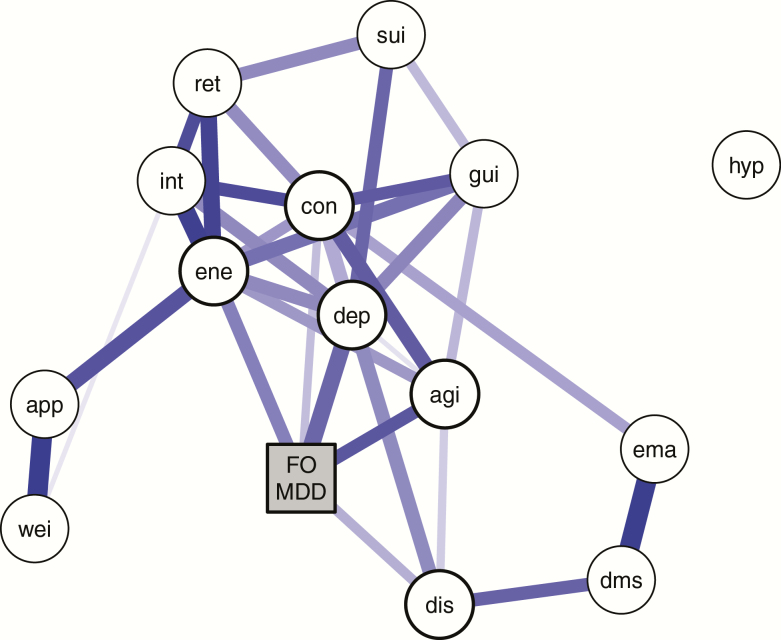
In total, 768 participants from the Netherlands Study of Depression and Anxiety who were free from current and lifetime MDD were followed-up for four repeated assessments, spanning 6 years in total. We performed separate Cox proportional hazard analyses to evaluate whether baseline insomnia severity, short-sleep duration, and individual insomnia complaints prospectively predicted first-onset MDD during follow-up. The novel method of network outcome analysis (NOA) allowed us to sort out whether there is any direct predictive value of individual insomnia complaints among several other complaints that are associated with insomnia.
Over 6-year follow-up, 141 (18.4%) were diagnosed with first-onset MDD. Insomnia severity but not sleep duration predicted first-onset MDD (HR = 1.11, 95% CI: 1.07-1.15), and this was driven solely by the insomnia complaint difficulty initiating sleep (DIS) (HR = 1.10, 95% CI: 1.04-1.16). NOA likewise identified DIS only to directly predict first-onset MDD, independent of four other associated depression complaints.
We showed prospectively that DIS is a risk factor for first-onset MDD. Among the different other insomnia symptoms, the specific treatment of DIS might be the most sensible target to combat the global burden of depression through prevention.
重度抑郁症(MDD)是全球范围内导致残疾的主要原因。其高复发率需要预防首发 MDD。尽管荟萃分析表明失眠是最强的可改变风险因素,但以前的研究没有充分解决失眠可能是未评估的先前抑郁的残留症状,或者是由于其他抑郁风险的合并抱怨而发生的问题。
总共对来自荷兰抑郁和焦虑研究的 768 名目前无 MDD 和终生无 MDD 的参与者进行了四次重复评估,随访时间总共为 6 年。我们分别进行 Cox 比例风险分析,以评估基线失眠严重程度、睡眠时间短和个体失眠抱怨是否在随访期间预测首发 MDD。网络结果分析(NOA)的新方法允许我们梳理在与失眠相关的其他几种抱怨中,个体失眠抱怨是否具有任何直接的预测价值。
在 6 年的随访中,141 人(18.4%)被诊断为首发 MDD。失眠严重程度而非睡眠时间预测首发 MDD(HR=1.11,95%CI:1.07-1.15),这完全是由失眠抱怨入睡困难(DIS)引起的(HR=1.10,95%CI:1.04-1.16)。NOA 同样仅发现 DIS 直接预测首发 MDD,独立于其他四种相关的抑郁抱怨。
我们前瞻性地表明,DIS 是首发 MDD 的危险因素。在不同的其他失眠症状中,特定的 DIS 治疗可能是通过预防来对抗全球抑郁负担的最明智目标。