Department of Gastroenterology and Hepatology, Zhongshan Hospital, Fudan University, Shanghai 200032, China.
The First Affiliated Hospital, Yunnan Institute of Digestive Disease, Kunming Medical University, Kunming 650000, Yunnan Province, China.
World J Gastroenterol. 2019 Nov 21;25(43):6440-6450. doi: 10.3748/wjg.v25.i43.6440.
Serum amyloid A (SAA) is an acute phase protein mainly synthesized by the liver. SAA induces inflammatory phenotype and promotes cell proliferation in activated hepatic stellate cells, the major scar forming cells in the liver. However, few studies have reported on the serum levels of SAA in human liver disease and its clinical significance in various liver diseases.
To investigate the serum levels of SAA in patients with different liver diseases and analyze the factors associated with the alteration of SAA levels in chronic hepatitis B (CHB) patients.
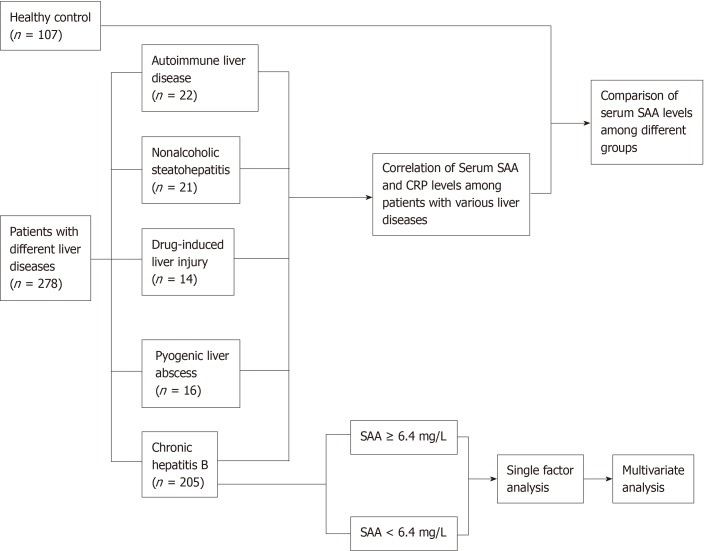
Two hundred and seventy-eight patients with different liver diseases and 117 healthy controls were included in this study. The patients included 205 with CHB, 22 with active autoimmune liver disease (AILD), 21 with nonalcoholic steatohepatitis (NASH), 14 with drug-induced liver injury (DILI), and 16 with pyogenic liver abscess. Serum levels of SAA and other clinical parameters were collected for the analysis of the factors associated with SAA level. Mann-Whitney test was used to compare the serum SAA levels of patients with various liver diseases with those of healthy controls. Bonferroni test was applied for post hoc comparisons to control the probability of type 1 error (alpha = 0.05/6 = 0.008). For statistical tests of other variables, < 0.05 was considered statistically significant. Statistically significant factors determined by single factor analysis were further analyzed by binary multivariate logistic regression analysis.
All patients with active liver diseases had higher serum SAA levels than healthy controls and the inactive CHB patients, with the highest SAA level found in patients with pyogenic liver abscess (398.4 ± 246.8 mg/L). Patients with active AILD (19.73 ± 24.81 mg/L) or DILI (8.036 ± 5.685 mg/L) showed higher SAA levels than those with active CHB (6.621 ± 6.776 mg/L) and NASH (6.624 ± 4.891 mg/L). Single ( < 0.001) and multivariate logistic regression analyses ( = 0.039) for the CHB patients suggested that patients with active CHB were associated with an SAA serum level higher than 6.4 mg/L. Serum levels of SAA and CRP (C-reactive protein) were positively correlated in patients with CHB ( < 0.001), pyogenic liver abscess ( = 0.045), and active AILD ( = 0.02). Serum levels of SAA (0.80-871.0 mg/L) had a broader fluctuation range than CRP (0.30-271.3 mg/L).
Serum level of SAA is a sensitive biomarker for inflammatory activity of pyogenic liver abscess. It may also be a weak marker reflecting milder inflammatory status in the liver of patients with CHB and other active liver diseases.
血清淀粉样蛋白 A(SAA)是一种主要由肝脏合成的急性期蛋白。SAA 可诱导激活的肝星状细胞呈现炎症表型,并促进其增殖,肝星状细胞是肝脏中主要的形成瘢痕的细胞。然而,目前关于人类肝脏疾病中 SAA 的血清水平及其在各种肝脏疾病中的临床意义的研究较少。
研究不同肝脏疾病患者的血清 SAA 水平,并分析慢性乙型肝炎(CHB)患者中 SAA 水平变化的相关因素。
本研究纳入了 278 例不同肝脏疾病患者和 117 名健康对照者。患者包括 205 例 CHB 患者、22 例活动性自身免疫性肝病(AILD)患者、21 例非酒精性脂肪性肝炎(NASH)患者、14 例药物性肝损伤(DILI)患者和 16 例化脓性肝脓肿患者。收集血清 SAA 和其他临床参数,分析与 SAA 水平相关的因素。采用 Mann-Whitney 检验比较不同肝脏疾病患者与健康对照者的血清 SAA 水平。采用 Bonferroni 检验进行事后比较,以控制Ⅰ类错误的概率(α=0.05/6=0.008)。对于其他变量的统计检验, < 0.05 被认为具有统计学意义。单因素分析确定的有统计学意义的因素,进一步采用二元多变量 logistic 回归分析进行分析。
所有活动性肝病患者的血清 SAA 水平均高于健康对照者和非活动性 CHB 患者,化脓性肝脓肿患者的 SAA 水平最高(398.4±246.8 mg/L)。活动性 AILD(19.73±24.81 mg/L)或 DILI(8.036±5.685 mg/L)患者的 SAA 水平高于活动性 CHB(6.621±6.776 mg/L)和 NASH(6.624±4.891 mg/L)患者。单因素( < 0.001)和多因素 logistic 回归分析( = 0.039)表明,活动性 CHB 患者的 SAA 血清水平高于 6.4 mg/L。CHB 患者( < 0.001)、化脓性肝脓肿患者( = 0.045)和活动性 AILD 患者( = 0.02)的 SAA 血清水平与 CRP(C 反应蛋白)呈正相关。SAA(0.80-871.0 mg/L)的血清水平波动范围较 CRP(0.30-271.3 mg/L)更广。
血清 SAA 水平是化脓性肝脓肿炎症活动的敏感生物标志物。它可能也是反映 CHB 及其他活动性肝病患者肝脏轻度炎症状态的一个较弱标志物。