• 文献检索
  • 文档翻译
  • 深度研究
  • 学术资讯
  • Suppr Zotero 插件Zotero 插件
  • 邀请有礼
  • 套餐&价格
  • 历史记录
应用&插件
Suppr Zotero 插件Zotero 插件浏览器插件Mac 客户端Windows 客户端微信小程序
定价
高级版会员购买积分包购买API积分包
服务
文献检索文档翻译深度研究API 文档MCP 服务
关于我们
关于 Suppr公司介绍联系我们用户协议隐私条款
关注我们

Suppr 超能文献

核心技术专利:CN118964589B侵权必究
粤ICP备2023148730 号-1Suppr @ 2026

文献检索

告别复杂PubMed语法,用中文像聊天一样搜索,搜遍4000万医学文献。AI智能推荐,让科研检索更轻松。

立即免费搜索

文件翻译

保留排版,准确专业,支持PDF/Word/PPT等文件格式,支持 12+语言互译。

免费翻译文档

深度研究

AI帮你快速写综述,25分钟生成高质量综述,智能提取关键信息,辅助科研写作。

立即免费体验

小输出装置蛋白SctS在III型分泌系统活性中的作用

The Role of the Small Export Apparatus Protein, SctS, in the Activity of the Type III Secretion System.

作者信息

Tseytin Irit, Mitrovic Bosko, David Nofar, Langenfeld Katja, Zarivach Raz, Diepold Andreas, Sal-Man Neta

机构信息

The Shraga Segal Department of Microbiology, Immunology and Genetics, Faculty of Health Sciences, Ben-Gurion University of the Negev, Be'er Sheva, Israel.

Department of Ecophysiology, Max Planck Institute for Terrestrial Microbiology, Marburg, Germany.

出版信息

Front Microbiol. 2019 Nov 13;10:2551. doi: 10.3389/fmicb.2019.02551. eCollection 2019.

DOI:10.3389/fmicb.2019.02551
PMID:31798543
原文链接:https://pmc.ncbi.nlm.nih.gov/articles/PMC6863770/
Abstract

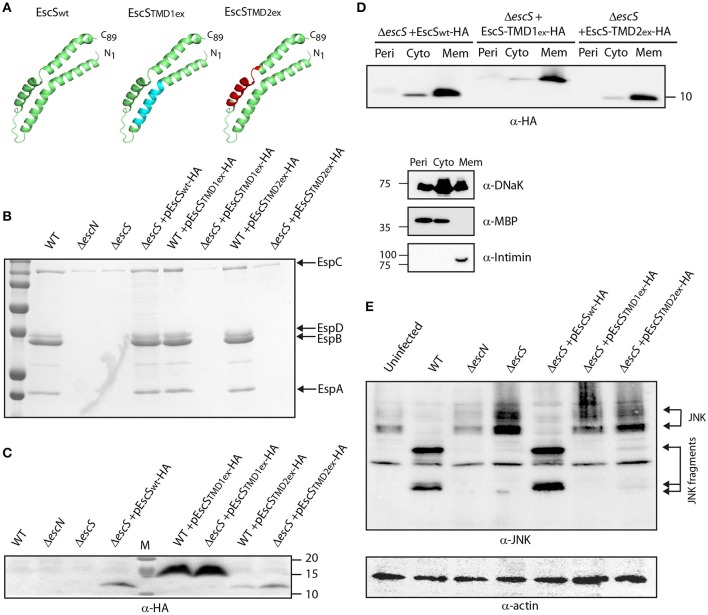
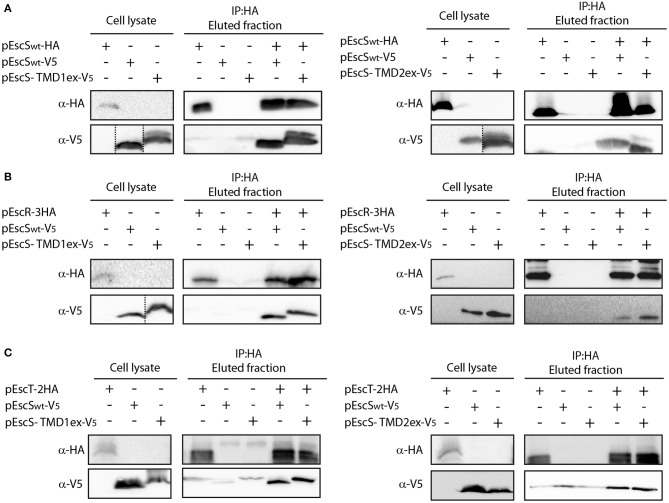
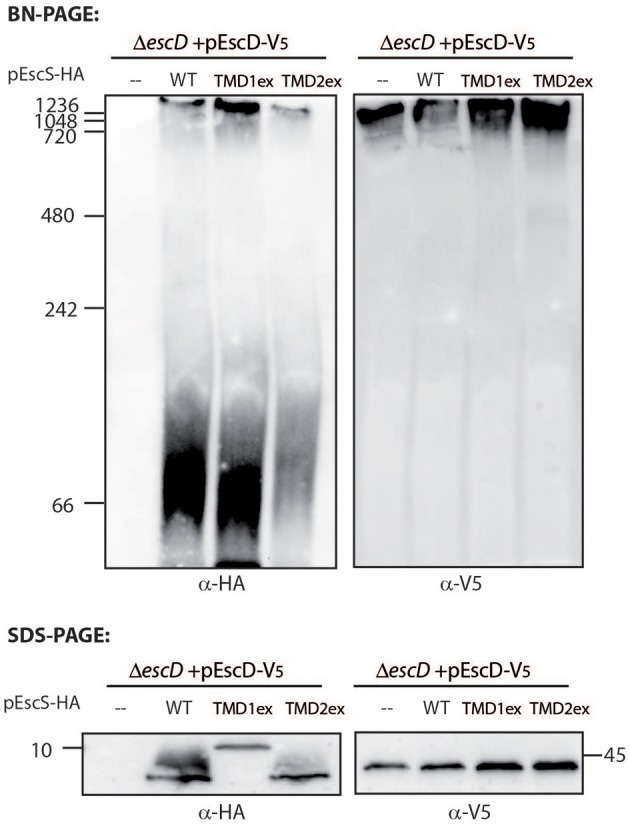
Many gram-negative pathogens utilize a protein complex, termed the type III secretion system (T3SS), to inject virulence factors from their cytoplasm directly into the host cell. An export apparatus that is formed by five putative integral membrane proteins (SctR/S/T/U/V), resides at the center of the T3SS complex. In this study, we characterized the smallest export apparatus protein, SctS, which contains two putative transmembrane domains (PTMD) that dynamically extract from the inner membrane and adopt a helix-turn-helix structure upon assembly of the T3SS. Replacement of each SctS PTMD with an alternative hydrophobic sequence resulted in abolishment of the T3SS activity, yet SctS self- and hetero-interactions as well as the overall assembly of the T3SS complex were unaffected. Our findings suggest that SctS PTMDs are not crucial for the interactions or the assembly of the T3SS base complex but rather that they are involved in adjusting the orientation of the export apparatus relative to additional T3SS sub-structures, such as the cytoplasmic- and the inner-membrane rings. This ensures the fittings between the dynamic and static components of the T3SS and supports the functionality of the T3SS complex.

摘要

许多革兰氏阴性病原体利用一种称为III型分泌系统(T3SS)的蛋白质复合物,将其细胞质中的毒力因子直接注入宿主细胞。由五种假定的整合膜蛋白(SctR/S/T/U/V)形成的输出装置位于T3SS复合物的中心。在本研究中,我们对最小的输出装置蛋白SctS进行了表征,它包含两个假定的跨膜结构域(PTMD),这些结构域动态地从内膜中提取出来,并在T3SS组装时形成螺旋-转角-螺旋结构。用替代的疏水序列替换每个SctS PTMD会导致T3SS活性丧失,但SctS的自我和异源相互作用以及T3SS复合物的整体组装不受影响。我们的研究结果表明,SctS PTMD对T3SS基础复合物的相互作用或组装并不关键,而是参与调整输出装置相对于其他T3SS子结构(如细胞质环和内膜环)的方向。这确保了T3SS动态和静态组件之间的适配,并支持T3SS复合物的功能。
https://cdn.ncbi.nlm.nih.gov/pmc/blobs/ccc5/6863770/f400ab2c9b96/fmicb-10-02551-g0009.jpg
https://cdn.ncbi.nlm.nih.gov/pmc/blobs/ccc5/6863770/14506c25db71/fmicb-10-02551-g0001.jpg
https://cdn.ncbi.nlm.nih.gov/pmc/blobs/ccc5/6863770/7b175448462f/fmicb-10-02551-g0002.jpg
https://cdn.ncbi.nlm.nih.gov/pmc/blobs/ccc5/6863770/3f067c71a963/fmicb-10-02551-g0003.jpg
https://cdn.ncbi.nlm.nih.gov/pmc/blobs/ccc5/6863770/1b9c136cfe47/fmicb-10-02551-g0004.jpg
https://cdn.ncbi.nlm.nih.gov/pmc/blobs/ccc5/6863770/8fafca7d451a/fmicb-10-02551-g0005.jpg
https://cdn.ncbi.nlm.nih.gov/pmc/blobs/ccc5/6863770/31e8a25160df/fmicb-10-02551-g0006.jpg
https://cdn.ncbi.nlm.nih.gov/pmc/blobs/ccc5/6863770/da2bf95e32c9/fmicb-10-02551-g0007.jpg
https://cdn.ncbi.nlm.nih.gov/pmc/blobs/ccc5/6863770/1d5be49efe1a/fmicb-10-02551-g0008.jpg
https://cdn.ncbi.nlm.nih.gov/pmc/blobs/ccc5/6863770/f400ab2c9b96/fmicb-10-02551-g0009.jpg
https://cdn.ncbi.nlm.nih.gov/pmc/blobs/ccc5/6863770/14506c25db71/fmicb-10-02551-g0001.jpg
https://cdn.ncbi.nlm.nih.gov/pmc/blobs/ccc5/6863770/7b175448462f/fmicb-10-02551-g0002.jpg
https://cdn.ncbi.nlm.nih.gov/pmc/blobs/ccc5/6863770/3f067c71a963/fmicb-10-02551-g0003.jpg
https://cdn.ncbi.nlm.nih.gov/pmc/blobs/ccc5/6863770/1b9c136cfe47/fmicb-10-02551-g0004.jpg
https://cdn.ncbi.nlm.nih.gov/pmc/blobs/ccc5/6863770/8fafca7d451a/fmicb-10-02551-g0005.jpg
https://cdn.ncbi.nlm.nih.gov/pmc/blobs/ccc5/6863770/31e8a25160df/fmicb-10-02551-g0006.jpg
https://cdn.ncbi.nlm.nih.gov/pmc/blobs/ccc5/6863770/da2bf95e32c9/fmicb-10-02551-g0007.jpg
https://cdn.ncbi.nlm.nih.gov/pmc/blobs/ccc5/6863770/1d5be49efe1a/fmicb-10-02551-g0008.jpg
https://cdn.ncbi.nlm.nih.gov/pmc/blobs/ccc5/6863770/f400ab2c9b96/fmicb-10-02551-g0009.jpg

相似文献

1
The Role of the Small Export Apparatus Protein, SctS, in the Activity of the Type III Secretion System.小输出装置蛋白SctS在III型分泌系统活性中的作用
Front Microbiol. 2019 Nov 13;10:2551. doi: 10.3389/fmicb.2019.02551. eCollection 2019.
2
Interactions and substrate selectivity within the SctRST complex of the type III secretion system of enteropathogenic .肠致病性 型三型分泌系统 SctRST 复合物内的相互作用和底物选择性。
Gut Microbes. 2022 Jan-Dec;14(1):2013763. doi: 10.1080/19490976.2021.2013763.
3
The Third Transmembrane Domain of EscR Is Critical for Function of the Enteropathogenic Type III Secretion System.EscR 的第三个跨膜结构域对肠致病性 III 型分泌系统的功能至关重要。
mSphere. 2018 Jul 25;3(4):e00162-18. doi: 10.1128/mSphere.00162-18.
4
Conserved Salt Bridges Facilitate Assembly of the Helical Core Export Apparatus of a Salmonella enterica Type III Secretion System.保守盐桥促进沙门氏菌肠型 III 分泌系统螺旋核心出口装置的组装。
J Mol Biol. 2021 Sep 17;433(19):167175. doi: 10.1016/j.jmb.2021.167175. Epub 2021 Jul 22.
5
The Role of the Membrane-Associated Domain of the Export Apparatus Protein, EscV (SctV), in the Activity of the Type III Secretion System.输出装置蛋白EscV(SctV)的膜相关结构域在III型分泌系统活性中的作用
Front Microbiol. 2021 Aug 3;12:719469. doi: 10.3389/fmicb.2021.719469. eCollection 2021.
6
Reconstitution of Functional Type III Protein Export and Insights into Flagellar Assembly.功能性 III 型蛋白输出的重建与鞭毛组装的深入了解。
mBio. 2018 Jun 26;9(3):e00988-18. doi: 10.1128/mBio.00988-18.
7
The inner rod of virulence-associated type III secretion systems constitutes a needle adapter of one helical turn that is deeply integrated into the system's export apparatus.毒力相关的 III 型分泌系统的内杆构成了一个螺旋深嵌在系统出口装置中的针状适配器。
Mol Microbiol. 2019 Sep;112(3):918-931. doi: 10.1111/mmi.14327. Epub 2019 Jun 26.
8
EscI: a crucial component of the type III secretion system forms the inner rod structure in enteropathogenic Escherichia coli.EscI:III 型分泌系统的关键组成部分,在致病性大肠杆菌中形成内杆状结构。
Biochem J. 2012 Feb 15;442(1):119-25. doi: 10.1042/BJ20111620.
9
Biophysical Mechanism of Protein Export by Bacterial Type III Secretion System.细菌III型分泌系统蛋白输出的生物物理机制
Chem Pharm Bull (Tokyo). 2019;67(4):341-344. doi: 10.1248/cpb.c18-00947.
10
The Structure of an Injectisome Export Gate Demonstrates Conservation of Architecture in the Core Export Gate between Flagellar and Virulence Type III Secretion Systems.注射器出口门的结构揭示了鞭毛和毒性 III 型分泌系统核心出口门之间的结构保守性。
mBio. 2019 Jun 25;10(3):e00818-19. doi: 10.1128/mBio.00818-19.

引用本文的文献

1
Secretion of functional interferon by the type 3 secretion system of enteropathogenic Escherichia coli.肠致病性大肠杆菌 III 型分泌系统分泌功能性干扰素。
Microb Cell Fact. 2024 Jun 1;23(1):163. doi: 10.1186/s12934-024-02397-y.
2
Interactions and substrate selectivity within the SctRST complex of the type III secretion system of enteropathogenic .肠致病性 型三型分泌系统 SctRST 复合物内的相互作用和底物选择性。
Gut Microbes. 2022 Jan-Dec;14(1):2013763. doi: 10.1080/19490976.2021.2013763.
3
The Role of the Membrane-Associated Domain of the Export Apparatus Protein, EscV (SctV), in the Activity of the Type III Secretion System.

本文引用的文献

1
T3S injectisome needle complex structures in four distinct states reveal the basis of membrane coupling and assembly.T3S injectisome 针复合物的四种不同状态的结构揭示了膜耦联和组装的基础。
Nat Microbiol. 2019 Nov;4(11):2010-2019. doi: 10.1038/s41564-019-0545-z. Epub 2019 Aug 19.
2
The Structure of an Injectisome Export Gate Demonstrates Conservation of Architecture in the Core Export Gate between Flagellar and Virulence Type III Secretion Systems.注射器出口门的结构揭示了鞭毛和毒性 III 型分泌系统核心出口门之间的结构保守性。
mBio. 2019 Jun 25;10(3):e00818-19. doi: 10.1128/mBio.00818-19.
3
Bacterial type III secretion systems: a complex device for the delivery of bacterial effector proteins into eukaryotic host cells.
输出装置蛋白EscV(SctV)的膜相关结构域在III型分泌系统活性中的作用
Front Microbiol. 2021 Aug 3;12:719469. doi: 10.3389/fmicb.2021.719469. eCollection 2021.
4
The Type III Secretion System: An Overview from Top to Bottom.III型分泌系统:从上到下的概述
Microorganisms. 2021 Feb 22;9(2):451. doi: 10.3390/microorganisms9020451.
5
Molecular Targets and Strategies for Inhibition of the Bacterial Type III Secretion System (T3SS); Inhibitors Directly Binding to T3SS Components.抑制细菌 III 型分泌系统(T3SS)的分子靶点和策略;直接结合 T3SS 成分的抑制剂。
Biomolecules. 2021 Feb 19;11(2):316. doi: 10.3390/biom11020316.
细菌III型分泌系统:一种将细菌效应蛋白递送至真核宿主细胞的复杂装置。
FEMS Microbiol Lett. 2018 Oct 1;365(19). doi: 10.1093/femsle/fny201.
4
Structural determinant of functionality in acyl lipid desaturases.酰基脂质去饱和酶功能的结构决定因素。
J Lipid Res. 2018 Oct;59(10):1871-1879. doi: 10.1194/jlr.M085258. Epub 2018 Aug 7.
5
The Third Transmembrane Domain of EscR Is Critical for Function of the Enteropathogenic Type III Secretion System.EscR 的第三个跨膜结构域对肠致病性 III 型分泌系统的功能至关重要。
mSphere. 2018 Jul 25;3(4):e00162-18. doi: 10.1128/mSphere.00162-18.
6
Structure of the core of the type III secretion system export apparatus.III 型分泌系统出口器核心结构。
Nat Struct Mol Biol. 2018 Jul;25(7):583-590. doi: 10.1038/s41594-018-0086-9. Epub 2018 Jul 2.
7
SWISS-MODEL: homology modelling of protein structures and complexes.SWISS-MODEL:蛋白质结构和复合物的同源建模。
Nucleic Acids Res. 2018 Jul 2;46(W1):W296-W303. doi: 10.1093/nar/gky427.
8
Sequences flanking the transmembrane segments facilitate mitochondrial localization and membrane fusion by mitofusin.跨膜结构域侧翼的序列通过线粒体融合蛋白促进线粒体的定位和融合。
Proc Natl Acad Sci U S A. 2017 Nov 14;114(46):E9863-E9872. doi: 10.1073/pnas.1708782114. Epub 2017 Nov 1.
9
The role of EscD in supporting EscC polymerization in the type III secretion system of enteropathogenic Escherichia coli.肠致病性大肠杆菌 III 型分泌系统中 EscD 对 EscC 聚合的支持作用。
Biochim Biophys Acta Biomembr. 2018 Feb;1860(2):384-395. doi: 10.1016/j.bbamem.2017.10.001. Epub 2017 Oct 4.
10
Subdomain 2, Not the Transmembrane Domain, Determines the Dimerization Partner of Growth Hormone Receptor and Prolactin Receptor.亚结构域2而非跨膜结构域决定了生长激素受体和催乳素受体的二聚化伙伴。
Endocrinology. 2017 Oct 1;158(10):3235-3248. doi: 10.1210/en.2017-00469.