López-Jácome Luis Esaú, Garza-Ramos Georgina, Hernández-Durán Melissa, Franco-Cendejas Rafael, Loarca Daniel, Romero-Martínez Daniel, Nguyen Phuong Thi Dong, Maeda Toshinari, González-Pedrajo Bertha, Díaz-Guerrero Miguel, Sánchez-Reyes Jorge Luis, Díaz-Ramírez Dánae, García-Contreras Rodolfo
Laboratorio de Bacteriología, Departamento de Microbiología y Parasitología, Facultad de Medicina, Universidad Nacional Autónoma de México, Mexico City, Mexico.
Laboratorio de Infectología, Centro Nacional de Investigación y Atención de Quemados, Instituto Nacional de Rehabilitación, Mexico City, Mexico.
Front Microbiol. 2019 Nov 14;10:2657. doi: 10.3389/fmicb.2019.02657. eCollection 2019.
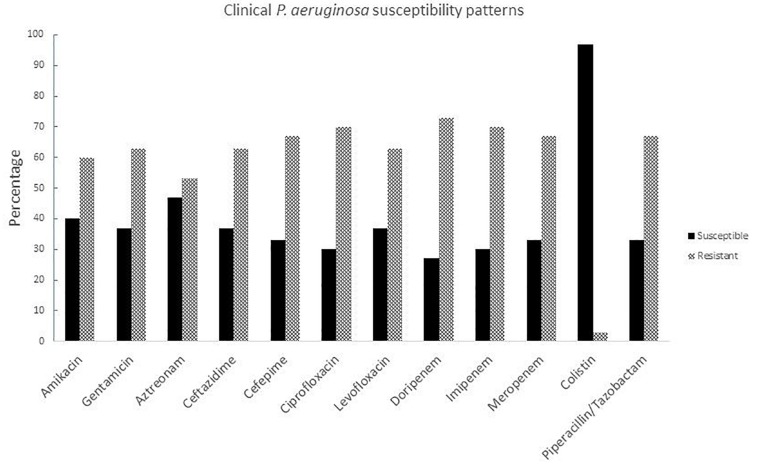
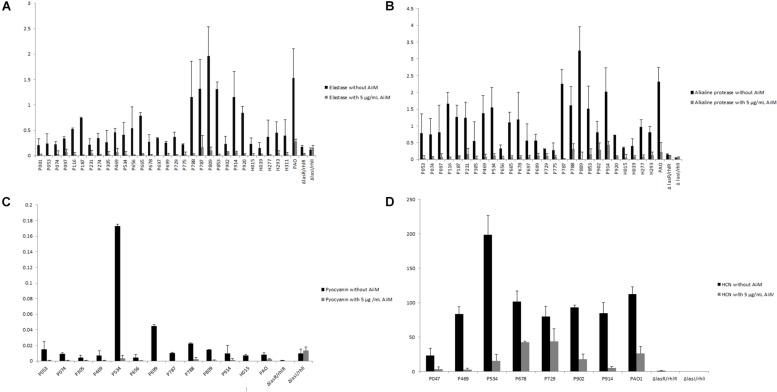
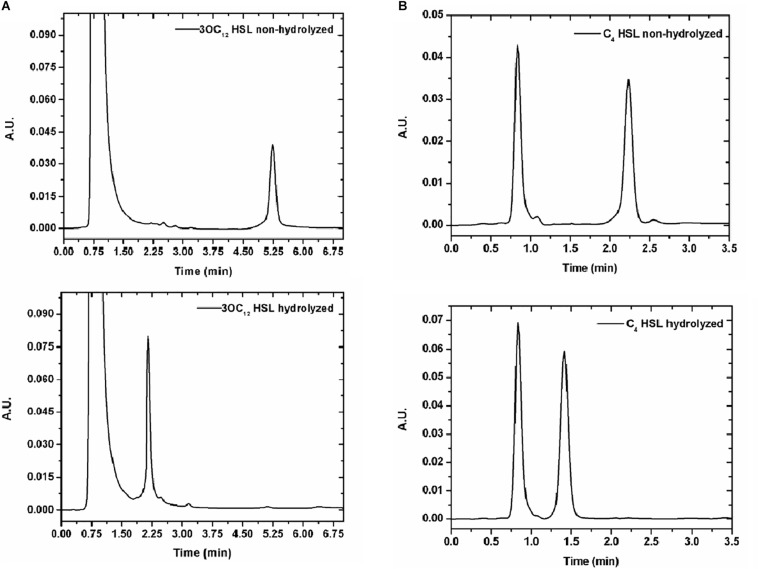
is an opportunistic bacterium associated with healthcare infections in intensive care units (ICUs), ventilator-associated pneumonia (VAP), surgical site infections, and burns. This bacterium causes 75% of death in burned patients, since it can develop a persistent biofilm associated with infections, express several virulence factors, and antibiotic-resistance mechanisms. Some of these virulence factors are proteases such as elastase and alkaline protease, or toxic metabolites such as pyocyanin and is one of the few microorganisms able to produce cyanide, which inhibits the cytochrome oxidase of host cells. These virulence factors are controlled by quorum sensing (QS). In this work, 30 clinical strains isolated from burned patients from a tertiary hospital in Mexico City were studied. Antibiotic susceptibility tests were done, and virulence factors (elastase, alkaline protease, HCN, and pyocyanin) were determined in presence of an N-acylhomoserine lactonase, AiiM able to hydrolyze a wide range of acyl homoserine lactones. The treatment reduced significantly the activities of elastase and alkaline protease, and the production of pyocyanin and HCN in all producer strains but not the secretion of toxins through the type III secretion system. Our work suggests that AiiM treatment may be an effective therapy to combat infection in burn patients.
是一种与重症监护病房(ICU)的医院感染、呼吸机相关性肺炎(VAP)、手术部位感染和烧伤相关的机会致病菌。这种细菌导致75%的烧伤患者死亡,因为它能形成与感染相关的持久性生物膜,表达多种毒力因子和抗生素耐药机制。其中一些毒力因子是蛋白酶,如弹性蛋白酶和碱性蛋白酶,或有毒代谢产物,如绿脓菌素,并且是少数能够产生氰化物的微生物之一,氰化物会抑制宿主细胞的细胞色素氧化酶。这些毒力因子受群体感应(QS)控制。在这项工作中,研究了从墨西哥城一家三级医院的烧伤患者中分离出的30株临床菌株。进行了抗生素敏感性试验,并在能够水解多种酰基高丝氨酸内酯的N-酰基高丝氨酸内酯酶AiiM存在的情况下测定了毒力因子(弹性蛋白酶、碱性蛋白酶、HCN和绿脓菌素)。该处理显著降低了所有产生菌株中弹性蛋白酶和碱性蛋白酶的活性以及绿脓菌素和HCN的产生,但没有降低通过III型分泌系统分泌的毒素。我们的工作表明,AiiM处理可能是对抗烧伤患者感染的一种有效疗法。