Nilsson Birgitta Blakstad, Bunæs-Næss Heidi, Edvardsen Elisabeth, Stenehjem Aud-Eldrid
Department of Clinical Services, Oslo University Hospital, Oslo, Norway.
Faculty of Health Sciences, Oslo Metropolitan University, Oslo, Norway.
BMJ Open Sport Exerc Med. 2019 Nov 10;5(1):e000617. doi: 10.1136/bmjsem-2019-000617. eCollection 2019.
Patients with end-stage renal disease (ESRD) undergoing haemodialysis (HD) have significantly reduced cardiorespiratory fitness and health-related quality of life (HRQoL). Our hypothesis was that high-intensity interval training (HIIT) is a feasible and safe form of exercise during HD and that HIIT would elicit greater change in cardiorespiratory fitness and HRQoL compared with moderate-intensity continuous training (MICT).
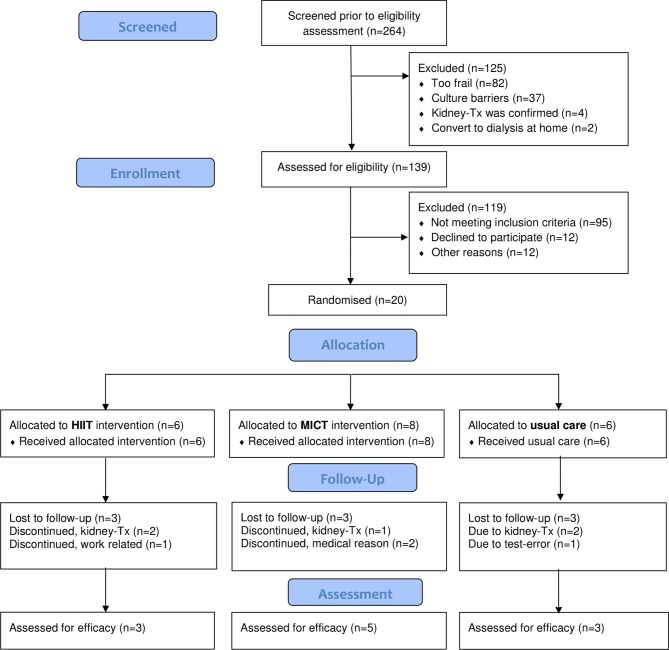
Twenty patients were randomised to either HIIT (n=6), MICT (n=8) (two times a week within 22 weeks) or usual care (n=6). Feasibility was assessed by session attendance and adherence to exercise intensity. Safety was assessed by adverse event reporting. Efficacy was determined from change in peak oxygen uptake (VO), 6 min walk distance and a HRQoL questionnaire (the COOP-WONCA chart).
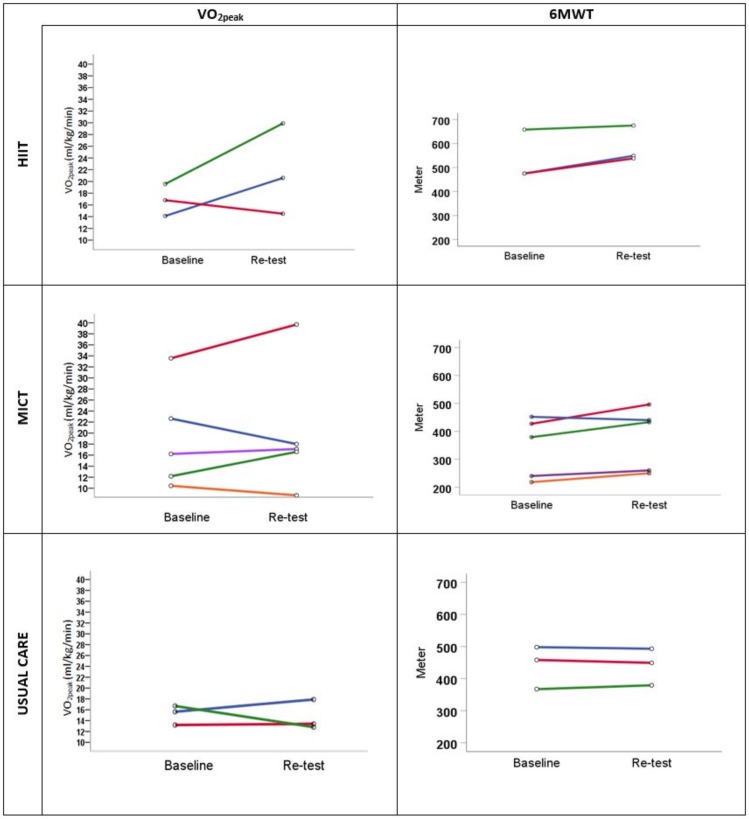
Eleven patients (55%) completed premeasurements and postmeasurements. The main reason for drop-out was due to kidney transplant during follow-up. The patients completed the same number of sessions in each group and adhered to the target heart rates after habituation. There were no adverse events. In the HIIT group, two of the three patients increased VO by 46% and 53%, respectively. Three of the five patients in the MICT group increased their VO by 6%, 18% and 36%, respectively.
This pilot study demonstrated that HIIT is a feasible and safe exercise model for intradialytic exercise in patients undergoing HD. There might be a considerable potential of intradialytic HIIT in patients undergoing HD. Further studies with larger sample sizes are needed to determine if HIIT is an optimal approach in patients with ESRD undergoing HD.
NCT01728415.
接受血液透析(HD)的终末期肾病(ESRD)患者的心肺适能和健康相关生活质量(HRQoL)显著降低。我们的假设是,高强度间歇训练(HIIT)是HD期间一种可行且安全的运动形式,并且与中等强度持续训练(MICT)相比,HIIT会使心肺适能和HRQoL产生更大的变化。
20名患者被随机分为HIIT组(n = 6)、MICT组(n = 8)(在22周内每周两次)或常规护理组(n = 6)。通过出勤情况和对运动强度的依从性评估可行性。通过不良事件报告评估安全性。根据峰值摄氧量(VO)、6分钟步行距离的变化以及一份HRQoL问卷(COOP - WONCA图表)确定疗效。
11名患者(55%)完成了测量前和测量后的评估。退出的主要原因是随访期间进行了肾移植。每组患者完成的疗程数量相同,适应后均能坚持目标心率。未发生不良事件。在HIIT组中,三名患者中有两名的VO分别增加了46%和53%。MICT组五名患者中有三名的VO分别增加了6%、18%和36%。
这项初步研究表明,HIIT是HD患者透析期间运动的一种可行且安全的运动模式。HD患者进行透析期间HIIT可能具有相当大的潜力。需要进一步进行更大样本量的研究,以确定HIIT是否是ESRD患者HD的最佳方法。
NCT01728415。